Mike Squire: Helping Citizens Speak and the City to Listen
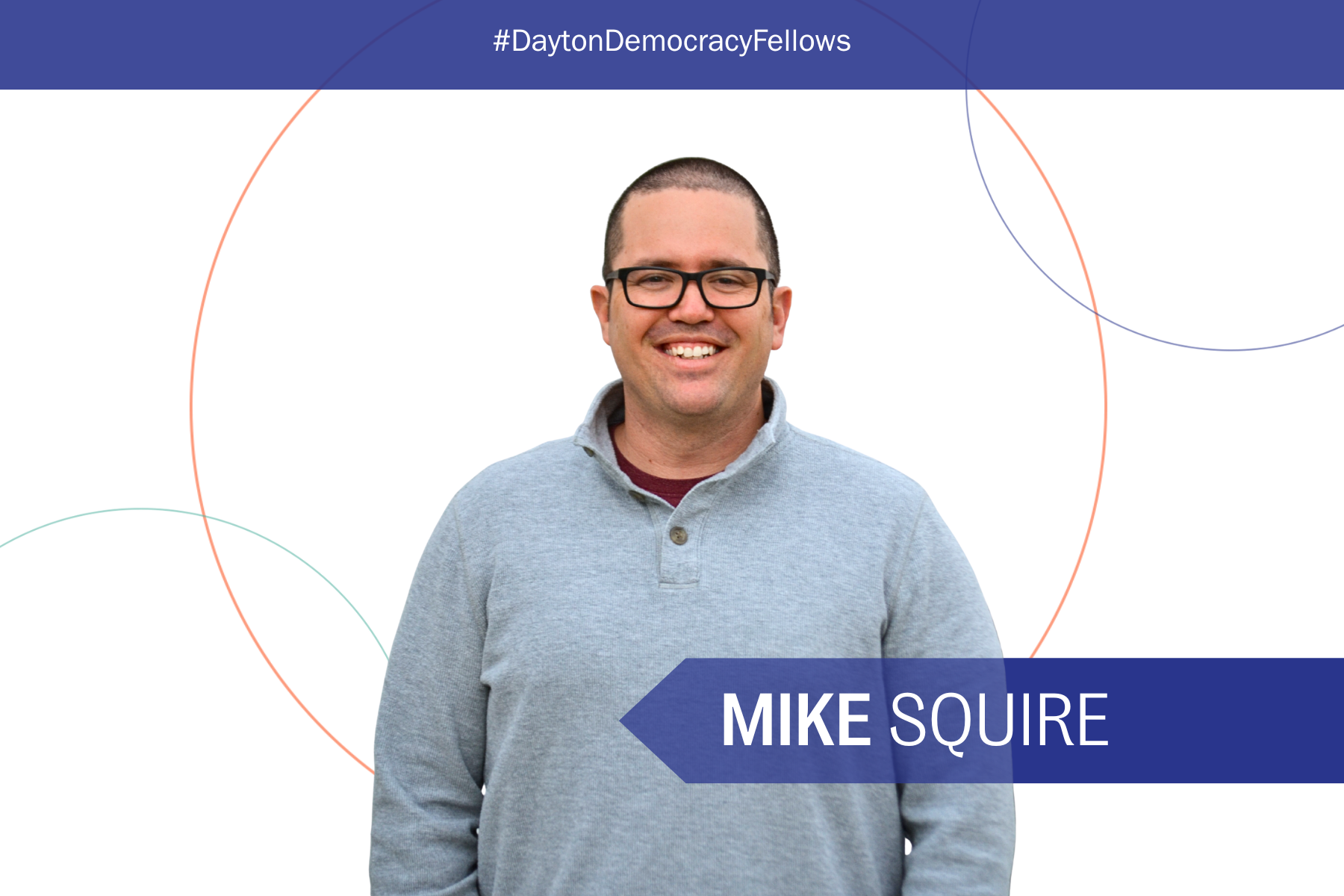
The Kettering Foundation’s Dayton Democracy Fellowship is a program that supports innovative leaders, changemakers, and dreamers who are building movements for inclusive democracy in their communities and in our wider world. This series of articles about the Dayton Democracy Fellows highlights their robust work and the powerful narratives that drive the advancement and defense of democracy.
Dayton Democracy Fellow Mike Squire’s job is to convince people that good government depends on them.
“There’s a lot of distrust in government, generally speaking, that makes people think, ‘What I have to say doesn’t matter.’ What I tell people is, ‘No, actually, it does,’” he said.
Squire is the division manager of community engagement for the City of Dayton. He and his staff work directly with the city’s 65 neighborhoods. They work directly not only with residents whose families have deep roots in Dayton but also the immigrant and refugee population. Their efforts focus on encouraging dialogue and civic participation and providing citizens with leadership training.
One effort is the city-run Neighborhood Leadership Institute, which, for more than 40 years, has trained residents to take an active part in governance and their community. His staff is also working to bring Citizens’ Assemblies—a democracy innovation that began in Europe—to Dayton in the future. These assemblies bring together a representative group of residents to deliberate on specific city problems or issues and to suggest approaches or solutions.
Squire’s staff tries to spend most of their time in the neighborhoods, talking with those who live there. It’s labor intensive, but face-to-face communication is key. “We need to be out in the neighborhood in front of people, knocking on doors, talking to people individually, because that cuts through a lot of the noise of people’s inboxes, mailboxes, phones, and everything else,” Squire said.
He said they also work to make sure the city is responsive to citizen voices. That means making meetings accessible to as many residents as possible. “We love our partners, but sometimes when they’re proposing a meeting for three o’clock on a Wednesday, [we say] that’s not going to work for everybody, you know?,” Squire said. He emphasized that people are yearning for a sense of community, and cities have great potential to bring democracy to the masses.
Sometimes what residents say and think about a certain issue is a surprise; officials don’t get the feedback they expected. What the city considers a priority might not be an aim the neighborhood shares. “I can’t tell you how many times I go into a neighborhood, and I’m like, ‘These are my top things,’ and then I talk to residents [and] the neighborhood leadership, and their goal doesn’t match up with what I was thinking,” Squire said.
Has he seen success stories? Squire cited the example of the former Residence Park Elementary School, which had been closed for years due to low enrollment. Then Dayton Public Schools suggested that the building be reopened as an international school to serve the city’s immigrant population. The city held public meetings with the school district that neighborhood leaders also attended. Officials pointed out that the new school would have a lower enrollment than the old school when it closed. Residents didn’t want to be seen as anti-immigrant and did not oppose the idea of an international school, but they wanted to be able to send their kids there, too. The school district listened. Now the International School at Residence Park is the district’s combined school for neighborhood children as well as English language students.
Squire said he is proud of the neighborhood. “It felt contentious at the time, and it was challenging . . . but they didn’t back down,” he said.
The hardest thing to impart to citizens eager to participate in governance, he said, is that policy change is almost never immediate. Finding solutions takes time. “The thing about local government is that local government didn’t change to a sprint culture. We’re still a marathon,” he said.
“We’re a hodgepodge of people, and we happen to live next to each other. What I have been emphasizing lately to people is [that] your voice matters so much, and when you show up, your influence matters, and it will be heard,” Squire said.
Maura Casey is a former editorial writer for the New York Times and has worked with the Kettering Foundation since 2010.