A Tale of Two Pandemics: Public Health and Democracy from H1N1 to COVID-19 and Beyond
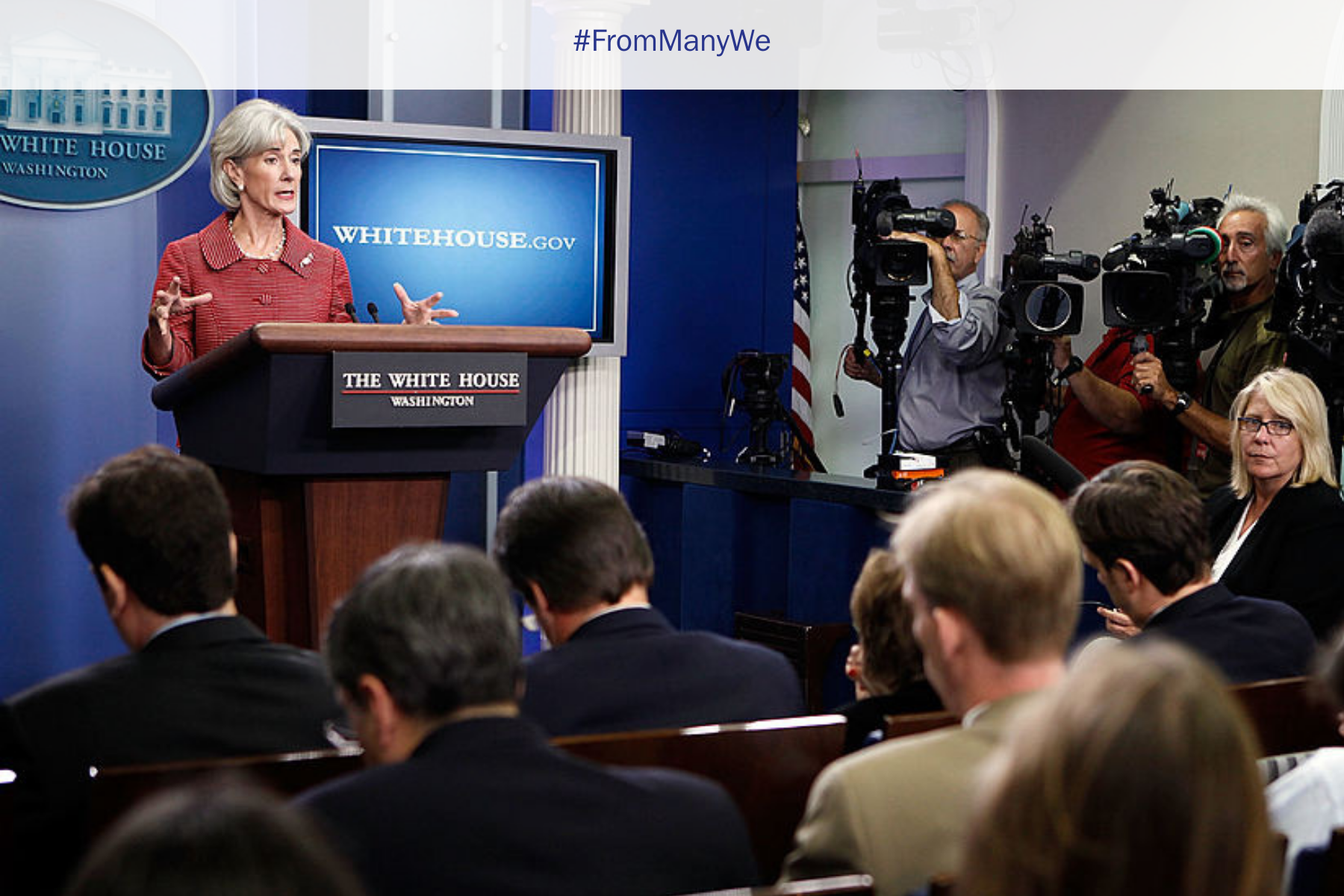
One of the greatest public health advancements for children in the United States and across the globe is the development of vaccines to save lives. When I was a child, my parents were grateful to have me and my brothers participate in early polio trials as the disease raged in neighborhoods. As a mother and grandmother, I have welcomed the advances that kept my children and now my grandchildren healthier. I knew my children were safer when they entered school because health policies were in place to protect everyone. As Secretary of HHS, I oversaw an effort to develop a vaccine and mobilize that vaccination effort against H1N1. This flu strain was lethal to children and young adults in 2009 and 2010 and was the first pandemic the US had experienced in 70 years. So I have personal and professional experience throughout my life with beneficial vaccines.
As the Secretary of HHS for five and a half years, I learned a lot dealing with public health officials and leading responses to outbreaks of unknown origin. I also learned the importance of using credible, consistent information that is based on reliable science to quell fears and prepare the public for group response. The people’s confidence in a trustworthy information environment is a foundation of our democracy and is also critical to our public health.
Putting Science First: The H1N1 Response
An unknown strain of flu virus greeted me almost immediately upon entering office in 2009. I learned there was no available vaccine, that the virus started in Mexico and was already in the United States and Canada, and that children and young adults who weren’t normally victims of seasonal flu were becoming very ill or dying. That was alarming, and the prospects for a global pandemic were terrifying.
In the US, leaders across the cabinet were mobilized for a rapid response, and a communication strategy of giving the public clear, scientifically based information about what we knew and, as important, what we didn’t know, was quickly implemented under President Obama’s leadership. Rule number one was to follow the science. We would not risk lives for the sake of politics.
Work quickly began in the US and other countries to develop an effective vaccine, and progress was shared with health ministers, first in the Americas and then throughout the world, on a regular basis. The US closely coordinated efforts with the World Health Organization (WHO) and committed to vaccine-sharing agreements with under-developed nations when a vaccine was available.
We were lucky that the virus ultimately wasn’t as lethal as it had initially appeared. Trust and investment in science led to a vaccine that helped to curtail the rapid spread of H1N1 by late summer 2009. A national vaccination effort was underway in the fall. The vaccine targeted the most vulnerable populations first and then all eligible Americans as production increased. The US participated in vaccine-sharing, so as the flu season moved across the globe, other countries were prepared and could limit illness and death. Lower-income countries received life-saving vaccines through previously negotiated international agreements and donations.
But clear communication, international trust and coordination, and shared responsibility to assist countries with little ability to buy medicines were key components of limiting deaths and curtailing the spread of disease. The public trusted the information and the recommendations they were given. Although fear and uncertainty persisted until we had a safe vaccine and enough was manufactured to satisfy demand, Americans trusted the process, listened to the experts, and followed the best scientific advice.
COVID-19: When Science and Politics Collide
Those principles of clear, scientifically based information, as well as collaboration and cooperation with health ministers in countries around the world, began to break down in 2020 with the emergence of COVID-19. For the first time in the US, political leaders openly disputed scientific recommendations, and public health information and recommendations were treated as partisan issues.
Since COVID-19 was also a novel virus with no vaccine available, initial recommendations about the spread and containment changed with time as more was learned about the disease. The White House didn’t use the bully pulpit to calm fears or bring people together, but instead political leaders made accusations about the motives of long-serving health experts, made recommendations about remedies and treatments that were not tried or tested, and openly disputed decisions by elected leaders in the opposite political party about keeping their citizens safe and secure. Despite pushing forward the vaccine that ultimately ended the pandemic, the first Trump administration sowed seeds of uncertainty and distrust that continue to hamper public health efforts today.
Politics and Public Health in the Post-COVID-19 Era
Now after living through the long nightmare of COVID-19, with millions of deaths and economic losses, the second Trump administration has further eroded our public health framework, at home and abroad. The huge success of the COVID-19 vaccine, saving millions of lives in America and around the world, is now a casualty of the current vaccine skeptics. The world health alliances, so critical to identify, inform, and contain outbreaks before they reach American shores, are now operating without the US. We have withdrawn from WHO and from Gavi, the Vaccine Alliance, the international partnership for vaccine sharing.
And within the US, a formerly small band of vaccine skeptics has grown into a political force, urged on by the new Secretary of Health and Human Services, who spent decades suing vaccine companies and making unsubstantiated claims linking vaccines to autism. Public health officials have been driven from their jobs, and the US is no longer collecting and sharing health data on outbreaks.
The primary public health agency in the US, the CDC, has been decimated with staff and leadership firings and a 40% budget cut. We are once again seeing outbreaks in the US of childhood diseases proclaimed eradicated years ago.
Before the measles vaccine, around three to four million children in the US got the wildly contagious disease every year, leading to tens of thousands of hospitalizations and hundreds of deaths annually. Since 1963, when the vaccine was developed, it is estimated that measles vaccinations have prevented over 90 million deaths worldwide. The current US outbreak of measles—over 2,000 cases reported in 2025 largely among unvaccinated individuals resulting in hundreds of hospitalizations and at least two child deaths—is horrifying in a country where a measles vaccine is safe, effective, and affordable.
It is alarming to see public health undermined and expertise discounted by appointed public officials who maintain, without any scientific evidence, that vaccines are more harmful than the diseases they prevent. Currently those same federal appointees and their allies in states are working to undermine the comprehensive school-vaccine mandates, declared constitutional by the Supreme Court in 1922 and expanded to all states by 1980.
The Secretary of HHS has now fired all the experts on the Advisory Committee on Immunization Practices, established in 1964, replacing them with many vaccine skeptics. Already the new committee has suggested that several childhood vaccines be removed from the recommended list of shots and that parents should be given wide latitude on refusing vaccinations for entry into school. Some on the new committee have even suggested that all vaccine recommendations should be eliminated.
The new US health officials have disrupted and withdrawn from surveillance and joint research programs with health ministers around the world. Americans are now less safe and secure as novel viruses cross our borders and infect our citizens. And now we are seeing the dangerous policies of top health officials putting our children and grandchildren at risk.
Demanding Experts We Can Trust
I am confident that parents want their children to be healthy and that they try very hard to keep their children from harm. I also know that many parents are overwhelmed with work and family obligations and want the best possible professional advice on health issues. It is dangerous to intentionally undermine parental confidence about the safety and effectiveness of vaccines. And expanding immunization exemptions undercuts protections that children who medically can’t tolerate a vaccine gain when their classmates are vaccinated.
As the grandmother of five, including a two-year-old who is too young to receive all the necessary immunizations, I am bewildered and alarmed by the efforts to dismantle over 50 years of progress on childhood diseases. The individuals who are the top health officials in the US should be trusted to give accurate and scientifically based recommendations for the public good. That is not happening in the US in 2026, and we must demand better for the health of our children and grandchildren.
Kathleen Sebelius is the former governor of Kansas and served as the Secretary of the US Department of Health and Human Services from 2009 to 2014. She continues policy work with KFF (formerly known as the Kaiser Family Foundation) and co-leads the Health Strategy Group for the Aspen Institute. She is the Kettering Foundation’s inaugural David Mathews Democracy Fellow.
From Many, We is a Charles F. Kettering Foundation blog series that highlights the insights of thought leaders dedicated to the idea of inclusive democracy. Queries may be directed to fmw@kettering.org.
The views and opinions expressed by contributors to our digital communications are made independent of their affiliation with the Charles F. Kettering Foundation and without the foundation’s warranty of accuracy, authenticity, or completeness. Such statements do not reflect the views and opinions of the foundation which hereby disclaims liability to any party for direct, indirect, implied, punitive, special, incidental, or other consequential damages that may arise in connection with statements made by a contributor during their association with the foundation or independently.