Leveraging Gender to Advance Authoritarianism, Part Two
The (En)gendering Authoritarianism report and the reason for the research behind it were introduced in “Leveraging Gender to Advance Authoritarianism, Part One.”
Around the world, political and cultural leaders are leveraging narratives and policies on gender to justify anti-democratic practices, rights restrictions, expanded state powers, eroded accountability mechanisms, and even violence. In other words, gender is not something that is ancillary to or that merely coincides with rising authoritarianism. Instead, it is a key tactic in the authoritarian playbook.
As we covered in our previous post, gender is both complex and deeply personal. It is intimately connected to people’s identities, underlying how we all understand ourselves and relate to the world. This is precisely what makes gender such a potent tool for sowing moral panic. It can create a sense of threat, divide the opposition, and help normalize social hierarchies, all of which help pave the way for authoritarian power consolidation.
Our research identifies six strategies through which political and cultural leaders weaponize gender in ways that advance the authoritarian project. In the full report, we delve deeply into each strategy; in this piece, we have provided a more general overview.
1. Construct a Threat
Authoritarian populists need to construct an enemy. This proposed enemy is something that poses a danger to the nation, its way of life, women and children, or its overall security. Protection against this enemy is used to justify the extreme measures being used, such as emergency powers, rights restrictions, or attacks on watchdog institutions, civil society, and the media.
The threat of so-called “gender ideology” or “homosexual propaganda” was a pretext in Russia, and later in Hungary, Romania, Bulgaria, and some US states, to justify censorship and book bans. In Texas, it was used to justify a series of restrictive measures that created what Adam Serwer described as a “snitch state,” providing inroads for the state to extend control into classrooms, doctor’s offices, bathrooms, and the home. Further, this creates a precedent for future rights restrictions and power expansions any time a new “threat” emerges.
2. Normalize Authoritarian Ideas
Political and cultural leaders reframe what democracy entails to normalize ideas of intergroup hierarchies and dominance. These ideas are first explored as they relate to family, gender relations, gender identity, women, and LGBTQ+ rights—realms in which hierarchies already exist or are less contested. This lays the groundwork to more broadly challenge equality, pluralism, and human rights—all core ideals of liberal democracy—and to frame them as unnatural, undesirable, or unrealistic.
In the Visegrad countries (Czech Republic, Hungary, Poland, and Slovakia) the Pro-family Declaration labels the family as the foundation of society. While seemingly benign, this rhetoric is used to justify curtailing the individual rights and freedoms of women and sexual minorities— including reproductive rights, the right to same-sex partnership recognition, and protections against discrimination based on gender and sexual orientation. This then normalizes the idea that individual rights and freedoms, the fundamental tenets of liberal democracy, can be sacrificed in the name of “family values.” The argument is further strengthened by rhetoric that frames international human rights norms and agreements as being violations of national sovereignty imposed by foreign governments and international organizations.
3. Change Culture
Narratives that exploit gender anxieties are often introduced in spaces that purport to be apolitical, such as cooking or fitness spaces. These typically apolitical communities are used as a medium to convey ideas about traditional gender roles and to make authoritarian ideas more palatable. Authoritarians will also co-opt existing or create new cultural and educational institutes to promulgate, reinforce, or help legitimize these ideas.
Take for example the online women’s magazine Evie, which on its face is not overtly political, nor does the vast majority of its content explicitly discuss politics. Nonetheless, Evie clearly presents a very specific view of womanhood and motherhood, one that romanticizes the “old-fashioned” days when women had no independent financial or social freedom without the consent of their husbands. Much of the content is built on a kernel of truth such as the reality that for women in the United States, having a fulfilling career and a full family life often feel incompatible. However, these ideas directly counter core ideas of feminism, such as a recent article entitled, “They Lied to Us About Having It All, and It’s Costing Us Our Children.” Content like this, in a purportedly apolitical space, slowly slips in new ideas about the role of women in the home and society and, over time, contributes to a dramatic shift in cultural norms and mores.
4. Build a Big Tent Movement
Authoritarian political leaders and their cultural allies foment gender-related anxieties to create a symbolic glue that builds and holds together an otherwise unlikely coalition of actors, many of whom hold political views that are in direct contradiction with the views of other coalition members.
At the international level, scholars have documented how anti-gender activists and religious organizations came together across countries, ideologies, and religious denominations to push their agenda in ways that mimic progressive and pro-democracy activism. Consider, for example, the World Congress of Families, an international conference that stirs up anxiety about declining nativist birth rates. Couched in the language of concern about declining traditional values, or moral decay, conferences like this bring together a coalition of cultural and political actors who may not agree on many policy preferences, but who are nonetheless united by their work to fight “gender ideology” and push for policies that cast women in the role of wife and mother above all else.
In the United States, the “threat” of “gender ideology” serves as a symbolic glue that unites libertarian pro-natalists with religious actors and political leaders, even though these actors do not share the same view on the policy solutions to the problems they’re fighting against. For example, a recent Heritage Foundation report entitled “Saving America by Saving the Family” explicitly argues against what some in the pro-natalist coalition see as key to increasing birth rates: reproductive technology. Rather than increasing access to reproductive health care for both women and men, the Heritage Foundation argues instead that the solution is to change social and economic incentives to encourage women to forgo college, marry younger, and begin having children in their prime reproductive years. Despite these key differences, both of these groups are represented in and by this coalition that uses gender as its symbolic glue.
5. Divide and Polarize
Authoritarian populists thrive in a divisive, us-versus-them environment in which they can claim the commonsense, majority position against an out-of-touch elite. To create these conditions, they will often frame gender issues in a purposefully divisive way to further polarize society and to wedge apart pro-democracy coalitions because a united opposition threatens their power. Using gender in this way also obscures areas of general public agreement and common ground, which in turn further prevents the formation of a cohesive opposition.
6. Distract
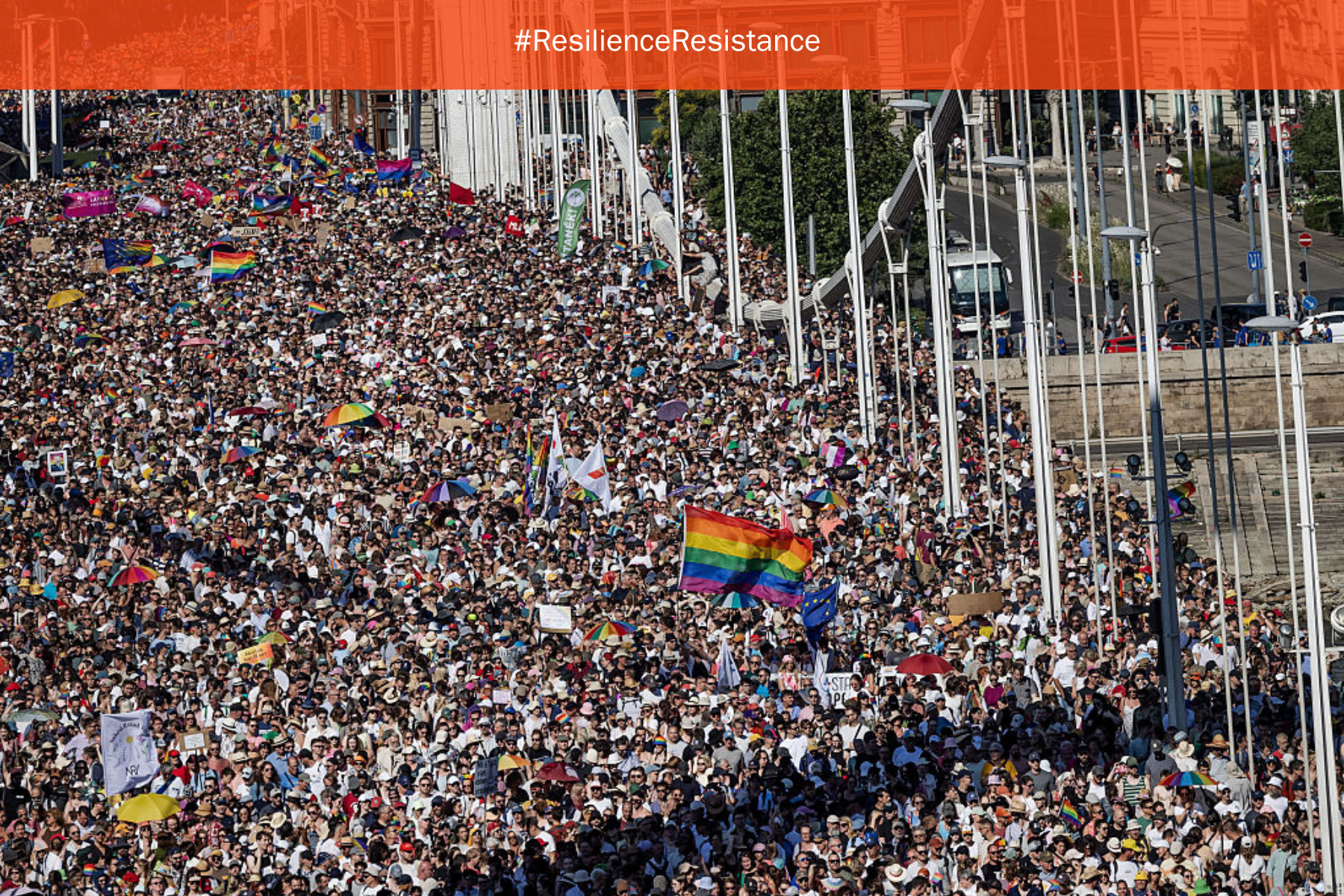
Authoritarian populists leverage gender-related issues (such as sex education, women’s rights, trans rights, and purported threats to children’s safety) to divert attention from their power grabs, unpopular or ineffective policies, and corruption. For example, in the summer of 2025, Viktor Orbán attempted to distract from a rising opposition and concerns about economic policy by invoking the boogeyman of “gender ideology” in Hungary. Using “gender ideology” as a justification, Orbán’s government banned all pride events. This tactic backfired when the opposition and gender justice organizers reframed the ban as an attack against freedom of assembly, ultimately resulting in the largest pride parade in Hungarian history.
Weaponizing gender and scapegoating the LGBTQ+ community are powerful mechanisms for building support for authoritarian policies. However, we all have a role to play in pushing back. Communities around the world are already doing so by building coalitions, reframing the narrative, and engaging a constellation of approaches to simultaneously support LGBTQ+ communities and women and to build longer-term resilience to these tactics. In the next phase of our research, we are studying these examples of success and are looking forward to uplifting these strategies. While we recognize that much work remains to turn the tide, there is also a great deal that we can learn from communities and organizations around the world.
Miriam Juan-Torres is Head of Research, Democracy & Belonging Program at the Othering and Belonging Institute at UC Berkeley. The Othering & Belonging Institute is a think-and-do-tank that advances groundbreaking approaches to transforming structural marginalization and inequality. We are scholars, organizers, communicators, researchers, artists, and policymakers committed to building a world where all people belong.
Laura Livingston is the Senior Director of Field Support & Strategy at Over Zero, an organization dedicated to building resilience to political and identity-based violence. Her role focuses on developing frameworks and resources to support organizations and leaders in navigating risks of violence. She leads Over Zero’s work to examine how gender and sexuality are weaponized to advance authoritarianism.
Tara Chandra is a consultant and researcher focused on human rights and democracy, gender, and international security. She received her PhD in political science from the University of California, Berkeley, where her research focused on violence perpetrated against women in civil conflicts.
Resilience & Resistance is a Charles F. Kettering Foundation blog series that features the insights of thought leaders and practitioners who are working to expand and support inclusive democracies around the globe. Direct any queries to globalteam@kettering.org.
The views and opinions expressed by contributors to our digital communications are made independent of their affiliation with the Charles F. Kettering Foundation and without the foundation’s warranty of accuracy, authenticity, or completeness. Such statements do not reflect the views and opinions of the foundation which hereby disclaims liability to any party for direct, indirect, implied, punitive, special, incidental, or other consequential damages that may arise in connection with statements made by a contributor during their association with the foundation or independently.