Ableism in America: How Christian Nationalism Informs Project 2025

Americans with disabilities and their families have long fought for equal protection under federal and state law in the United States. The passage of the Americans with Disabilities Act in 1990 was a landmark victory, but in the decades since, the results have been mixed. Today, Americans with disabilities face lower employment rates, higher levels of poverty, reduced access to healthcare, and lower educational attainment than Americans who do not report one or more disabilities. The current political climate presents additional obstacles to Americans with disabilities being able to participate and thrive as full members of society.
Project 2025: Christian Nationalism’s Ableist Agenda
Christian nationalism is an ideology that is committed to fusing a particularly conservative strain of Christianity with American civic life. It demands all levels of our government preserve and defend this fusion as being central to our national identity while determining which Americans truly belong. The benefits of citizenship are bestowed on those who adhere to the preferred social norms and social categories of Christian nationalism.
Disabled Americans are currently dealing with the hurdle of Project 2025. Written by leaders and organizations who explicitly embrace Christian nationalism, Project 2025 seeks to dramatically reshape the federal government in favor of expansive executive powers with the goal of elevating biblical principles. Before the 2024 election, the Center for American Progress identified numerous threats that Project 2025 posed to disabled people, several of which have already begun to be implemented. The current Trump administration has begun to enact Project 2025’s goals by limiting disabled students’ access to free and public education, making cuts to the Department of Health and Human Services and the Social Security Administration, and proposing large-scale cuts to SNAP and Medicaid programs.
Christian Nationalism and Ableism: The Data
I recently published a peer-reviewed research article that provides some insight into why Christian nationalist agendas like Project 2025 threaten the services that support disabled Americans. Using a large, national, random sample of American adults, I found that Christian nationalism is strongly linked to ableism. Ableism refers to the tendency to stereotype and discriminate against people with disabilities, primarily by assigning value to their intellectual and physical abilities, and generally prefers able-bodied people.
Talking about and understanding ableism is important because ableism tends to hide the social and cultural challenges that Americans with disabilities experience, resulting in inequalities that are structural in nature. Ableism disguises the fact that the difficulties people with disabilities face are not just an individual’s fault. It also hides the importance of collective action to support people with disabilities so that their survival is not just up to them or their families.
Ableism is one of the underlying justifications that Project 2025 uses when advocating for cuts to education, healthcare, and public benefits that serve Americans with disabilities. It seeks to put all the responsibility for survival on the backs of disabled Americans and their families and essentially blames them for the inequalities they face. The data show that being able-bodied is one of the preferred social categories for Christian nationalism.
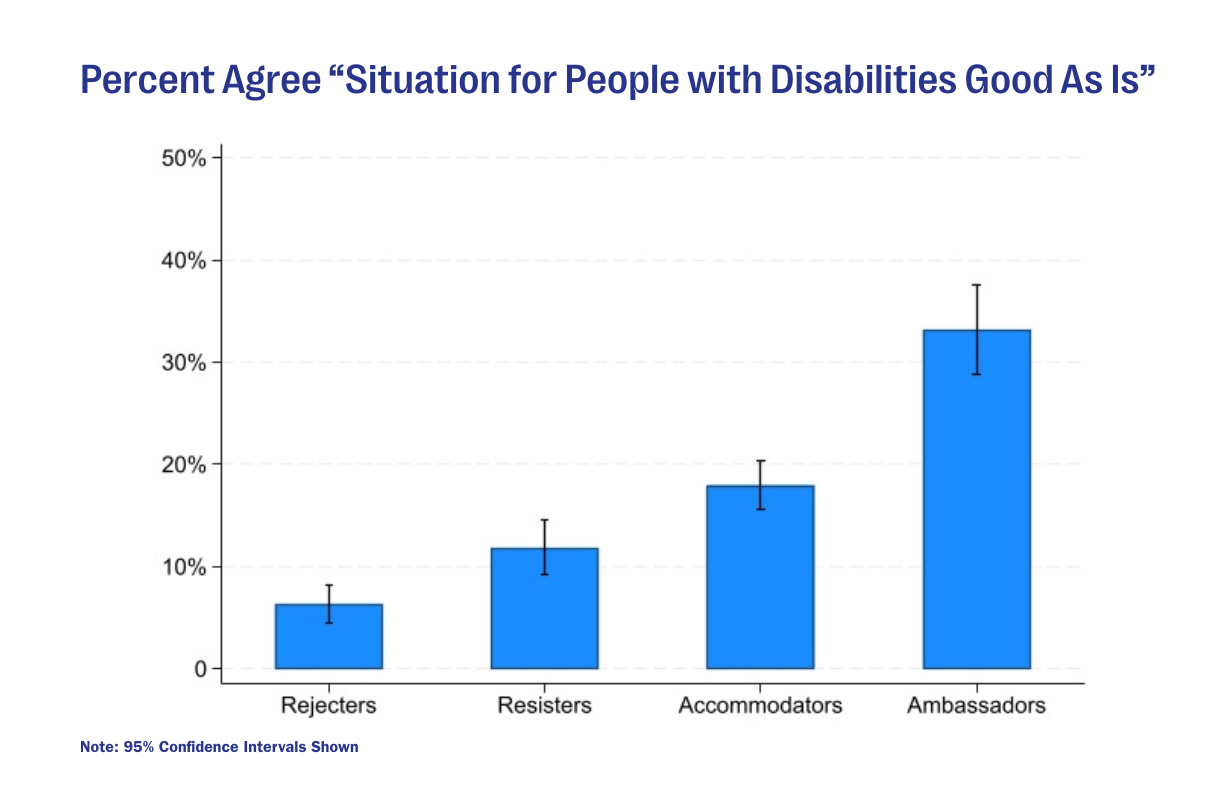
For instance, in the figure below we can see that around 33% of Americans who strongly endorse Christian nationalism, who Samuel Perry and I call “Ambassadors,” agree with the statement “the situation for people with disabilities is good as it is.”
However, only 18% of “Accommodators,” those Americans who are somewhat favorable toward Christian nationalism, agree with this statement. Americans who wholeheartedly reject (6%) and resist (12%) Christian nationalism are much less likely to agree that the situation for people with disabilities is “good as is.”
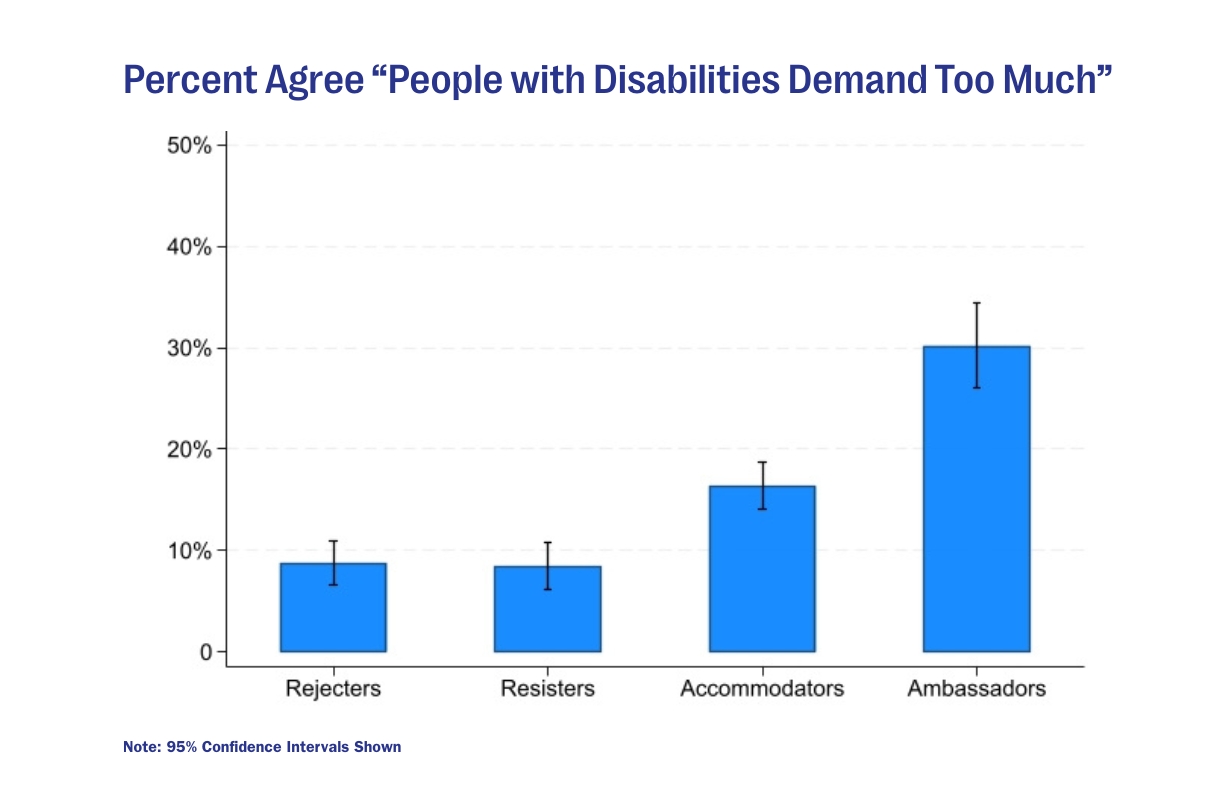
I find similar patterns when examining agreement with the statement “people with disabilities are demanding too much from the rest of society.” Yet again, around 30% of Americans who strongly embrace Christian nationalism, Ambassadors, agree that “people with disabilities demand too much.” This is by far the largest proportion of the four groups. Less than 10% of Rejecters and Resisters of Christian nationalism agree with this statement.
The final measure of ableism used in this study asked for the level of agreement with the statement “there have been enough societal efforts in favor of people with disabilities.” Here again we see it is Americans who strongly embrace Christian nationalism (41%) who are most likely to agree.
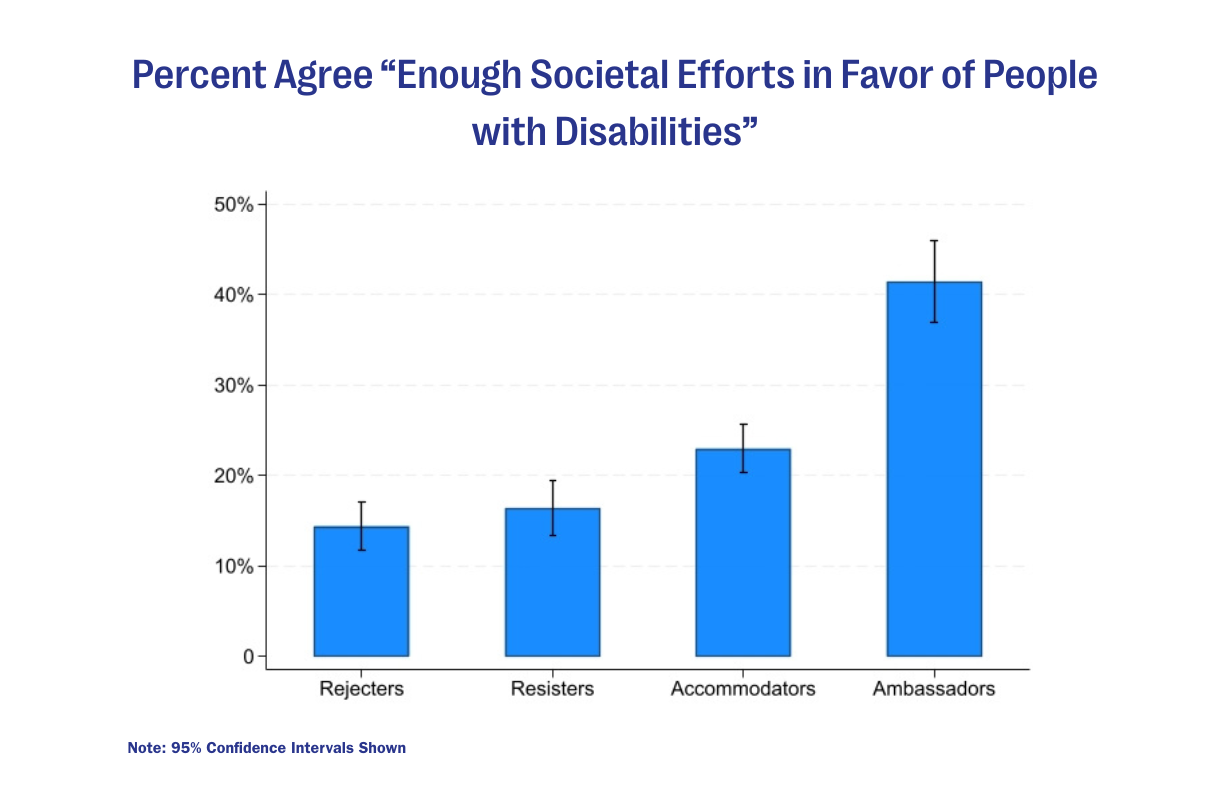
Americans who reject (14%) or resist (16%) Christian nationalism are much less likely to agree our society has done enough to favor Americans with disabilities.
Even when I account for Americans’ political views, religiosity, age, gender, or even if they know someone or have a disabled family member, Christian nationalism remains one of the strongest predictors of discrimination toward Americans with disabilities.
Ableist Discourse in Christian Nationalist Ideology
There are several reasons why Christian nationalism and ableism are so strongly linked in the minds of Americans. First, one of the key cultural markers of Christian nationalism is idealizing free-market capitalism. Through the 20th century, religious and political leaders promoted privatization, deregulation, and reduced public spending as markers of the Christian God’s preferred economic system.
The spread of the ideology of free market capitalism coincided with the development of ableism in the United States, which also tends to elevate economic productivity as the primary measure of citizens’ individual worth. “Good” people are economically “productive” people, and strong nations are filled with such people. Mehmet Oz, the administrator of the Centers for Medicare and Medicaid Services, claims, “The most patriotic thing you can do is get healthy. Healthy people don’t consume healthcare resources.”
Christian nationalism is strongly linked with ableism through theological streams within certain interpretations of the Bible. Using biblical scripture in these ways has led to discrimination and prejudice against people with disabilities. For instance, some have used Christian scriptures to interpret disability as divine punishment for sin, as an occasion to demonstrate virtuous suffering, or as an opportunity for others to show charity.
These views of disability place the burden of survival on disabled people and their families. When disability is viewed as an individual theological problem possibly willed by God, people are likely to ignore the ways society places disabled people at a disadvantage and may overlook ways to change those situations. In viewing disability as merely an opportunity for others to show charity, it absolves us of our collective responsibility to address the society-wide issues that create the need for charity. It also means disabled people and their ongoing needs depend upon the whims of those who might be feeling charitable from moment to moment. The strong relationship between Christian nationalism and ableism is influential because it is actively shaping our collective values and guiding the functioning of important social institutions, like healthcare and education.
What Citizens Can Do
Citizens who are committed to living in a pluralistic, democratic society—where all people should have equal access to the benefits of citizenship and social support, able-bodied or not—can respond in several ways.
Begin to listen, learn from, and follow the lead of disabled Americans and their families in your community. They will be able to clearly articulate what they need and how you can best support them.
Join and support local groups in your town, city, or state that bring disabled Americans and their families together. These groups may share resources for parents with children who have just received an autism diagnosis or adults who have a physical disability. One example is The Arc, which has advocated for the passage of state and federal legislation on behalf of people with disabilities and established a broad network of state and local chapters.
If you identify as Christian, explore how to recognize and address ableist interpretations of Christian scripture and theology. Christian nationalism desires to elevate one particular expression of Christianity that embraces ableist narratives. One way to confront Christian nationalism is to elevate Christian traditions and theologies that center disabled people and recognize the gifts they bring to all communities.
We are on a path where decades of public policy aimed at supporting Americans with disabilities is being weakened and overturned due to the ongoing influence of Christian nationalism. We must rebuild the civil society organizations that strengthen communities and protect the rights of the most vulnerable among us. A supportive and accessible society benefits every American.
Andrew L. Whitehead is professor of sociology at Indiana University Indianapolis, codirector of the Association of Religion Data Archives, and a Charles F. Kettering Foundation Research Fellow. Follow him on Bluesky and Substack.
From Many, We is a Charles F. Kettering Foundation blog series that highlights the insights of thought leaders dedicated to the idea of inclusive democracy. Queries may be directed to fmw@kettering.org.
The views and opinions expressed by contributors to our digital communications are made independent of their affiliation with the Charles F. Kettering Foundation and without the foundation’s warranty of accuracy, authenticity, or completeness. Such statements do not reflect the views and opinions of the foundation which hereby disclaims liability to any party for direct, indirect, implied, punitive, special, incidental, or other consequential damages that may arise in connection with statements made by a contributor during their association with the foundation or independently.