Building Peace, One Story at a Time
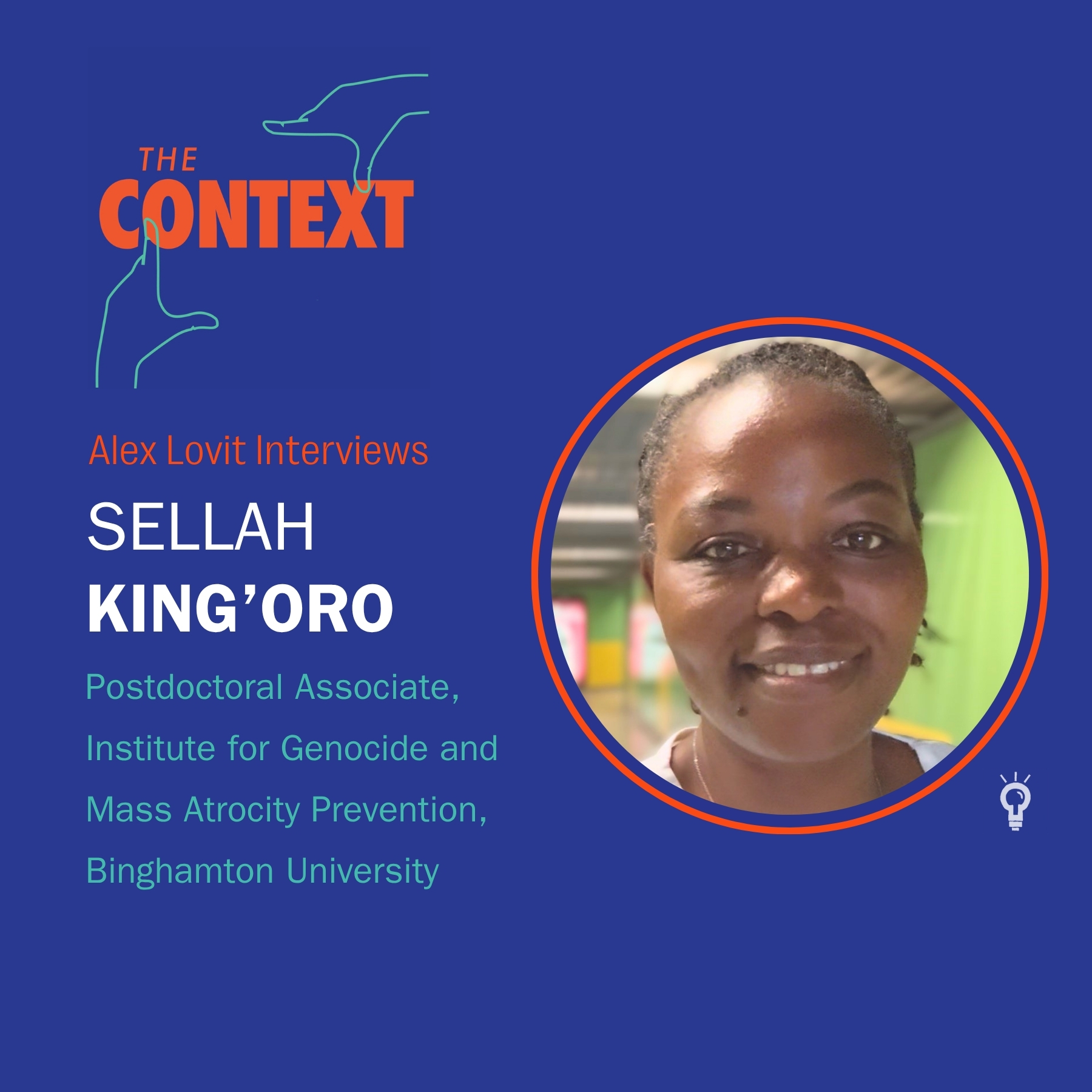
The line between peaceful politics and violent conflict can be fragile. In recent years, there have been many instances of election-related violence around the world. One of the worst examples occurred in Kenya. Following a disputed election in 2007, opposing political and ethnic factions clashed in the streets. More than a thousand people were killed, and more than 300,000 were forced from their homes. As is often true, these hostilities were based in cultural narratives—the stories people tell themselves about who they are, who their enemies are, and the sources of that conflict. Sellah King’oro, who has worked to build peace in Kenya and around the world, joins host Alex Lovit to explain how telling more diverse stories can prevent violence.
Sellah King’oro is a narrative peacebuilder from Kenya with a particular interest in women’s inclusion in peace and security processes. She is currently a postdoctoral associate at the Institute for Genocide and Mass Atrocity Prevention at Binghamton University, State University of New York. She previously served as the head of the Research and Policy Department at the National Cohesion and Integration Commission in Kenya. She is also a member of the Inclusive Narratives Practice Group convened by the Institute for Integrated Transitions, where she contributes to advancing narrative approaches to peace and justice.
Share Episode
Building Peace, One Story at a Time
The line between peaceful politics and violent conflict can be fragile. In recent years, there have been many instances of election-related violence around the world. One of the worst examples occurred in Kenya. Following a disputed election in 2007, opposing political and ethnic factions clashed in the streets. More than a thousand people were killed, and more than 300,000 were forced from their homes. As is often true, these hostilities were based in cultural narratives—the stories people tell themselves about who they are, who their enemies are, and the sources of that conflict. Sellah King’oro, who has worked to build peace in Kenya and around the world, joins host Alex Lovit to explain how telling more diverse stories can prevent violence.
Sellah King’oro is a narrative peacebuilder from Kenya with a particular interest in women’s inclusion in peace and security processes. She is currently a postdoctoral associate at the Institute for Genocide and Mass Atrocity Prevention at Binghamton University, State University of New York. She previously served as the head of the Research and Policy Department at the National Cohesion and Integration Commission in Kenya. She is also a member of the Inclusive Narratives Practice Group convened by the Institute for Integrated Transitions, where she contributes to advancing narrative approaches to peace and justice.
Share Episode
Building Peace, One Story at a Time
Listen & Subscribe
The line between peaceful politics and violent conflict can be fragile. In recent years, there have been many instances of election-related violence around the world. One of the worst examples occurred in Kenya. Following a disputed election in 2007, opposing political and ethnic factions clashed in the streets. More than a thousand people were killed, and more than 300,000 were forced from their homes. As is often true, these hostilities were based in cultural narratives—the stories people tell themselves about who they are, who their enemies are, and the sources of that conflict. Sellah King’oro, who has worked to build peace in Kenya and around the world, joins host Alex Lovit to explain how telling more diverse stories can prevent violence.
Sellah King’oro is a narrative peacebuilder from Kenya with a particular interest in women’s inclusion in peace and security processes. She is currently a postdoctoral associate at the Institute for Genocide and Mass Atrocity Prevention at Binghamton University, State University of New York. She previously served as the head of the Research and Policy Department at the National Cohesion and Integration Commission in Kenya. She is also a member of the Inclusive Narratives Practice Group convened by the Institute for Integrated Transitions, where she contributes to advancing narrative approaches to peace and justice.
Alex Lovit: The election is over. The results are in. But the losing candidate refuses to walk away. They claim fraud, they claim theft, and their supporters back those claims up with violence. This is a common story. I could be talking about Cote d’Ivoire in 2010, the US in 2021, Brazil in 2023. But one of the worst examples happened in Kenya. In the wake of a disputed election in 2007, protests turned into riots, and police responded with live ammunition. More than a thousand people were killed, and hundreds of thousands were forced from their homes. My guest today was there. She has seen firsthand what happens when politics stops being about policy and starts being about identity, when political division turns neighbors into enemies. What do you do when politics destroys peace?
You’re listening to The Context. It’s a show from the Charles F. Kettering Foundation about how to get democracy to work for everyone and why that’s so hard to do. I’m your host, Alex Lovit. Today, I’m talking with Sellah King’oro. Sellah is a narrative peace-builder. She previously led research and policy for Kenya’s National Cohesion and Integration Commission, and she’s currently a postdoctoral associate at Binghamton University’s Institute for Genocide and Mass Atrocity Prevention. Violence, Sellah tells us, doesn’t just come from policies. It’s rooted in cultural narratives, stories people have heard their whole lives. So if we want to find peace, we have to look at those stories and learn how to tell them differently.
Sellah King’oro, welcome to The Context.
Sellah King’oro: Thank you for having me.
Alex Lovit: So you work in the professional field of peace-building. When I first heard that phrase, and I’m sure this is true for a lot of people, it sounds good, I like peace, I’d like to build it, but I didn’t really know what it meant. So can you give us a brief description of what is peace-building?
Sellah King’oro: Peace-building is a process of addressing root causes of conflict, and there are many ways of achieving peace-building. It may look at repairing injustices, strengthening institutions. It may look at broken relationships between groups, between people, between institutions as well. And it does work not just where violence is present, but it also looks at what we call latent conflict, so conflict that has not yet manifested into violence.
Alex Lovit: How did you get into this field? How did you first get interested in it?
Sellah King’oro: My interest goes way back to when I was a young child. I was born on the border of Kenya and Uganda, small village towards the border, and there was a conflict between my community and the neighboring community as to who is the rightful holder of the land that we were living in. Part of the violence was torching houses to force evictions of people. So there’s this day, I was about 11 years old, and my grandmother took a number of children in the village, and we were taken to the river in a small cave in the evening. And this is because there were rumors that the neighboring community was going to attack. And then the following morning when we came back into the village, we just saw so many houses already on the ground. And this is when I started asking myself, “What’s going on?”
When I go to school, my grandmother would tell me, “Don’t fight over small things,” and I’m thinking, “You’re the one telling me not to fight, and what’s going on here?” At that point, of course, I wasn’t really understanding what was going on, but that curiosity started at that time, especially not just seeing the houses, but also seeing people who were maimed. Ears were cut off. So people who were really injured during that conflict, and I would live interacting with some of the consequences of this conflict for a very long time until I went into college and I was really curious to learn more about conflict. And there was no specific degree on conflict, but there was one on diplomacy, which covered the essence of conflict and how to address conflict through diplomacy. So I ended up doing that, and today here I am.
Alex Lovit: You’re describing there a conflict between the village where you grew up and some neighboring folks. Was that part of a larger division within Kenya?
Sellah King’oro: Oh, indeed. So this is one of the major conflicts in Kenya because the community, the neighboring community had a lot of claims on land, while my community was claiming that the community moved from Uganda, our neighboring country, into Kenya, and therefore they do not have claim on the land. The issue of land management was a big problem that I would say is a result of the neocolonial policies as opposed to colonial policies. In this particular area, the white settlers did take land from the local people in Kenya. The post-independence policy was that if you had the money to buy the land, then the land would be yours. Now, the people who had money to purchase these lands were people who had privilege, those who had gone to school, those who had jobs. And what perpetuates the conflict is now the narratives that are told to generations after generations.
So as you can tell, we have so many years now, 50+ years, after independence, yet the conflict is still as rife as it was. You would think that this happened yesterday. And that’s because the stories of enmity, the stories of hate are passed down from grandmother to children and so on and so forth. And so narratives have become a defining factor to the conflicts that continue to take place in the country.
Alex Lovit: I know the field you focus on is narrative peace-building, and I think that might sound like a challenging thing to do. It is a challenging thing to do; I’m going to show up to this active conflict with nothing more than words and narratives and stories. But you’re already saying there some examples of how these conflicts are rooted in stories. So if you’re looking at a conflict and you’re looking at what narratives are generating that conflict, how do you research those narratives? How do you, in a structured way, find out what narratives are the problem here?
Sellah King’oro: First and foremost, let me just reinforce how narratives are a problem. Now, we did a study in Northern Kenya where there are communities, neighboring communities, again, whose conflict is mainly anchored on cattle wrastling. So on community would go into another community’s homes, for example, and take all the cows and kill people if they are on the way or if people try to retrieve the stolen cows. And then after a while, the other group B will go to group A’s home and do the same. So a revenge cycle of this cattle wrastling that’s never ending. Unfortunately, it’s not just about the cattle, it’s about casualties.
Now, while talking to young people in one of the communities, we did ask them, “Why do you as a person hate people from group A,” and the young person said, “They started it. They started killing us. They started taking our cows.” And so the question is, “When did they start doing this?” “Well, I don’t know. I was just told that they started it.” “Now, do you think it will ever end if they start and you do it as well,” and the young person was like, “Unfortunately, it’s not up to me. Because if it was up to me, I would actually stop it.” So this is the scenario. And so narratives shape our beliefs, our behavior. And in most cases, we try to justify our behavior by those narratives that we have had.
So now back to your question, how do we identify narratives, the best way to know narratives is to have the people tell their own stories. And everybody’s story is acknowledged because that’s how you feel like. I cannot dictate what you think or what you feel. But the most light-bulb moment is when we are sharing or we are having a group share their own story and we ask them, “What do you think the other group thinks about you,” and they will indeed say the negative things that they think the other group thinks about them. And the question is, “Do you think that what they think about you is valid,” and the people will say, “No, that’s not who we are.” And the following question would be, “So do you think what you think about them is valid,” and that’s how we start the conversation to get to know what narratives we hold if they indeed are backed by facts, which some are, because narratives are not really built from the air. They actually are built on facts, even though some are on myths, but most are from historical experiences of people, except we sometimes pick and choose which experiences we want to integrate into our narrative. So we leave out some other experiences and focus more on only a few experiences.
I don’t know if you’ve heard about this experiment where if you think about a red car and you’re driving through the street, you will see so many red cars. And that’s not because that’s the only day red cars were used on that road, but that’s because you thought about it. So you premeditate something and you see only that thing, and then you call it into your experience or into your narrative.
Alex Lovit: So you’re talking there about how to research narratives, how you find out what the narratives are, what do people believe. Basically you ask them and try to get a sense across the community of what are the common narratives, and you’re able to identify, “Okay, these are some of the narratives that are harmful.” How do you go about changing them? How do you influence narratives?
Sellah King’oro: When we talk about narrative peace-building, our main aim is really not to change narratives, but to diversify them. So like we talked about the red car, we want people to also see the blue car and the white car. And when you get to see the many other narratives that are there, then perhaps the red narrative will not influence your behavior as much. So how we do this, I have explained part of it, is through self-reflection, so look at yourself, see whether the narratives that have been formed about you because you know they exist, if they indeed are valid.
I don’t know if you’ve heard about the Pygmalion effect. There was this experiment that was done in 1968, and what they did was at the beginning of the school year, they took some elementary school students and gave them an IQ test. So they told their teachers that 20% of those students were late bloomers. So the rest, 80%, were bloomers. And then at the end of the school year, they did another IQ test and they realized that the ones who had been termed bloomers performed really well, while the other ones did not. The ones who were called bloomers were actually not. They were just randomly selected. So what this tells us is when you have thoughts about yourselves or beliefs about yourself, you act in a way that align with those beliefs. So we say, “Our group is good. We only do good things. And if we do attack someone, it’s because they deserve to be attacked.”
Now, the experiment works the other way around as well. How the others perceive us also influence their behavior towards us. In this case, the teachers, when they thought that these were bloomers, they gave them more challenging work, they gave them more time, and so they actually helped these students to improve more than the ones who they thought were not. So the effect comes around. It becomes a self-fulfilling prophecy that the other people act towards us the way they view us, and we act the way we view ourselves.
Going back to how else narratives are diversified is first to make sure that everybody has a say. So all narratives, however bad, are valid so that we do not exclude any groups and how they feel. Two, we don’t impose narratives on people. Now I’ll give you an example. There are so many countries, for instance, that have slogans of, “One nation, one country.” In Kenya, for example, we have a slogan called, “One nation, one people, one destiny.” Malaysia, for example, you have, “One Malaysia.” “One Malaysia” was started in 2009 with the hope to promote unity between the Malays, the Chinese, and the Indians. In Sierra Leone, you also have, “One nation, one country,” trying to bridge between different ethnic groups. In Zambia, you have, “One Zambia, one nation,” again, more than 72 ethnic groups. So you’ll find these slogans only in places where diversity has become a problem, and so we are trying to unify that diversity.
Unfortunately, these slogans and the programs that go with it may, as much as they may be an attempt to unify, sometimes they become a point of resentment. And I’ll give you the Kenyan example. We had a campaign called, “[foreign language 00:16:29] Kenya,” which means, “I am proud to be Kenyan,” a very well-meaning national campaign. Unfortunately, some Kenyans, and many of them, turned this slogan into another one called, “[foreign language 00:16:45] Kenya,” which means, “I endure being Kenyan.” And that’s because the campaign was not accompanied by real equality, real measures that reach the people. We cannot be equal or one people if indeed the practical issues make us different. So that’s why I said when it comes to narratives, you don’t impose a narrative, you create it from within.
And this is also generally applicable to democracy. So democracy doesn’t need a single story. In other words, the clash in stories should be an indicator of a healthy democracy. The biggest question, however, is how far can you push such a clash? So different political parties should indeed have different ways of thinking about something. That’s healthy. But the reason a democracy becomes solid is that people believe in the rules of the game. For instance, dehumanization, you cannot dehumanize people in your story. You have a right to your story. But as long as you get to a point where dehumanization takes place, that’s the point where democracy says, “No, you cannot pass this point.”
Alex Lovit: That’s interesting. And I’m thinking about how to apply it in my own context in the United States, and I think sometimes there’s an impulse to create a unifying narrative, to say, “We are all Americans. We are one people,” as you’re saying there. But really what I mean by that is my side is the true Americans, and everybody else really isn’t part of my conception of the country.
So there’s this phrase that often gets thrown around in American politics, conflict entrepreneurs. I think of this as sort of the opposite of what you’re saying. If narrative peace-building is trying to diversify narratives to not focus on division and hatred, conflict entrepreneurs tend to find ways to inflame hatred, inflame division, and often make a pretty good living doing it. Is that something you think about? Is there another side that you’re fighting against here?
Sellah King’oro: Conflict entrepreneurs is a phenomenon that I have interacted with a lot. One of the conflicts I already mentioned, cattle wrastling between the two ethnic groups in the northern part of the country, has thrived a lot today especially because of conflict entrepreneurs. So these are people who benefit from the existence of that conflict.
So we look at, for example, politicians. Now in the Kenyan context, politics is run along ethnic lines. So the more you keep different ethnic groups separate, the better for the politician. Because if I come from ethnic group A and that ethnic group has major numbers, then I know that I can win an election. So I want this ethnic group to not vote for a candidate from ethnic group B simply because of hate. You also have government officers who have been involved in this cattle wrastling business. Now, most government officers who are involved may also be business people who come with trucks; animals are stolen at night, put up on trucks or lorries, and transported to Nairobi, to the capital city, the same night.
So we have had some people charged in court based on conflict entrepreneurship, but usually it’s very difficult to establish links between conflict entrepreneurs and the conflict itself. It’s very difficult to establish that link, and so most conflict entrepreneurs eventually go scot-free.
Alex Lovit: Okay. So conflict entrepreneurs aren’t necessarily going to face legal consequences for their actions, and it looks pretty different in the United States than the cattle wrestling you’re talking about, but we do have politicians that benefit from inflaming division; we have media figures that benefit from that. Is there anything we can do about it? Beyond legal consequences, is there any way we can oppose this kind of encouragement of conflict?
Sellah King’oro: So the National Cohesion and Integration Commission is a government agency in Kenya, which was established to promote peaceful coexistence between different ethnic groups in the country after the 2007, 2008 election violence. We had over 1,500 people die, over 600,000 people were displaced, and a lot of property destroyed.
So the reason I mention this agency is because it has tried to deal with conflict entrepreneurs. And one program they do is called the Name and Shame Program. Whoever is seen to encourage conflict through their words or their action is actually put on a wall of shame. And this could be business people, it could be politicians, could be government officials. Now, there was just a little problem we had with these walls. Some politicians actually used the wall of shame as a way to advance their networking within their communities. So the wall of shame started being counterproductive. At national level, it worked, but at community level, wasn’t as effective as it was intended to be.
Alex Lovit: So you mentioned there election violence that happened in Kenya in 2007, was it?
Sellah King’oro: Yeah.
Alex Lovit: And that’s tricky because elections can kind of exacerbate tension, exacerbate division, and in some cases cause violence, but you need to have elections in a democracy. We’ve got an election coming up this year that in this country is creating a lot of emotion and maybe exacerbating some conflict. What is it about elections that drives that conflict, and is there anything we can do about it?
Sellah King’oro: Yeah. So in the Kenyan context, what drives conflict around elections is the, I want to say, narrative that whoever takes political office will fully be in charge of the resources and can therefore decide where those resources go.
Alex Lovit: That’s a narrative we hear a lot here too, that whoever wins… This is the most important election of your lifetime. They’re going to be in control forever.
Sellah King’oro: Now in the Kenyan context, that’s even more serious because whoever has the resources will share them only with their ethnic group. And you now understand why elections or politics in general are an ethnic contest, because if our person gets into this office, then we are good.
However, there’s a lot that can be done, and we are seeing some of this happening in Kenya currently. One is the rise of this generation we call Gen Z, is Generation Z. And since the year 2024, Gen Zs have been protesting against bad governance. It all started with a bill that proposed to increase taxes. Gen Zs, having looked closely into this tax bill, realized that they were being taxed more, rather. They claimed they were actually being targeted by this bill. The bill proposed to tax internet, it proposed to tax smartphones, all these things that seemed to be very Gen Z related. That’s how the protest started.
But then it grew. Attention went into exclusion of youths, Gen Zs, in political and economic spheres of the Kenyan government. Now these are some of the ways that we can actually bring the other voice on the table. And as I said earlier, democracy is about having all the voices, so when young people are coming up and presenting alternative voices, it gives me a lot of hope. Can we open up the platform to more people? Can we have civil discussions, focus on the issues as opposed to personalities? Again, this is something that Kenya suffers a lot from more because we focus a lot on people and how people behave in politics, and then we forget the issues. So at the end of the day, when we are going into the ballot, we almost always are voting against people as opposed to voting for policies, for issues that will affect us.
Alex Lovit: Well, that’s definitely true here.
Sellah King’oro: So in my view, in order to reduce that conflict, we should actually focus more on the issues as opposed to the people.
Alex Lovit: So in this example you’re giving of Gen Z and opposing these taxes, was that a cross-ethnic coalition, or are you saying that-
Sellah King’oro: Oh, yeah.
Alex Lovit: So it’s diversifying kind of the way people are thinking of themselves, and it is issue-based, rather than… It’s about this particular tax, rather than we’re just going to vote for whatever politician represents my group.
Sellah King’oro: So this Gen Z movement, it actually decided to call itself leaderless. It had no leader because they knew the general schemes of Kenyan politicians to co-opt movements. They would buy out a leader; if they can’t buy you out, they will find a way to out you by other means. So they decided they’re leaderless. They also call themselves tribeless, which means they brought different young people from all ethnic groups, from the different divides, so those who are supporting government and those who are not supporting governments. All of them were supporting this particular protest.
Alex Lovit: So you’re talking there about young people, Gen Zers. I know you’ve also done some work specifically with women in Kenya. Can you talk a little bit about the gender perspective of this? Why focus specifically on women?
Sellah King’oro: Women, especially in the Kenyan context, have been excluded, not just in governance and the political sphere in general, but from economic opportunities, and most narratives have kept them down. When we talk about peace-building, especially in conflicts relating to communities, women are still relegated to the rear. And I remember having these conversations in another northern part of the country, and we had a community dialogue. In this one-hour conversation, I have several people from the community, men, women, young people as well, and only men and boys contribute to this discussion for a whole hour. The women are there, it’s not like they’re not there, but then I’m really concerned that I’ve not heard any one of them say anything.
So a few minutes before we end, I asked, “Can we get any opinions from the women?” And so one of the women, who seemed to be a leader of sorts, asks for permission from the elder there, and the elder says, “Yeah, go ahead and speak.” And the woman stands up, and she speaks, and she leaves my mouth open. I’m like, “Why have you been quiet this whole time?” Because what she says, if she said it when we were halfway through the meeting, perhaps we would actually have ended the meeting. But she had to seek for some form of approval for her to actually go ahead and speak.
Now, going back to the other conflict point where there’s cattle wrastling, one of the traditions they have to do is whenever young people go to steal cows, their mothers traditionally have to put on a certain belt, which is like a blessing declaring that their children will go and come back safe. And so when we spoke with these mothers and ask them, “Do you think this is the right thing to do, have your children go steal cattle?” Sometimes they’re killed there. Who suffers? Their husbands also go and are killed. So working with them, we came to a point when the women decided to tell their children that they will no longer put on these belts, so they shouldn’t go to steal cattle. Because if your mother doesn’t put on that belt, if you go, you will die. That’s the belief, that you will die. And you can see such a small thing, it may not have been sustained for so long, but for the time it was sustained, it worked. Why? Because this is a narrative that’s highly entrenched that the young men believe, “If my mom doesn’t support me on this, then I will not do it.”
Long and short of it is it’s important to include women in our peace-building agendas.
Alex Lovit: I look at my own country and the divisions in the United States, and throughout American history, racial divisions have been a major dividing line in the American population, and that has often been a way for politicians to play one group off against each other, and often we have narratives that are unhelpful that generate conflict. But if you look at the different racial ethnic groups in the United States, there are real disparities of who has access to wealth, who has access to opportunity. To go into that kind of circumstance and try to change narratives, do we need to think about, do you think about disparities of power between the different groups that you’re working with?
Sellah King’oro: Indeed. I mean, it’s important to think about that for two reasons. One, the narratives of the powerful are highly likely the ones adopted as their narrative. So when we talk about even building a national narrative when a community is participating in violence, they don’t value the country because they don’t see themselves in the country or in the history, in the narrative of the country. Now the second reason disparity of power is important is because of how the powerful treat the less powerful. Creates or finishes what we call the self-fulfilling prophecy. How you treat me, then I’ll know how I treat you back. And so if we do want to have a cohesive country, as Kenya has declared having one nation, one people, then the powerful have to treat the less powerful in a just manner. So justice has to be the anchor of the relationship between the powerful and the less powerful.
Alex Lovit: As a final question, I want to ask… I hope we’ve convinced the listeners that narratives can be powerful both to generate conflict and to diffuse conflict, but of course we all participate in this. Narratives are not something that’s happening off to the side. These are the stories we believe, the stories we tell. Do you have advice for folks about how they might think about the narratives they’re participating in in their own lives? How might people recognize narratives that might be harmful, narratives that might be helpful, and try to promote a more helpful and a more hopeful story about their own identity, about national identity, or about politics, elections, any of those things?
Sellah King’oro: One thing I can say about narratives is your narrative deserves to be heard, but your narrative is only one way in which you can view your society. And so what you can do as an individual is to be self-aware, try to identify your own biases in your narrative, try to seek out other narratives around you, and these may be your own narratives, but they may be different narratives from the main one or the dominant one you hold. Try to also listen to other people’s narratives, even though they may seem to be against you. It would be important for you to learn from what their view of you is. And be open to flexibility so your narrative is not rigid; it grows. And allow logic to help you sway your narrative as is appropriate. Studies have shown that it’s very difficult for logic to sway narratives. We have seen, for example, people having experiences that really oppose the narrative they hold, but they keep holding their narrative as is, and that’s how powerful a narrative is. So unless you deliberately open up your mind to being flexible, and that’s the reason I’m putting it out there, calling on people to be flexible, unless you’re deliberately flexible, it’s very difficult for your narrative to be swayed.
Alex Lovit: That’s wise advice and a good note to end on. Sellah King’oro, thank you for joining me on The Context.
Sellah King’oro: Thank you for having me once again.
Alex Lovit: The Context is a production of the Charles F. Kettering Foundation. Our producers are George Drake Jr. and Emily Vaughn. Melinda Gilmore is our director of communications. The rest of our team includes Jamaal Bell, Tayo Clyburn, Jasmine Olaore, and Darla Minnich. We’ll be back in two weeks with another conversation about democracy.
In the meantime, visit our website, kettering.org, to learn more about the foundation or to sign up for our newsletter. If you have comments for the show, you can reach us at thecontext@kettering.org. If you like the show, leave us a rating or a review wherever you get your podcasts, or just tell a friend about us. I’m Alex Lovit. I’m a senior program officer and historian here at Kettering. Thanks for listening.
The views and opinions expressed in this podcast are those of the host and guests. They are not the views and opinions of the Kettering Foundation. The foundation’s support of this podcast is not an endorsement of its content.
Speaker 3: This podcast is part of The Democracy Group.
More Episodes
 Published On: January 14, 2025
The separation of church and state is a foundational principle of American democracy, but that doesn’t mean that religion hasn’t played an...
 Published On: December 17, 2024
“Administrative burdens” is a term for the frictions people experience when interacting with government—learning how a program works, taking the time to...
 Published On: December 3, 2024
In 2015, Crossroads Church, a majority-White evangelical megachurch based in Cincinnati, Ohio, launched a new program to address racial division and racism....
 Published On: November 19, 2024
Donald Trump has been elected the 47th president of the United States. He will enter the White House with his party in...
 Published On: November 5, 2024
Argentina’s constitution is among the oldest democratic constitutions in the world, and in significant respects it was modeled after the constitution of...