
Can the Courts Protect the Ballot?
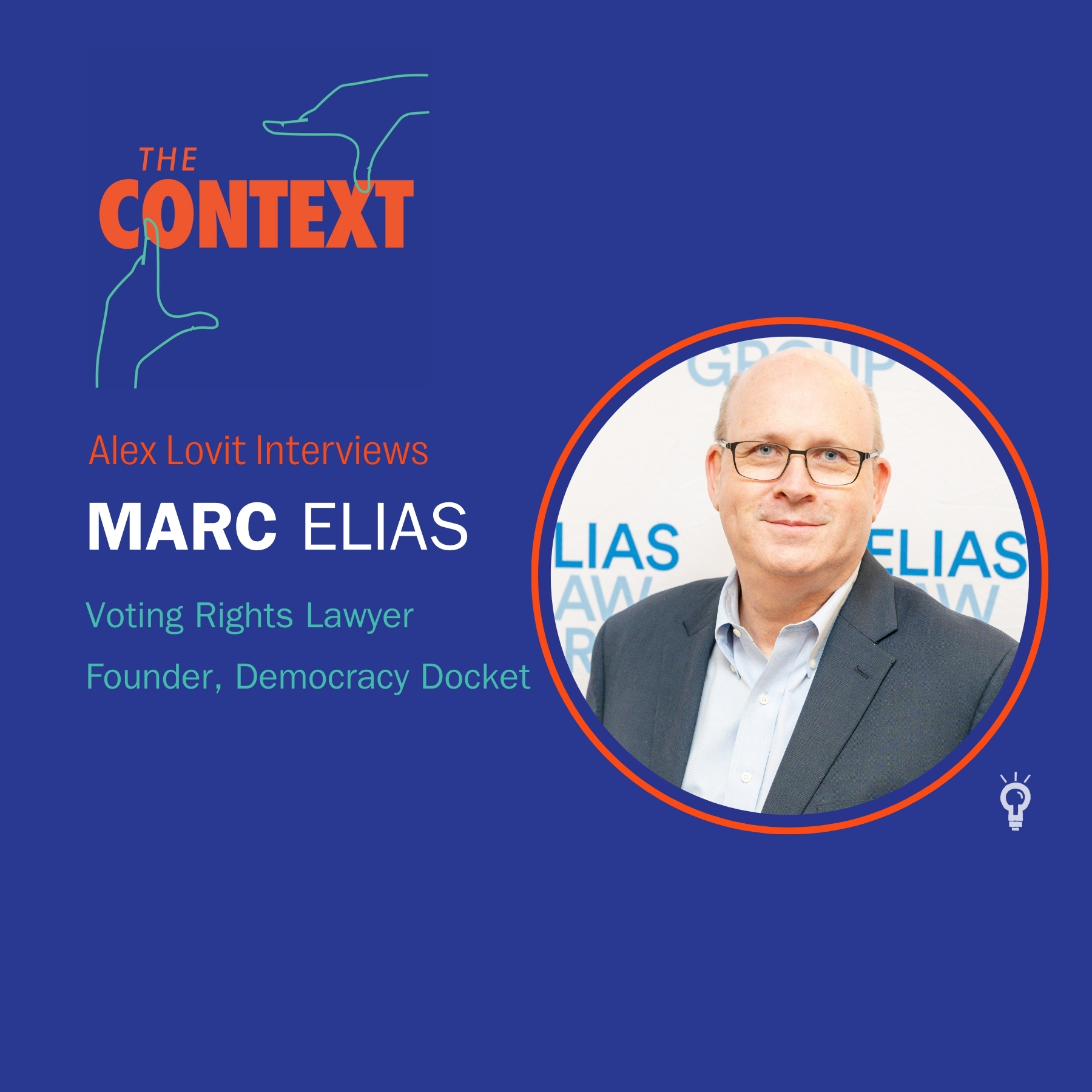
The decisions judges make during the coming months in various active legal cases will affect who can vote, which districts they vote in, and what political advertising they see—among many other factors. What’s at stake is not just the outcomes of this year’s elections but also the future integrity of democracy in the US. Voting rights attorney Marc Elias joins host Alex Lovit to discuss threats to ballot access in the United States, how lawyers are fighting back, and what the rest of us can do to help.
Marc Elias is one of the most experienced and prominent voting rights lawyers in the country. He is the founder of the Elias Law Group and the voting rights media platform, Democracy Docket.
Share Episode
Can the Courts Protect the Ballot?
The decisions judges make during the coming months in various active legal cases will affect who can vote, which districts they vote in, and what political advertising they see—among many other factors. What’s at stake is not just the outcomes of this year’s elections but also the future integrity of democracy in the US. Voting rights attorney Marc Elias joins host Alex Lovit to discuss threats to ballot access in the United States, how lawyers are fighting back, and what the rest of us can do to help.
Marc Elias is one of the most experienced and prominent voting rights lawyers in the country. He is the founder of the Elias Law Group and the voting rights media platform, Democracy Docket.
Share Episode
Can the Courts Protect the Ballot?
Listen & Subscribe
The decisions judges make during the coming months in various active legal cases will affect who can vote, which districts they vote in, and what political advertising they see—among many other factors. What’s at stake is not just the outcomes of this year’s elections but also the future integrity of democracy in the US. Voting rights attorney Marc Elias joins host Alex Lovit to discuss threats to ballot access in the United States, how lawyers are fighting back, and what the rest of us can do to help.
Marc Elias is one of the most experienced and prominent voting rights lawyers in the country. He is the founder of the Elias Law Group and the voting rights media platform, Democracy Docket.
Alex Lovit: Right now in courtrooms across America, cases are being argued that could determine the outcome of this November’s elections before a single vote is cast. There are active court cases about how voting districts get drawn, whether your voter registration data is kept private, who can donate how much to candidates. The cases are underway at every level of the judicial system from the Supreme Court on down. What’s at stake here is big, control of the US Congress, but it even goes beyond that. Democracies depend on the integrity of their elections. The US doesn’t have a perfect track record at that, but today we’re seeing existential threats to voting rights. Without lawyers to stand up for our democracy, it might not survive. You’re listening to The Context. It’s a show from the Charles F. Kettering Foundation about how to get democracy to work for everyone, and why that’s so hard to do.
I’m your host, Alex Lovit. My guest today is Marc Elias. Marc is one of the most experienced and prominent voting rights lawyers in this country. He’s the founder of the Elias Law Group, and the Voting Rights Media Platform, Democracy Docket. Marc and the organizations he works with are involved in dozens of the most consequential election law cases right now. He’s going to tell us why they matter, where they stand, and what he expects will happen to our democracy in this year’s elections and beyond.
Marc Elias, welcome to The Context.
Marc Elias: Thank you for having me.
Alex Lovit: So this is an election year, and you know American election law about as well as anyone on this planet. It would be nice if you were about to tell me that there’s no problem, everything’s fine. We’re going to have a nice free and fair election. I think that’s not what you’re about to tell me. To start off, tell me two or three of the most important open legal cases that might have implications for this year’s election.
Marc Elias: Sure. So there are actually a number. Probably the biggest category, and it’s not one case, it’s a series of cases, involve the voter files that states maintain. So every state maintains a list of everyone who has ever registered in the state to vote, everyone who has voted. It includes your name, your social security number, your date of birth, your address, in states with partisan registration, whether you’re a registered Democrat or Republican. It’s a lot of information. And the Department of Justice has sought that information in all 50 states. And there are 24 states, including the District of Columbia, that have refused to turn it over. And there is litigation going on in all 24 of those states. So I’d put that probably as number one.
Beyond that, I think there are a series of cases that have been argued before the US Supreme Court. There is the Louisiana redistricting case, which could result in a curtailment or overturning of the Voting Rights Act. And that’s obviously a very important one, but there are others. There’s a very important campaign finance case that I argued in the Supreme Court in December, that could dramatically increase the amount of money that goes from parties to candidates. So there is no shortage of litigation and there’s no shortage of important cases.
Alex Lovit: Well, let’s start with those three. So in the cases about the Trump administration has requested data, voter data from all 50 states. What’s at stake here? Why does this matter?
Marc Elias: Yeah. So the reason why I list that number one, and my law firm and I are actually involved in litigating in each and every one of those cases against the Department of Justice, is because if you want to do anything in elections, you need to start with a data set. When you talk about campaigns that have done successful get out the vote, you can’t do that work if you don’t know who the people are. The problem is, it is also true that if you want to suppress the vote, if you want to target black voters and make it harder for them to vote, if you want to target college students and disenfranchise them, if you want to target any group, you need to know who they are.
And so there are people like me who are gravely worried that the Department of Justice, that has never before collected this information, now all of a sudden, it’s an administration of people who have denied the outcome of previous elections, that their effort to collect this information, the concern is, and it’s a concern I have, is a prelude to some action by the Department of Justice or this administration to target at scale, large numbers of voters for either disenfranchisement or suppression, or in the post-election to have their ballots discarded.
Alex Lovit: So how would they use that data to do that?
Marc Elias: Sure. So let’s take the easiest example. Let’s say you want to launch a challenge to disenfranchise 100,000 Democrats. Okay. We’ll put it in a partisan context, but you could put it in any context. Well, the first thing you need to know is who they are. Then you can figure out what characteristics they may share in common. For example, they may all vote by mail, or you may be able to find 100,000 of them who vote by mail. And then you target a category of people who vote by mail who share a common characteristic. This is not a hypothetical. In the 2024 post-election, in the state of North Carolina, there was an effort by the losing judicial candidate for State Supreme Court and the Republican Party who supported him to disenfranchise 100,000 voters. 100,000 voters in North Carolina who had all followed the state law, followed the county rules, followed the instructions they got. But after the election was over, they said, “We want to disenfranchise them essentially retroactively.”
And they were only huddled in three heavily Democratic counties. So this was not evenly distributed among all the population. So that’s an example of where it was targeted geographically to affect a partisan outcome, but you couldn’t do that without the voter file. And so those kinds of bad acts that I have been fighting in my legal career now for decades, I’m used to fighting against right-wing organizations that are doing this. It’s quite a different thing though, and this is why my alarm is so high. If the person doing it is not some right-wing organization, but is in fact the Department of Justice, it’s the people who when they walk into the courtroom, the judges say, “Oh, you’re here on behalf of the United States.” It’s just a different dynamic. And that is what I’m most worried about.
Alex Lovit: Help us understand where that stands right now. So you’re saying a number of states are refusing to turn over the data and are therefore being sued. I believe some states have turned over the data, and this is complicated because it’s 50 different states. But what are the chances that these court cases are going to be resolved in time for the 2026 election, and how might that impact the election?
Marc Elias: Yeah. So we don’t have perfect information on all 50 states. That’s a hard group to track exactly, because the state could turn it over and not publicly say they’ve turned it over, but we know that there are on the order of 10 or a dozen states, let’s just say, who have turned that data over. We then know for sure, because they have been sued. Like I said, there are 23, 24 states that have been sued for failing to turn it over. In the group that has refused to turn it over, there have been a handful of court decisions. They have all right now broken against the administration, although again, it’s just a handful of cases, and the Department of Justice has said they will appeal them.
So that raises the question that you ultimately ask, which is like, does this all get resolved for 2026? And I think the answer is sort of yes and sort of no. For the states obviously that have turned it over, that gets resolved. They have that data. In the states that haven’t turned it over, at some point in the calendar, it just becomes too late for the data to be collected, turned over and used for 2026. If you made me guess, I would say that for 2026, they will not get all of the data from all the states. They will get the data from some of the states and it will be a bit of a hodgepodge.
Alex Lovit: But even in the best case scenario, we know some states have already turned over that data, and some of the things you’re worried about may still happen?
Marc Elias: Yeah. And that’s really important because I think a lot of people live in this frame of reference in which they say, “Well, what about the swing states?” In other words, too many Americans live in a worldview that there are only seven or eight states that matter, and that is wrong for three reasons. First of all, it’s terrible for democracy. Someone having their right to vote denied, does not become more or less tragic based on whether they live in a presidential swing state. That’s number one.
Number two, bad ideas travel. So it’s not like something bad happens in the state that you are less interested in and it just stays there. Good ideas travel, bad ideas travel, so you should care about everywhere. And then finally, if neither of those convince you, and you’re just someone out there who’s like, “Look, that’s all well and good. You’re talking about democracy, but all I really care about are the midterm elections in 2026.” Well, in midterm elections, there aren’t just seven states with House elections. There are 50 states with House elections. So I worry a lot about the 10 states that have turned it over because there are a lot of house seats in those states.
Alex Lovit: Let’s get to your number two most important case, which was Louisiana versus Kelley. This is the Voting Rights Act case. I think most observers expect the Supreme Court to overturn Section II of the Voting Rights Act. So I guess one, is that also what you expect? And two, what is Section II of the Voting Rights Act? Why does that matter?
Marc Elias: Yeah. So I think that they will overturn Section II of the Voting Rights Act. I hope they don’t, just to be clear, but I think they will effectively gut Section II of the Voting Rights Act. And what it basically does is protects minority voters from vote dilution. What it basically says is to states, “Look, if you are drawing redistricting maps that are diluting minority voting strength, and you have a history of doing this kind of thing, and that there is an inability of minority voters to elect their candidates of choice because you have highly racially polarized voting. The black candidate of choice or the Latino candidate choice will never win because the surrounding white population will never support their candidate. So if you have those circumstances and there is the ability to draw districts to remedy that, the state has an obligation to do so.”
And this has meant a revolution for black voters, particularly in the deep south, and for Latino voters in states like Texas. This has enabled black voters in states like Alabama, and Mississippi, and Louisiana, and Georgia, and South Carolina to elect candidates that otherwise they’d never be able to elect because the surrounding white population wouldn’t let them. It will be an absolute travesty, and an absolute gutting of our commitment to democracy if and when the Supreme Court does away with this. Because what it will mean is that these states will now be able to do away with these districts that have given black voters, given Latino voters, given Asian-American voters, the ability to elect their candidate of choice and therefore be included in democracy.
Alex Lovit: Yeah. And I’m glad you framed it that way around minority voters being able to elect candidates of their choice. I think often in the media, this is framed around partisan advantage. It will have partisan effects, but fundamentally Section II is about protecting the right of voters of color to fully participate in our democracy.
Marc Elias: Yes. And it is, as you say, about the voters. You’re right, it’s not about partisanship, but it’s also not about elected officials. It does not say to a black representative or a Latino representative that you have some special right. No, it’s up to the voters. It’s a protection of the people to cast a ballot and not have that ballot worth less because of the circumstances of the way in which districts are drawn.
Alex Lovit: So as you said, you hope that the Supreme Court does not overturn this, but you expect that probably will happen. Do you have any expectations of the timing of that? Will that happen in time to affect this year’s election?
Marc Elias: You have asked the question that everybody wants to know the answer to, and I wish I could tell you I knew the answer, but I don’t. I will say that we are starting to get to the point where it will be practically impossible for states to redraw their maps for 2026. Some states have very early primaries, so it’s probably too late to redraw a map, because your primary ballots may have already been printed. On the other hand, some states have relatively late primaries. You may have an August primary. So it may not be a one size fits all in every state, depending on when it comes out. I think the closer it comes out to the end of the term, the less likely states are to redraw their maps. The earlier, the more states may be able to.
Alex Lovit: Would it change how you think of the Supreme Court if they issue this exact same ruling in March versus June?
Marc Elias: No. Fundamentally, the job of the federal courts are to protect federal rights, federal statutory rights, federal constitutional rights. It will be cold comfort to say that the voters of Louisiana may be spared one more year, but the price of that is that in the next go around, they’re not protected. So I don’t want to give a half gold star to the court for doing something, if it does it, that is destroying what we once called the crown jewel of American democracy.
Alex Lovit: Well, fair enough. Let me ask about number three on your list of most important cases, which was, I think, NRSC versus the FEC. So first of all, what do those things stand for? What’s at stake here?
Marc Elias: NRSC stands for the National Republican Senatorial Committee. So this is a case in which the Republican Senatorial Committee, along with some others, are challenging a limit on the amount of money they can spend in direct coordination with candidates they want to support.
Alex Lovit: Help me understand the stakes here, because the way I understand the current state of campaign finance in the United States is, effectively there is unlimited anonymous campaign spending. It has to be through PACs rather than directly through the parties. So how would this change things and how would this make things worse?
Marc Elias: So I get this question a lot because there are people who say, “Look, there’s already a broken campaign finance system.” The original campaign finance system that we currently have in place was passed in the early 1970s. The seminal case that upheld the majority of it was a case called Buckley versus Valeo. And what the Supreme Court said there was essentially, we are going to let Congress and states regulate the amount of money that is contributed to candidates. We’re not going to allow you to regulate the amount of money that is spent independently of the candidate.
So if you want to give money to a candidate, we are going to limit you to $3,500. At that point, it was actually $1,000. But if you want to spend your own money independently to the candidate, it’s unlimited. There are lots of reasons to fault that distinction. There are lots of reasons to decry what the campaign finance system has become, but that distinction is what prevents the coordination of that dark money that you just said already exists. This would be the first time the Supreme Court has struck down a contribution limit to candidates. This would basically overturn the very pillar that is preventing all coordinated spending with candidates.
Alex Lovit: Well, that sounds pretty bad.
Marc Elias: I know. So far I haven’t given you any good news. Think about it. We’re 0 for three on good news.
Alex Lovit: And we expect a decision in this term, which means before the end of June, which means in the middle of a campaign season. So what happens if the campaign finance system has changed in the middle of a campaign?
Marc Elias: Yeah. So unlike the Voting Rights Act case, it might depend on the state based on the timing, this will be an on/off switch. The moment the Supreme Court rules on a campaign finance law, if it says it’s unconstitutional, then it’s unconstitutional. It’s all of its applications. So I think you would see an even bigger flood of money into the political parties, from the political parties into candidates. I think you would, as a result, see more television ads. And then you’d see the second order, third order effects. And I really want to emphasize this.
As a narrow matter, it just means the political parties will spend more money and there’ll be more television ads by political parties. But it will have this second order and third order effect very quickly, of just pulling out a bunch of threads of this tapestry that is our campaign finance system. And at some point you pull out so many threads, there’s just nothing left. All you’ve got is a bunch of threads on the floor. You no longer have a tapestry. And I think this may be that case.
Alex Lovit: Well, so as you said, we’re 0 for three on good news. And as you said also, these are not the only three cases that matter. Let’s see here. There’s court cases about the postmark policy, about when ballots need to be postmarked.
Marc Elias: Yeah, this is the Watson versus Mississippi case. This is a case I’m also involved in litigating. The Supreme Court will hear oral arguments in this case on March 23rd. And at issue is whether ballots that are postmarked by election day, mail-in ballots that are postmarked by election day can be counted even if they arrive at the election office a few days later. About half the states say you can and half the states say you can’t. And the Republican National Committee is suing to say that all the states that allow these ballots to count have to stop allowing them to count. This is a very big deal for a few reasons. The people who would be most impacted if the answer was no, in other words, if the RNC gets its way, overwhelmingly young voters cast their ballots later than older voters, it would affect young voters, it would affect lower income voters.
So it would have a impact for sure on certain populations more than others. It would also, since their theory is that the national election day law that requires elections to be held on the Tuesday following the first Monday in November, that these ballots that come in after that day violate that law. Well, if you take that to its logical next step, that would also ban early voting, and it would potentially ban all mail-in voting. So this is a bit of a stalking horse by the RNC. I’m proud that we represent a group of nonprofit clients. We intervened in this in the trial court and we have obviously briefed it fully in the Supreme Court.
Alex Lovit: Well, so too soon to say what the outcome and that will be, good luck to you. We’ll keep the score at 0 for three.
Marc Elias: I think we’re going to win that case.
Alex Lovit: Well, okay. That’ll be one for four.
Marc Elias: Yep.
Alex Lovit: Redistricting. A lot of mid-decade redistricting in a number of states has been widely reported in the news, some ongoing litigation there. Where do we stand with that? What’s locked in? What still might change?
Marc Elias: Here, it’s really hard to look at it other than through a partisan frame, because essentially Donald Trump reopened mid-cycle redistricting, which probably in my view shouldn’t be allowed, but here you go. In fact, my law firm, we sued Texas over their mid-cycle redistricting, and argued that it shouldn’t be allowed, and we lost in the Supreme Court. But essentially a Texas redrawn map got five Republican seats or seats that are likely to perform Republican, although let’s see how that plays out. California passed a new map through ballot initiative that would add five Democratic seats again, depending on the results of the elections. Republicans then gerrymandered one additional seat in North Carolina, one additional seat in Missouri. There’s ongoing litigation in New York. There’s ongoing litigation in Utah that could swing districts the other way.
As I look at it, it’s basically a wash. If you told me I had to pick a number, I’d say net-net, Democrats will gain one seat from the back and forth. But I don’t think there’s going to be a big partisan advantage one way or the other. What you’re going to have is a lot fewer competitive seats across the country. Let
Alex Lovit: Me ask about one more set of legal questions. There’s been a big push on the part of the Republican Party and the Trump administration to require proof of citizenship for voting. This was initially an executive order by Trump. There’s also proposed legislation that US Congress could pass, and then it’s also being passed in a number of states. Where does that stand? Who has the legal authority to mandate that and who doesn’t?
Marc Elias: Yeah. So I’m glad you asked that last question first. So Donald Trump tried to do some of this by executive order. My law firm sued and we won. In that decision, the trial judge said explicitly, the President of the United States has no role in the setting of election rules for federal elections. And that’s really important for people to stay grounded in, because Donald Trump periodically acts as if he does have a role or even says that he has a role. And the Constitution is very clear. Congress can pass legislation, but not the president. The Republicans in Congress are trying to pass legislation. That would dramatically scale back on the ability of people to register to vote and to vote. It is the Save America Act. The name periodically gets slight derivations, but we’ll just call it the Save America Act. And what these bills all have in common are some combination of a very strict photo ID requirement and what is called proof of citizenship.
And you’re right, individual states have then passed individual state proof of citizenship laws. We’ve been suing those states and actually winning most of those as we go along, but we’ll see, there are still a bunch of those cases ongoing. The problem is there isn’t a easy way to prove citizenship in this country. We don’t have a national ID card, and actually we don’t have a national ID card because both people on the left and people on the right historically are very allergic to national ID cards. To prove citizenship, you basically need a US passport, but most Americans don’t have US passports. US passports are not free. They’re not easy to get. If you don’t have a US passport, you can have an original or certified copy of your birth certificate. I ask you, how many of you out there have your original birth certificate? Most people, they’ve lost it, their parents lost it, they’ve misplaced it.
And if you need to get a new one, it’s not easy. I actually did this as an experiment with the state of New York where I was born, not an easy process. And then you get into the problem that if you have your birth certificate and you happen to have changed your name, as many married women have and other people as well, now your birth certificate actually doesn’t match the name on your other photo ID. And so now you’re down a whole other rabbit hole.
So the estimates of how many people this would disenfranchise range into the tens of millions. Yes, tens of millions of people would be disenfranchised by this. And so it is a terrible idea. Democrats thankfully can filibustered in the US Senate to prevent it from becoming federal law, but it’s entering the zeitgeist of the psyche, which is really what Donald Trump wants. Because what it does is sets up a permission structure come next November if he’s not happy with the outcome of the elections, for him to falsely claim that there is widespread non-citizen voting in this country, when in fact there is virtually no non-citizen voting in this country.
Alex Lovit: We’ve talked about a number of legal issues, open legal cases that could have an impact on this election. That doesn’t necessarily a full list of all the threats to a free and fair election.
Marc Elias: No, nor all the cases. My law firm alone are currently litigating 80 cases in 40 states.
Alex Lovit: Well, we’ll have to have you back on for part two. We’ll go through the rest of them. But let me ask about some other threats to this election. Trump has said he wants to nationalize the election. He wants Republicans to take over the election in 15 places. He mentioned Detroit, Atlanta, and Philadelphia as places that would be on that list. Those are all Democratic-leaning cities in otherwise competitive states. Two of those states have likely competitive Senate races this year. There’s the raid of the Fulton County Board of Elections Office by the FBI. That’s five years after the election’s already concluded. What happens if that’s one day after the election is concluded? What do you think when you hear this nationalized election? What does that mean? What should we be prepared for?
Marc Elias: The first thing I think is that you need to… And I think you did a good job. You need to contextualize the circumstances in which he said it and what he said around it. It can almost sound like what he wants is uniform standards. What he actually said is, Republicans should take over the voting. He didn’t even say take over the elections. He said, “Take over the voting.” And then he says, “15 places.” So I think we need to keep in mind that he’s not thinking of uniform standards. He’s actually thinking about different treatment of states and cities like the ones you listed, than other places.
The second thing you mentioned was the raid in Fulton County. And I think these two things are connected. In December of 2020, we learned afterwards, there was a meeting in the Oval Office with Donald Trump, and his advisors, and some election deniers, in which there was a pitch to him to sign an executive order that would order the Pentagon to go into certain places to seize ballots and election equipment and take over the vote counting. He didn’t sign it. And he didn’t sign it not because he didn’t want to. He didn’t sign it because the Department of Justice said, “This is crazy, you can’t do this.” And his White House counsel said, “This is crazy. You can’t do this.” There’s no more guardrails around him. And he, by the way, told the New York Times that he wished he had done it in 2020, but he wasn’t sure the National Guard was up for it. Well, he may have learned that maybe the National Guard’s not up for it, but ICE may be up for it. That’s one of the lessons.
But the second thing is, he just did it. He just did it in Fulton County. He just literally sent in, the administration sent in people to seize ballots in Fulton County. And sure, they were seizing ballots from the 2020 election. But make no mistake, that was an important breakpoint for democracy. This is the first time that you have had federal law enforcement seize ballots for an entire election in a county the size of Fulton County. And he learned a lot. He found, for example, that maybe the local US attorneys won’t be willing to do it, but there’s a US attorney in Missouri willing to do it. And what I’m really afraid of, is that one of the lessons that he may have learned is that he can desensitize the public to this. That it’s not quite as outrageous as it would be the first time if it happens a second time.
Alex Lovit: Let me ask one more question about a threat to elections this year. Steve Bannon said ICE would surround the polls this November. Is this something you’re worried about? What would this look like?
Marc Elias: I am very worried. I’m very worried. And for people who disingenuously say, “Well, it’s just to prevent non-citizens.” Tell that to the people in Minneapolis. Alex Pretti was shot and killed after he was thrown to the ground and beaten, and he’s a US citizen. Renee Goode was driving her car with the family dog in the backseat, with stuffed animals coming out of her glove compartment. She was shot and killed. She was a US citizen. The images that you see of the people being pepper sprayed at close range, of being insulted and sworn at by federal law enforcement, the people who are being told that if they videotape what’s going on, they will wind up in some database someplace. Those are all US citizens. There is nothing about the way in which ICE and the other federal law enforcement have been deployed by this administration in American cities, that suggests that they will be narrow in scope, and unobtrusive and unfailingly polite.
And so my fear is that whether ICE surrounds the polls, or is near the polls, the very behavior we are seeing caught on videotape, the very destructive, and intimidating, and disrespectful, and worse, fatal behaviors we are seeing is what is being set up for November of 2026. And we all need to be aware of it and we all need to prepare for it. And we all need to insist that it’s not okay. And I think if enough people of goodwill stand up and say, “This is not okay. And no matter who wins or loses an election, we can’t have this.” We might actually prevent it from happening.
Alex Lovit: So what would you want people to do?
Marc Elias: So the message people need to walk away with is not a hopeless one. When I do these podcasts and people are like, “It’s all doom and gloom.” Because I’m actually not giving you doom and gloom. I’m actually telling you what I think is going to happen, but that doesn’t mean it has to happen. We’re not without recourse. The biggest thing anyone and all of us can do is to speak out. Donald Trump wants you to be afraid. Authoritarians want you to think you are powerless. People who want to subvert free and fair elections want you to be cynical that there can ever be free and fair elections.
So the thing we can all do is to stand up in public and say, “This is not okay.” We can tell our friends and our family, our neighbors, our bridge club, our book club, people at the local diner, we can tell them that we insist that there be fair and fair elections, that these are some of the challenges that are in front of us, but that people need to check their voter registration, make sure they’re registered. They need to know what documentation they need to vote in their jurisdiction. We can lament that they need it, but they should know what it is and they should get it. And they should speak out about the deployment of ICE, and say that they don’t want them around elections in their communities. They can call their state legislators. Whether those legislators are Democrats or Republicans, doesn’t matter. It doesn’t matter whether they are staunch supporters of voting rights or staunch opponents.
There is no elected official who does not care when they get calls in their office in favor of opposing certain policies. So call your members of Congress, call your state legislators, make sure you’re registered to vote. And most importantly, like I said, stand up. Don’t be afraid. Be as brave as the people in Minnesota have been in insisting that we have free and fair elections, and stand for nothing less.
Alex Lovit: A lot of this conversation has been about this upcoming election, and trying as best we can to keep it free and fair. And I think that’s appropriate right now. But there’s a lot of long-term problems. Gerrymandering, in recent elections, somewhere between nine and 18% of US House districts have been competitive depending on how you define competitive. So that means somewhere between 82% and 91% of American voters do not live in a district where their vote for US House really matters. And that’s going to get worse. That’s getting worse right now with these redistricting cases. Distrust in elections might be misguided, but it’s real. Campaign spending, the amount of campaign spending in the US is dozens of times higher than in most comparable democracies.
So if we get through 2026 with democracy intact, and let’s say the candidate of your choice wins in 2028, whoever that may be, and they call you in to the Oval Office, and this actually might happen, given your prominence, and say, “Mark, what do I do? How do we fix American democracy in the longer term?” Do you have advice?
Marc Elias: I do. I think the first thing I tell people on the left is we need to get over nostalgia. Too much of what we think we want to do is restorative. And after four years of this administration, there won’t be a lot of that stuff to restore. And so rather than lamenting what was destroyed and trying to rebuild it, we need to realize what was destroyed gives us an opportunity to build something new, and build something stronger. So you mentioned the campaign finance system. At some point, and I hope I win my case and I hope my predictions are wrong, but at some point, rather than trying to hold up Buckley V. Valeo, which has been pulled apart, just pass a new law. Start over.
I was a big supporter of the various voting bills that Democrats proposed when they controlled the House and Senate and the White House, including the John Lewis Voting Rights Advancement Act. But we can do better than simply trying to restore a Voting Rights Act that was passed in 1965. We should be thinking bolder and bigger about what the future is around our jurisprudence around elections.
So I think the first thing I would tell the president is, we need to start with a blank piece of paper and sketch out what we want rather than what we think would bring us back to 2014. Because 2014 is not coming back, and it wasn’t great when we were there. We can do better. The single biggest thing that I would tell any president is we need a law, preferably a constitutional amendment, that puts the right to vote on the same playing field with all of the rights. We’re told that the Second Amendment, I’m not a big Second Amendment guy, but we’re told by the people who are that it is an absolute right, and that the practicalities of it be damned. We are told by the First Amendment advocates, and I am a First Amendment advocate, that the practicalities of it don’t matter. The most important thing is the right to express yourself with very limited exceptions.
But when we come to the right to vote, when I litigate right to vote cases, the first thing I get back is, “Well, what you propose would be very inconvenient for the election officials.” I’m sorry, what? I’m worried about the convenience of the election officials? Our entire approach to elections has been to put the convenience of election officials above that of the voters. So most of the things that I would tell them to do would be to center the voters. I’ve proposed a bill that blue states could adopt today. Congress could adopt it today, that I direct the president to adopt, which is to guarantee every voter in America does not wait more than 30 minutes in line to vote. And if they do, the state pays them for their time.
The state pays them for their time. Don’t make excuses for the long lines. If there are long lines, that’s not a failure of the voters, that’s a failure of the state. And they should not be allowed to run another election with the same set of parameters that caused the lines the last time. Because what happens with long lines, and you know this, is the people who wind up waiting in long lines are poorer voters rather than richer. They are younger, rather than older, and they are disproportionately minority voters. The way it works now is everyone says, “Oh, there’s long lines. Look at the people waiting in line. Look how heroic that is. Look at how committed to democracy they are.” No, they’re not committed to democracy. They’re stuck in a long line.
And so I really think we just need to reframe our approach to these things and really be just voter-centric. I don’t believe that anyone should be allowed to challenge your right to vote. Why do we have this system where a random person can go to your county election office, Alex, and say, “You’re not eligible to vote.” And now all of a sudden you have to go in a back and forth with the election official to prove you have the right to vote? We shouldn’t allow that. We need to be voter-centric rather than system-centric, election official-centric, or otherwise.
Alex Lovit: Marc Elias, thank you for everything you do to protect American democracy today, and I hope you’ll have the chance to help us perfect it in the future. And thank you for joining me on The Context.
Marc Elias: Thanks for having me.
Alex Lovit: The Context is a production of the Charles F. Kettering Foundation. Our producers are George Drake Jr and Emily Vaughn. Melinda Gilmore is our Director of Communications. The rest of our team includes Jamal Bell, Theo Clyburn, Jasmine O’Lari, and Darla Minich. We’ll be back in two weeks with another conversation about democracy. In the meantime, visit our website, kettering.org to learn more about the foundation or to sign up for our newsletter. If you have comments for the show, you can reach us at thecontext@kettering.org. If you like the show, leave us a rating or a review wherever you get your podcasts, or just tell a friend about us.
I’m Alex Lovit. I’m a Senior Program Officer and historian here at Kettering. Thanks for listening. The views and opinions expressed in this podcast are those of the host and guests. They’re not the views and opinions of the Kettering Foundation. The foundation’s support of this podcast is not an endorsement of its content.
This podcast is part of the Democracy Group.
More Episodes
 Published On: March 26, 2024
A devoted public servant, Maureen O’Connor discusses the importance of efficiency, fairness, and nonpartisanship in government. After years of witnessing and ruling...
 Published On: March 12, 2024
Throughout history, the rules and practices of American democracy have contradicted the nation’s democratic ideals. Kimberlé Crenshaw has dedicated her career to...
 Published On: February 27, 2024
J. Michael Luttig was one of the earliest, and most prominent, conservative voices to publicly condemn the effort to overturn the 2020...
 Published On: February 13, 2024
America’s institutions are not perfect, but they are essential to the functioning of the rule of law. James Comey shares his experience...
 Published On: January 30, 2024
The U.S. is less democratic than other established democracies in the world. Steven Levitsky discusses how structural reform is necessary to put...
