
In a Polarized Country, Latinos Are Still Making Up Their Minds
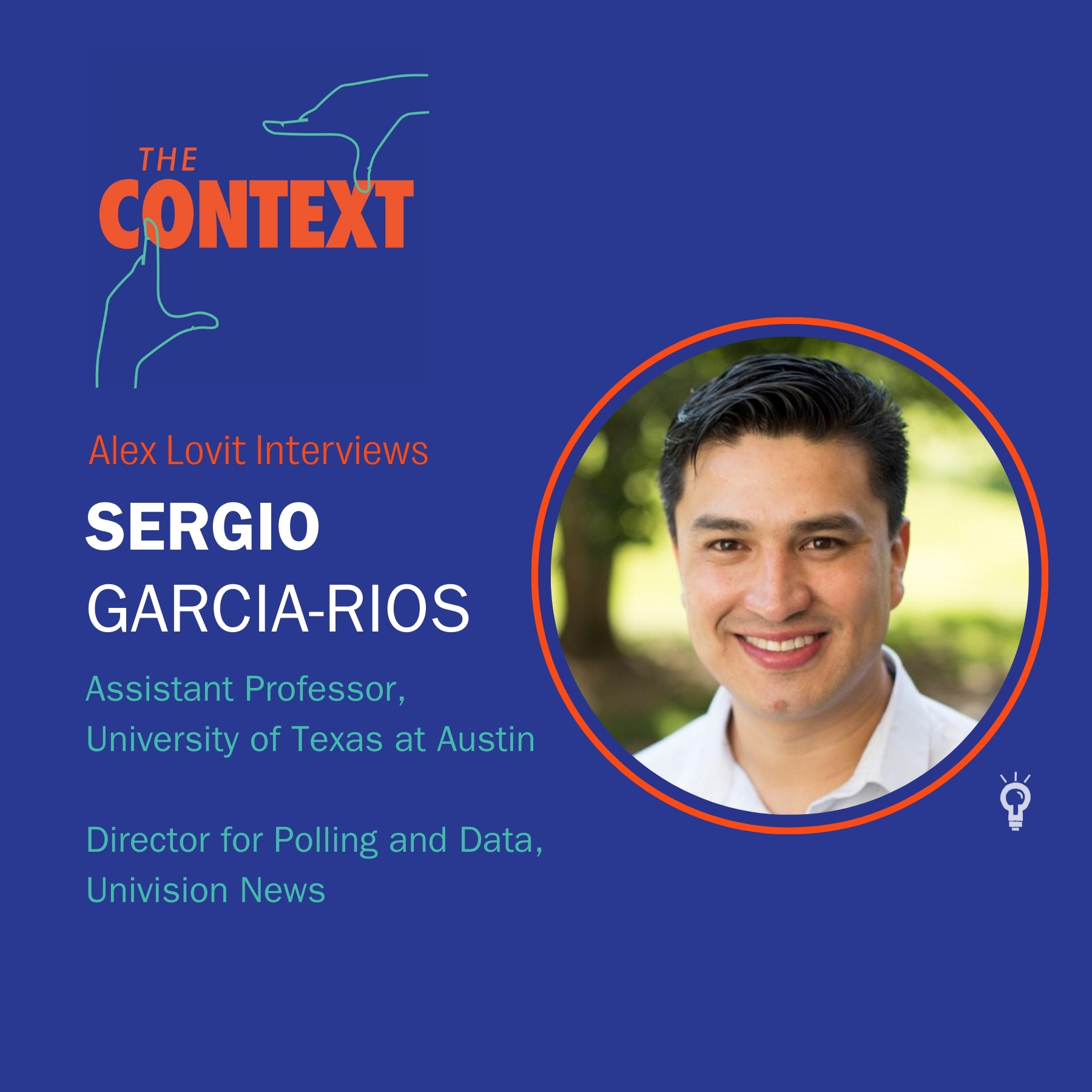
Latinos are the largest and fastest growing minority group in the United States, which means they have growing political influence. In recent elections, Latino voters have been split between the two major parties, with Republicans gaining significant vote share (though not quite a majority) in 2024. Sergio Garcia-Rios joins host Alex Lovit to discuss what Latino Americans want from their government and what to expect in upcoming elections.
Sergio Garcia-Rios is an assistant professor and the associate director for research at the Center for the Study of Race and Democracy at the LBJ School of Public Affairs, University of Texas at Austin. He is also the director for polling and data at Univision News.
Share Episode
In a Polarized Country, Latinos Are Still Making Up Their Minds
Latinos are the largest and fastest growing minority group in the United States, which means they have growing political influence. In recent elections, Latino voters have been split between the two major parties, with Republicans gaining significant vote share (though not quite a majority) in 2024. Sergio Garcia-Rios joins host Alex Lovit to discuss what Latino Americans want from their government and what to expect in upcoming elections.
Sergio Garcia-Rios is an assistant professor and the associate director for research at the Center for the Study of Race and Democracy at the LBJ School of Public Affairs, University of Texas at Austin. He is also the director for polling and data at Univision News.
Share Episode
In a Polarized Country, Latinos Are Still Making Up Their Minds
Listen & Subscribe
Latinos are the largest and fastest growing minority group in the United States, which means they have growing political influence. In recent elections, Latino voters have been split between the two major parties, with Republicans gaining significant vote share (though not quite a majority) in 2024. Sergio Garcia-Rios joins host Alex Lovit to discuss what Latino Americans want from their government and what to expect in upcoming elections.
Sergio Garcia-Rios is an assistant professor and the associate director for research at the Center for the Study of Race and Democracy at the LBJ School of Public Affairs, University of Texas at Austin. He is also the director for polling and data at Univision News.
Alex Lovit: Latinos are the fastest-growing demographic group in the United States. Just a couple decades ago in 2004, about one in every 17 voters in the presidential election were Latino. By this last presidential election, they’d grown to be one out of every seven. So clearly, Latinos have growing political power in our democracy, which means they’ll play a growing role in answering some of the big questions our country is facing at this point in our history, like, “How Democratic will our government be going forward? And how inclusive will our society be?” But unlike many other racial and ethnic groups in the US, Latino voters don’t vote consistently red or blue from election to election. Why is that? And what do the experts on Latino voters think we can expect in this November’s midterms?
You’re listening to The Context. It’s a show from the Charles F. Kettering Foundation about how to get democracy to work for everyone, and why that’s so hard to do. I’m your host, Alex Lovit. My guest today is Sergio Garcia-Rios. He’s an assistant professor at the LBJ School for Public Affairs at the University of Texas at Austin, where he’s also the associate director for research at the Center for the Study of Race and Democracy. Sergio helps to design and direct survey research, studying Latino public opinion with Univision News as their director for polling and data. He and his team have talked to thousands of Latinos about how they voted, how they think about politics, and what they want from their government. Today, he’ll tell us what he’s learned.
Sergio Garcia-Rios, welcome to The Context.
Sergio Garcia-Rios: Well, thank you for the invitation. I’m excited to be here.
Alex Lovit: We’re going to be talking a lot about Latinos today and Latino voting behavior, but just because two people check the Latino box on the census form, it doesn’t mean that it means the same thing to them, that it’s equally important to them, that they think about discrimination in the same way. So as a political scientist, how do you think about those variations and how do you measure them?
Sergio Garcia-Rios: Well, that’s exactly the way that we need to think about it. I often tell my students to think myself about it in terms of a matrix. And this is really everyone, we have different cells in that matrix, different squares that will describe you. But for Latinos, that matrix is probably even much more complex. You have your country origin, your generation, your immigration status, and then everything else that affects everyone else in terms of political behavior, age, gender, income, education. But then when you add altogether, that matrix gets much more complicated than the average American voter. And so that’s exactly right, just because someone checks that box, if they check that box, it doesn’t mean that the two Latino voters are identical.
Alex Lovit: So you’re talking about some things there that are kind of Latino-specific, which would be country of origin or heritage, how many generations they’ve been in the United States, that kind of thing. But then also factors that apply to everyone, age, gender, education level. So if you were trying to guess someone’s political affiliation and you could only ask a few demographic questions, what would be the top questions you would ask, and would they be any different for Latinos than for anyone else?
Sergio Garcia-Rios: It will be much more complex. It wouldn’t be different. I think if I know your age, your gender, socioeconomic status, where you live, I’m pretty much there with those three. And if it’s Latino, if I know your country of origin and language at home, I’m probably closer. But I call all of those part of your identity portfolio. All those identities that I’ve just got from this description gets me closer to knowing who you are. But with Latinos, the way that I’ve been understanding behavior lately, is that it’s getting more and more complex. And I think it’s probably been always this complex, but now I want to know what’s your top issue? What do you care the most about? And that really gets me there. Once I know what is the thing that you care the most about, I probably know who you’re voting for and who else in your family is voting for.
What you care about, it’s been changing election to election. And so I think now we need to understand Latinos, and this is where we’re getting lost in understanding Latino behavior, is that Latinos probably have, and this is a comparison to the general voter, is that Latinos are still being moved a lot by issues, much more than party affiliation or party loyalties.
Alex Lovit: So if I’m a political party or if I’m a candidate running for office, I think I would look at Latino population in the United States and I would say this is a large and growing population, a growing segment of the voting public, and I would think also that maybe partisan identities aren’t totally solidified. Some of that might just be age. Part of being a growing segment of the population is also Latinos are disproportionately young. Older people tend to get pretty locked into their political affiliations. So if I’m a political party, I’m looking at Latinos as a target demographics I’m going to go after and try to win their votes. Is that how political parties are seeing Latinos, and what are they doing about it?
Sergio Garcia-Rios: It’s not how they’re looking at Latinos.
Alex Lovit: Yeah?
Sergio Garcia-Rios: I think you mentioned age, and age is such a determinant factor. When you look at the youngest bracket, 18 to 29, 20% of the general voter is in that bracket. 20%. If you look at Latinos, that’s 31%. If you look at the next bracket, 30 to 45, that’s 32% the general population and then about 38% Latinos. So we do have a much younger Latino electorate. Now, that bracket is going to move. We know young voters turn out a lower rates, but they’re getting older and they’re getting to the brackets where they vote more. And for a long time, Democrats understood or thought that immigration was the most important issue, and it was an important issue. It’s not that immigration is not important to Latinos, it’s that other issues and identities come to play and become much more salient than immigration.
I think that’s where many in the Latino electorate felt that they were not listening to their concerns, that they all show up and promise to fix the immigration system. You say that the immigration system was broken. We continue to hear this from both parties really. And Latinos heard that and say, “Yeah, we know that. You don’t need to tell us that. But then at the same time, I have these concerns. I want a better healthcare system,” or “I want better economy and I want better jobs. And so what of what you’re doing is going to make a difference in my life beyond immigration? It’s not that I don’t care about immigration, but I need to put food on the table.” And I think both parties have forget about that.
Alex Lovit: Do you think that there’s an opportunity for the political parties here? Is this something you would advise the Democratic or Republican Party to change their approach?
Sergio Garcia-Rios: Yeah, it starts by really addressing them directly. I heard this at a focus group when someone say that they don’t want to feel like they’re at the kids’ table. They don’t want the Latino message. They want to feel like they’re invited to the party. They don’t want to be invited to a party, they want to be invited to the party. When they hear that the main message is something and then all of a sudden I show up to your neighborhood and I tell you, “But for you, this is what I have.”
Alex Lovit: “I have immigration reform for you.”
Sergio Garcia-Rios: “I have immigration reform, but I haven’t talked about it in any other rally. But now I see brown faces and so this is what I’m going to promise.” It’s not that Latinos don’t want a specific message to them, it’s that they want that to be part of the message. Just talking, addressing them directly, feeling like really the message is coming to them, and it doesn’t have to be in Spanish. They don’t necessarily like that. It’s kind of a wash. Sometimes kind of distinct that if they say one or two words in Spanish, they’ll do it, and then they bring someone to sing Ranchero music. It’s not that language doesn’t matter, but just the intentionality of it.
The Democratic primaries when we had them last, I had the opportunity to be in Iowa at the time and attend some of the caucuses. And so there was this special remote caucus location. You are supposed to have your representative from the candidate and they’ll deliver a message. And so again, this is Iowa, Latinable presence is not that great. And the only candidate that had a message in Spanish was Bernie Sanders. And of course, Bernie Sanders won that particular location, but I think Bernie Sanders understood that he needed to go talk to Latinos where it mattered. But his message was affordable healthcare in general. So they heard this from the candidate in general, and then deliver in particular. So it’s those two things.
I think Republicans did something similar in the Texas Valley delivering the economic message. I think that’s part of what we saw this last election. The message wasn’t necessarily directed to Latinos, but Latinos understood a dynamic in terms of what they care about, which was the economy at that point, in the previous election. And so we saw trends that we had never seen before and everyone is surprised. And I hear the community, I do a lot of focus groups and they’re not surprised. They say, “Well, this is what we care about. No one listens.”
Alex Lovit: You’re talking there about this last election being a surprise for many people, and including for myself. What the surprise was, was a large increase in Republican voting among the Latino population, a shift from Democrat to Republican. I think a couple of caveats to say about that is, one, the whole point of democracy is everybody gets to decide, so no individual and certainly no demographic group is obligated to vote one way or the other. That’s what democracy is. And secondly, I think when we talk about a shift, that’s not the same thing as talking about what that overall population looks like. So if only Latinos had voted in 2024, Kamala Harris would be president right now. But there was this large shift. In 2012, more than 70% of Latinos voted for the Democrat, and in 2024, just over 50% voted for the Democrat. So that’s a 20 point shift over the span of a decade-ish.
And for a lot of white people like me, I’m looking at that, I’m saying, “Donald Trump, to me, he looks like he’s saying a lot of racist things. It looks to me like he’s saying a lot of racist things specifically about Latinos.” So that’s why I’m surprised. That’s a question I’m sure you’ve gotten before, but how do you tell that story?
Sergio Garcia-Rios: I think about this all the time, and I’ve been thinking about this for a long time, because to understand what happened in 2024, we need to understand what happened even before that. We understand the 2016 election, you call it racist, but I don’t think it was anti-Latino, because when Donald Trump started his campaign, he said, “Mexicans are sending drugs, they’re bringing crime, and some I assume are good people.” He didn’t say Colombian, Hondurans. He said Mexicans. And then some people say, “Well, he meant everyone.” He says, Mexicans thinking everyone is … And yeah, that might be the case, but that’s not the case for Latinos who understand themselves as being something very particular. And so I imagine this political scenario where the Colombian father is talking to the family and they’re assessing what’s going to happen in 2016. And then the younger daughter says, “Oh, we need to vote for Democrats because Trump is saying all of this.” And then father is saying, “Well, but he’s saying that about Mexicans. He never said that about us Colombians.”
And we show clearly that, statistically speaking, there’s a significant drop in support from Mexicans only and not so much from any other country. But then of course, it branches out and then it expands to all Latinos. We had this interesting experiment in Pennsylvania. You might remember this rally in the Madison Square Garden when some committee had made a joke about Puerto Rico saying that it was a floating island or garbage or something like that. Pennsylvania having a bunch of Puerto Rican voters that were in such an important state, so we went immediately on the field and we asked them, “Do you think that was racist? Were you offended?” And Puerto Ricans in Pennsylvania say, “Yes.” Three-quarters clearly saying, “That was offensive, that was racist. I’m not happy with what he say.”
But then later in the survey, we asked them a hypothetical scenario. We asked, “If you have two hypothetical candidates and one has clearly denounced racism, but doesn’t have a clear economic plan, and this other candidate has a clear economic plan, but has not really condemned racism openly.” And remember, three-quarters, 75%, 60% of people say, “Clearly this is bad.” But then when we presented that scenario, they weren’t that sure. All of a sudden they said, “Well, I don’t know.” Many say, “I don’t know. ” Many say, “Well, I’ll just vote for the one that has the clear path. It’s not that I’m not offended, but I’ll still vote for the one with the clear economic path.”
I’m not saying that Trump’s was the best economic plan, it’s what they believed, it’s what many voters believed. And if you think about hierarchies and needs and what matters for your life, you might be offended, but you know you need to bring food to the table, and I think that was a tough choice that many Latinos had to make.
Alex Lovit: You earlier said that if you’re trying to predict someone’s political position or maybe how they voted in the last election, you would ask what issues were most important to them. And it sounds like if they say the economy is the most important to them, that’s a predictor that they might trend Republican. What issues would a Democratic voter say?
Sergio Garcia-Rios: During the Democratic Convention, we did a large poll and that was an optic on voters reporting mass shootings, including people who are self-identifying as Republicans and identifying mass shootings as one of the top issues. We hadn’t seen that before. And this comes, of course, after Uvalde and El Paso and many other difficult moments for the Latino community, particularly El Paso, where Latinos were being targeted for being Latinos. I think that’s the first time that we see it so high up. And then abortion, I think, and this is why we saw a very drastic split in gender. It’s long been believed that Latinos don’t support abortion. I think that has changed actually. We have seen Latinos, especially young Latinos and Latinas, I have another paper where I show this, that abortion mobilized much more Latinos than immigration.
And so while Democrats continue to campaign on immigration, there was another issue right there that was top of mind for many Latinos and they didn’t campaign on that. On the other hand, Republicans did campaign on abortion, and so those who were already predisposed to vote Republican, they heard this message and were much more mobilized.
Alex Lovit: So a lot of the stuff you’re saying, Republican voters are motivated by economic issues, Democratic voters are motivated by reproductive rights, worries about gun violence, there being a gender split. These are all things that are true of Latinos, but they’re also true of the full American electorate. Are there significant differences that you see specifically for Latinos on those issues or are on any other issues?
Sergio Garcia-Rios: Healthcare. Healthcare continues to be much more of a concern than many others. In fact, on that Democratic Convention poll, 30% of voters say that it was one of their top three issues. 30%. A poll released by YouGov that same week showed that it was only 10% for the general voter. Latinos still lack in terms of coverage. In terms of immigration, I think it’s very complex for Latinos because they do want safe communities and they live in those communities that are often affected by drugs and other things, but they also are part of the community that is being targeted. And the reality is that Latinos understand that there are millions of undocumented criminals on the streets. It’s more likely that there are someone in their family who is just trying to get a job and support family, and they know those. And so I think even if the numbers show similar trends, which I think is still higher for Latinos, the support for immigration reform, it hits home differently, no pun intended.
Alex Lovit: I think everyone’s always curious about how the next election’s going to turn out, and Latinos are going to have a big say in that. We are seeing constant headlines about the Trump administration’s immigration enforcement, some of it very violent and authoritarian. Do you have a sense of how the average Latino, how much that is affecting them in their day-to-day life? Are people scared? Are people seeing friends and family being affected by this?
Sergio Garcia-Rios: Well, part of that, Alex, is that I myself know that there are certain parts of the country where I’m going to be detained just by looking the way that I look. I know that when we go to a conference internationally and then fly back, all of us professors, I’m the one that’s going to be sent to secondary inspection and that has nothing to do with my immigration status. This is the case for many Latinos. This is not just what we see on TV, it’s just that regardless of our immigration status, people who have been here for many generations, people who never crossed the border, but rather the border crossed their families, in Texas and other places, now they’re also being targeted and they can be stopped. And they’ll be let go, maybe, but this isn’t something that everyone has to worry about. So it does hit differently.
The problem with this too, is that Latinos in general feel like they haven’t really had an answer for Democrats either, and the Democrats have also sort of forgotten about them. At Univision, we’ve been conducting continued surveys since 2018 and we’ve been asking a question about whether Republicans or Democrats care about the Latino community. And so the options are whether they care, whether they don’t care, or whether that particular party is being hostile. And so they’ve always sort of felt that Democrats care more about them, but that number has been slipping away, to the point that the most recent poll, only 45% say that Democrats care about them. 45%. So, 55% believe that Democrats don’t care about them. And remember, over 60%, sometimes close to 70% of Latinos self-identify as Democrats. That means that there’s a big percentage, close to 30% that say, “I identify as Democrat, yet I know they don’t care about me.” And the gap of people feeling that they don’t care about them has been growing. And so this is, again, both Democrats and Republicans.
Only 31% feels that Republicans care about them. The percent of people thinking that Republicans are hostile is higher, 34%, but still a huge percentage of people feel like neither party care about them. And again, that is growing. And in big part, it’s because they feel that Democrats come around every election and say, “We know you care about these things. We know that you’re being targeted. We know that your communities feel threatened even if there’s nothing to hide,” but they don’t feel like there’s any answer. And so I think Latinos are at a point where they really feel that there’s no answers for them and they just deflect to whatever feels like the answer at that point in time, but not necessarily with party loyalty. And I think Latinos feel like they don’t owe loyalty to neither party.
Alex Lovit: I know predicting the future is a fool’s game, but you are looking at polling, you are seeing how opinion is shifting on some of these issues that were important in the last election. Obviously, immigration is part of that and how people are experiencing Trump’s crackdown. We talked a little bit about that. How about these other issues, the economy, abortion? Are people feeling about them the same way now that they did a year ago?
Sergio Garcia-Rios: No, now they care about Greenland. No, it continues to be the main issue, inflation. And the thing is, I’m from Mexico, my wife’s from Colombia, when we travel, especially Colombia, you get a sandwich for 5,000 Colombian pesos. That’s inflation, that’s the way it happens, and it rarely goes back. And so the thing is, that promise was very tough to really do something about, and how to make things affordable is going to be challenging. So that continues to be the main concern. Latinos are still not seeing, and everyone else is not saying, the big changes that they expected. Recently, we’ve seen reports about prices, in fact, going up. Food prices are going up. And I think that can be reversed immediately.
And so if we are into predicting the future, if that continues to be the trend, I don’t think they’re going to have the same support. Republicans are going to see the same numbers, and I think they know it. And I think Democrats know it too, but I don’t think Democrats, again, are doing enough to capitalize on that, because then what is it that you’re going to offer that I’m not getting right now? And that still hasn’t happened, and I don’t think the lesson has been learned.
Alex Lovit: So part of what will determine the future is how the political parties react and what those campaigns look like. I want to ask about a couple other issues that are not necessarily about what the parties are doing or not necessarily about public opinion, but just about the structure of elections. You’re in Texas, you study Texas pretty closely. This Texas mid-decade redistricting, new gerrymander has been a pretty big story nationwide, with California also getting in the redistricting game. Do you have a sense of how that’s going to affect house elections in Texas? Does public opinion even matter anymore? Is Texas so gerrymandered that it won’t matter?
Sergio Garcia-Rios: Yeah, that’s a great question and it’s an important question, and I think it’s going to be somewhat surprising for many. The first thing that we need to know about that plan when you look closely at the numbers, is that it does gerrymander some new Latinos. And because I think the expectation was because of public opinion and because of voting, that Latinos were shifting and leaning more towards Republican. But I think the Latino vote that they were projecting to be Republican, it’s going to be underwhelming for Republicans. I think it’s not going to be exactly what they expected, but the map is the map and it will still capture a lot of solid Republican vote from rural areas. And so gerrymandering is a problem everywhere. We all see it in New York by Democrats. And so unfortunately it is what it is, but I think the expectation that Latino was now turning Republican was vastly overcalculated. It’s not as solid as they expected.
And so public opinion matters in the sense that we need to understand that it shifts, that public opinion shifts. If you really pay attention to public opinion, that’s exactly what you see, that it changes and you need to be attentive to what’s happening, really month to month.
Alex Lovit: Yeah. So you’re saying that there’s limitations to how effective gerrymandering can be, especially when you’re dealing with a population that is shifting, because you can predict where they were last election but it might not be where they are next election. So we’ll see what the outcome is. I’m in Ohio. We also just had a mid-decade redistricting to give a few more seats to the Republican Party. Let me ask about the Voting Rights Act. The Voting Rights Act is passed in 1965, and we usually think of that in terms of the African American civil rights movement, and that is kind of what it came out of, but Latinos were also included in that, and other minorities.
And recently we’ve seen some changes in the Voting Rights Act. So the Supreme Court more than a decade ago now, overturned a portion of the Voting Rights Act that there were certain areas of the country that had history of discriminatory elections, voting policies, and the Voting Rights Act said, “Okay, you guys, we just don’t trust you. You’re going to come up with some creative way to limit Black voting. So we’re going to force you to put any election changes you want. You got to get approval from the federal government before you can do that.” Supreme Court said, “You can’t do that anymore.” Has that affected Latinos?
Sergio Garcia-Rios: Yeah, and we saw it pretty quickly. Many of these states immediately shifted and started making changes to their electoral system and many other changes. Voter ID laws, in particular have been implemented. We know there’s a bunch of research on this, that minorities tend to have less access to what they will consider an ID, including driver’s license, which for many people will sound like, “But everyone’s got a driver’s license.” So that’s actually not true. It was evident that immediately many of these states started making changes that have been detrimental to Latino community and other underrepresented communities.
Alex Lovit: And there’s a case in front of the Supreme Court right now, and a lot of court watchers think that they’re going to overturn another section of the Voting Rights Act, which is about gerrymandering, which we’ve just been discussing. The Voting Rights Act until now has prohibited basically the practice of, you dilute a minority vote, you spread them around so many districts that they don’t actually have electoral power. If that happens, if the Supreme Court does overturn that, how do you think that will affect districting regarding Latino populations?
Sergio Garcia-Rios: What we have in front of the Supreme Court right now really builds on this assumption that race and partisanship are not that tight. It is still so far, and hopefully continues to be, illegal to gerrymander on the basis of race, but the assumption now is that political gerrymandering is possible. And we have seen that really still, race determines many of your preferences. I develop a tool, a statistical tool with other colleagues to determine vote cohesion, and continues to be very consistent. People tend to vote consistently. Even if they cheat from one election to another, we can still safely assume that your positionality and your identities will predict your vote. So assuming that that’s no longer the case, it’s really trying to live in a world that’s still not possible in this country, where race really doesn’t affect your political preferences. That’s still pretty much present today. Erasing that part of the Voting Rights Act will set us back many, many years, and that’s unfortunate.
Alex Lovit: Let me ask about the upcoming election. I have a lot of concerns about the upcoming election, but among them are that maybe not everyone is going to feel safe and comfortable coming out to vote and participating. Is that something you’re concerned about with the Latino community?
Sergio Garcia-Rios: To a certain extent. A Lot of what I do academically builds on political psychology. There are parts of that research that will tell me some will be afraid and won’t turn up to vote. A big part of me tells me that those that are not turning out to vote will be not those that are scared, but rather those that are disappointed. And I’m concerned about that part, that they continue to feel that neither party is listening to them, that they’re not hearing answers from neither one, and that whatever they do, they really don’t have good choices. There’s a part of this research that will tell me that that fear can turn into energy and anger maybe, and then for them to turn out to vote.
But my main concern is disappointed with the system. All of these together, the fact that they’re not listening to me, the fact that I might feel prosecuted, I might feel targeted, is sending the message that whatever you think actually doesn’t matter. And so if we start to build consistently low turnout, we’re predicting low turnout moving ahead no matter what happens. And so it’s not just the midterm. I think for the general election we might see that same pattern. If I can venture to predict something, I want to be on the optimistic side. And I really have my own thoughts and preferences, but ultimately I want Latinos to go out and express their opinion. I might agree or disagree with that opinion, but I want them to vote. I’m choosing to be optimistic that that disappointment will turn into energy and will turn into really wanting to make their voices heard.
Alex Lovit: What do you think I should be worried about? I share your interest and I would like all Americans, and definitely including Latinos, to be able to fully participate in our democracy. What are the barriers to that? What should I be worried about?
Sergio Garcia-Rios: Well, I think beyond elections, I think probably everyone should be concerned about the institutional changes happening. The Voting Rights Act decisions can have permanent effects no matter who’s in power. Decisions of the Supreme Court are not permanent, but certainly here for years, many, many years. And so I think people are growingly distrustful of the system, and I’m worried that politicians want to capitalize on that distrust rather than alleviating and making them feel like the system works for them. That was one of the things that I first learned when I came to this country, how much people love their institutions and how much people felt proud about the system. And now I’m seeing the opposite, people are growing in dissatisfaction, and that’s tied to how those institutions are being changed and they’re being changed in the basis of distrust and instilling fear. And so regardless of electoral results, I think politicians continue to build political capital on the basis of fear, and I’m very concerned about that.
Alex Lovit: For Latinos and for all Americans.
Sergio Garcia-Rios: Yeah.
Alex Lovit: I think people need something to vote for and not just to vote against.
Sergio Garcia-Rios: That’s such a great point. That’s such a great point. And that actually probably sums up many of the things that I have said, that I think we have come to the point where elections are about voting against someone, on both sides. And when I say that Latinos just want to hear being invited to the party, they want to hear that there’s something to vote for and not vote against. We have asked this question and many, many voters voting for either party are voting against the other party, not so much for the candidate. And this is again, political psychology. We tend to have great attachments to the things we feel are good for us, much more than the things that we run away from. And so I think the opportunity is to build trust in saying, “This is what you’re attaching yourself to, it’s not what you’re running away from.”
Alex Lovit: Our politics could use a dash of hope, and you’ve given me some hope today, that our democracy is still alive. People are still participating and making up their minds. May that continue forever. Sergio Garcia-Rios, thank you for joining me on The Context.
Sergio Garcia-Rios: Thank you very much for the invitation. Really enjoyed it.
Alex Lovit: The context is a production of the Charles F. Kettering Foundation. Our producers are George Drake Jr. And Emily Vaughn. Melinda Gilmore is our director of communications. The rest of our team includes Jamal Bell, Teo Clyburn, Jasmine O’Lare, and Darla Minich. We’ll be back in two weeks with another conversation about democracy. In the meantime, visit our website, kettering.org, to learn more about the foundation or to sign up for our newsletter. If you have comments for the show, you can reach us at thecontext@kettering.org. If you like the show, leave us a rating or a review wherever you get your podcasts, or just tell a friend about us. I’m Alex Lovit. I’m a senior program officer and historian here at Kettering. Thanks for listening.
The views and opinions expressed in this podcast are those of the host and guests, they are not the views and opinions of the Kettering Foundation. The foundation’s support of this podcast is not an endorsement of its content.
Speaker 3: This podcast is part of the Democracy Group.
Jenna Spinelle: Hey, everyone. My name is Jenna Spinelle, and I host and produce a podcast called Democracy Works. It’s a collaboration between The McCourtney Institute for Democracy at Penn State, and WPSU, Central Pennsylvania’s NPR station. If you enjoy this podcast, I think you’ll like our show too. Every episode examines a different aspect of what it means to live in a democracy. Sometimes it’s big picture issues like neoliberalism or demagoguery, and other times it’s more on the ground topics like ranked choice of voting and how local news deserts are democracy deserts too. Some of our previous guests include Jonathan Haidt, Andrew Sullivan, and even Wynton Marsalis. So I hope you’ll check out Democracy Works. You can find it wherever you listen to podcasts.
More Episodes
 Published On: July 15, 2025
Americans are constantly arguing about politics—on the internet and at the family dinner table. But we rarely change one another’s minds, and...
 Published On: July 1, 2025
Voting rights are the foundation of democratic governance. But recent changes in elections policies have disenfranchised millions of Americans, and the voting...
 Published On: June 17, 2025
Juneteenth commemorates the end of slavery in the United States. Pulitzer Prize-winning historian Annette Gordon-Reed joins host Alex Lovit to discuss Juneteenth’s...
 Published On: June 3, 2025
Who should make decisions about what kinds of health care American minors can receive: their parents and doctors, or their state governments?...
 Published On: May 27, 2025
Pro-democracy progressives are their own worst enemy when it comes to recruiting conservative Americans to their cause. In part two of our...
 Published On: May 20, 2025
How did one of our major political parties abandon its principles? And what do voters make of that shift? Host Alex Lovit...
