
Saying No to Authority When Yes Is Easier
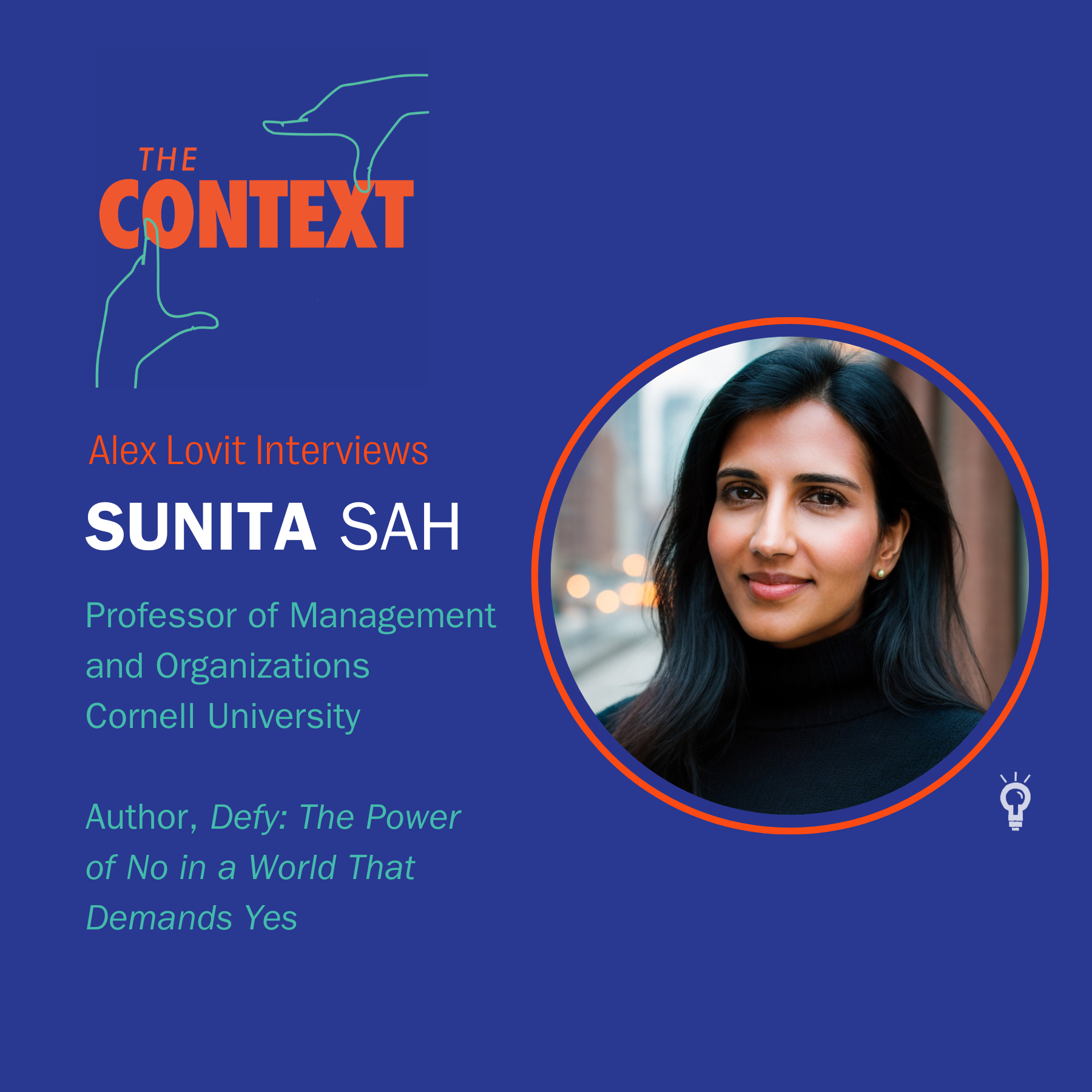
As the United States continues to experience democratic backsliding, people are looking for ways to rise to the moment. But what does it take for someone to stay true to their values and say, “no, I refuse to participate in this?” Organizational psychologist Sunita Sah joins host Alex Lovit to discuss why people have more trouble standing up to injustice than they think they will and how we can prepare ourselves to make difficult choices.
Sunita Sah is professor of management and organizations at Cornell University’s SC Johnson Graduate School of Management and the author of Defy: The Power of No in a World That Demands Yes.
Share Episode
Saying No to Authority When Yes Is Easier
As the United States continues to experience democratic backsliding, people are looking for ways to rise to the moment. But what does it take for someone to stay true to their values and say, “no, I refuse to participate in this?” Organizational psychologist Sunita Sah joins host Alex Lovit to discuss why people have more trouble standing up to injustice than they think they will and how we can prepare ourselves to make difficult choices.
Sunita Sah is professor of management and organizations at Cornell University’s SC Johnson Graduate School of Management and the author of Defy: The Power of No in a World That Demands Yes.
Share Episode
Saying No to Authority When Yes Is Easier
Listen & Subscribe
As the United States continues to experience democratic backsliding, people are looking for ways to rise to the moment. But what does it take for someone to stay true to their values and say, “no, I refuse to participate in this?” Organizational psychologist Sunita Sah joins host Alex Lovit to discuss why people have more trouble standing up to injustice than they think they will and how we can prepare ourselves to make difficult choices.
Sunita Sah is professor of management and organizations at Cornell University’s SC Johnson Graduate School of Management and the author of Defy: The Power of No in a World That Demands Yes.
Alex Lovit: We all like to think that if it came down to it, we would defy unjust orders or resist government tyranny. In the U.S., that’s a hypothetical that more and more people are actually facing these days, but studies show that statistically, far fewer of us will be able to resist the pressure to comply than we’d expect. So what can psychology teach us about how to stand up for our values when we’re being pressured to act against them?
You are listening to The Context. It’s a show from the Charles F. Kettering Foundation about how to get democracy to work for everyone and why that’s so hard to do. I’m your host, Alex Lovit. My guest today is Sunita Sah. Sunita is a physician turned organizational psychologist. She’s a professor at Cornell University’s S.C. Johnson College of Business, and she’s the author of the book, Defy: The Power of No in a World That Demands Yes.
Sunita studies what it looks like for people to defy, to refuse to obey orders or to participate in injustice. It’s not as simple as it sounds, and preparing in advance can help. So whether you’re a member of an institution that’s caving to authoritarian pressure, or you’re just an American who wants to stand up for freedom and democracy, this conversation will help you get ready. Sunita Sah, welcome to The Context.
Sunita Sah: It’s wonderful to be here. Thank you for inviting me.
Alex Lovit: So you’re an expert in defiance, and we all like to think of ourselves as individuals making our own decisions, beholden to no one. Maybe as Americans, we particularly like to think of ourselves that way. How true is that in reality?
Sunita Sah: Well, it’s interesting that you said that, Alex, because most of my studies and my research I’ve conducted in the U.S., and even though Americans like to think of themselves as being independent, having lots of agency and autonomy, what I’ve found in my experiments is that there’s an extremely high level of compliance, and that was actually something that really surprised me in my research. I wasn’t expecting it to be so high.
So even when something is really obviously bad for someone, like you give them really obviously bad advice … so ask them to pick between just option A and B, and option A is superior, is more than two times the expected value, and 95% of people will take it when they’re just given both choices and no advice … but then you have a stranger just recommending, “I think you should go with B.” There’s no consequences at all for disagreeing.
What I find is in certain conditions, up to 85% or more of people will choose option B, and it’s not because they want to. They like the person less, they trust the person less, but they just feel too uncomfortable to say no. Those percentages were so high. When people ask, “Did you look at other countries,” I was like, “Well, we’re already at what psychologists call a ceiling effect in terms of compliance, and so it’s really hard to get much higher than that.”
Alex Lovit: Before we get into defiance, I want to ask about compliance, about what makes people follow the advice of a stranger, in that case. I wanted to ask a little bit about the Milgram experiments. I mean, that’s something that people have probably heard of, but first of all, remind our listeners, what were the Milgram experiments, and what can we learn from them?
Sunita Sah: Yes. The Milgram experiments, they were conducted in the early 1960s at Yale, and what Stanley Milgram was particularly interested in was this refrain from the Nazis of, “We were just following orders,” and he wanted to see whether this was a psychological reality or not. And so he invited community members to come in to take part in an experiment that was described as a learning experiment, in whether giving someone painful electric shocks would help with their learning or not.
And as the participants came in, they were told that they would be the teacher in this situation, and they met somebody else that they thought was another participant, but it was actually an actor who played the part of a learner, who was then strapped into what looked like an electric chair. And then the teacher went to another room and they were sat in front of a machine that was labeled, from so 15 volts all the way up to 450 volts, and the 450 volts was labeled as XXX, Danger, Severe Shock. And what the teacher had to do was read out some word pairs to the learner, and if the learner got something wrong, they had to start giving them an electric shock, starting at 15 volts and then going up.
And before the experiment was run, a group of psychiatrists predicted that less than 1% of people would go up to the deadly 450 volts, but what Milgram found was that every single participant pulled the lever for 150 volts where the participant started complaining, and then every single one pulled the lever for 300 volts, after which the participant has said that they want to get out of the experiment, they have a heart condition and then just go silent, and still 65% continue all the way up to 450 volts. And Milgram himself called these participants moral imbeciles. He was quite surprised that so many people pulled the lever for 450 volts.
But when I was looking at the experiment, I also noticed that Milgram had described some of the participants’ reactions, that they were sweating, they were stuttering, they were biting their lips, they were asking questions as to whether the learner, the other participant, was okay. And I realized that these people were not just compliant or defiant, the way that Milgram described them. They were actually people who were trying to say no, they just didn’t know how. And I realized that, even though we might predict that we wouldn’t do that if we were in that basement and asked to pull the lever for 450 volts, most of us likely would, because our training in defiance is so low.
Alex Lovit: So in your own experiments and in Milgram’s, the majority of people were compliant. Was there any pattern to who didn’t comply, to who defied in those contexts?
Sunita Sah: Yes. There are some indications that people who were able to defy either understood the situation far better than other people and they were practiced in saying no, so they could connect with their values, and they may have rehearsed in advance how to say no. So there’s two people that stand out from the Milgram experiment in particular that I always remember.
So one was a religious scholar, a priest of some kind. So if somebody objected to pulling the lever, the experimenter would give four prompts. So, “Please go on,” “The experiment requires you to continue,” “It’s absolutely essential that you continue,” and then the fourth prompt was, “You have no choice. You must go on.” If the participant still objected after that, then the experiment would end. And what the priest said in this situation was, when the experimenter said, “You had no choice,” he basically said, “If I was in Russia, maybe, but not here.”
And it was also really interesting that he said, “The man in the other room,” the learner who was getting the shocks, “he’s requesting not to continue, so I’m going to take my orders from him now, not from the experimenter.” So it is interesting that he still positioned and framed his refusal to continue as taking orders from someone rather than it coming from within, but that might have given him some cover to be able to say no.
Another couple of participants that said no were engineers, who are very familiar with what electric shocks can cause, the harm and damage it can cause to participants. And so around 300 volts, one of them refused to carry on and just said, “No, this is really harmful.” And afterwards, they were really disturbed by the fact that they had gone so far, and were very interested in the psychology of why they had done that afterwards and wanted to understand it in more depth.
Alex Lovit: So I find that interesting. In one case, it’s maybe someone that’s spent a lot of time thinking about morality.
Sunita Sah: Yes.
Alex Lovit: In the other case, it’s someone that really has knowledge of … everyone else is seeing this label on the thing saying 450 is dangerous, but they actually know how dangerous it is.
Sunita Sah: Yes.
Alex Lovit: You also in the book talk about some of your own experiences, getting medical advice to receive X-rays and CT scans that you thought were not medically advisable. Even in your case, you complied the first time that happened, but for you, you trained as a doctor. You have a real understanding of what the risks of those imagings are and what the benefits are. If it happened to me, first of all, I wouldn’t even know. I would just say, “Okay, whatever you think,” and even if I did have some inkling of it, I wouldn’t have the confidence that I had the knowledge. Can you talk a little bit about the role that knowledge can play in allowing defiance?
Sunita Sah: Absolutely. So there’s two things that you mention here. One is the information, the knowledge, the understanding, and then the other is the actual ability to be able to defy, and you need both of those things. The best way to explain this, what do I mean by a true yes and a true no? So a true yes, when we think about compliance, compliance is actually something that is externally imposed. So it could be an order, a suggestion, even an expectation from society that we go along with something, and it’s something external that’s telling us what to do. Consent or a true yes is often conflated with compliance, but it’s actually radically different. And I take informed consent in medicine and apply it to other decisions we make in our lives because I think it’s a really useful framework.
So what do we actually need for consent or dissent, or your true yes or your true no? We actually need, first of all, capacity. So we need the mental capacity, so we shouldn’t be under the influence of drugs or alcohol or be too sick to make a decision. The second element is information, so we need accurate information about the decision that we’re going to make, but it’s not enough just to have information. We need a thorough understanding of the risks, the benefits, and the side effects. So that’s the third element. Then the fourth element is the freedom to say no, because if we don’t have the freedom to say no, then it’s merely compliance, it’s not consent.
So if we have those four elements, the capacity, information, understanding, the freedom to say no, if you want to say yes, that’s your true yes, your consent. That’s a thoroughly considered authorization. That’s an active expression of our deeply-held values. If you want to say no, that’s also your considered authorization. That’s also an active expression of your deeply-held values. It’s really having a good grasp of what’s going on in the situation to be able to make an informed choice.
Alex Lovit: We’ve been talking largely about psychological experiments, your own and Milgram’s. One of the things that I find interesting is in that case, there was zero cost to defiance. There’s zero cost to saying, “Hey, stranger, I’m not going to take your bad advice, or I’m just going to walk out of this experiment.” In real life, there are often costs to defiance. How should people think about those costs?
Sunita Sah: Defiance is inherently risky, but when we’re thinking about is this the right time to defy and we’re considering the costs, what I find is that people tend to ask themselves two main questions. “Is it safe for me to defy?” So by safety, we include physical safety, psychological safety, financial safety, many different types of safety. “What is going to happen to me if I defy in this situation? What’s going to happen to my family? Am I going to keep my job?” All of these questions come into it. And then there is also an additional question, which is where people say, “I actually don’t have any fear of speaking up. I feel safe, but I’ve spoken up so many times and nothing happens.” So we can also ask, “Is it going to be effective? Is it going to have positive impact?”
So they’re the two questions that people tend to ask, but they actually miss another half of the equation, because when we only think about the costs of defiance, we are not thinking about what are the costs of staying silent. We often neglect this aspect. If you’re constantly sacrificing your values, if you’re constantly not speaking up when you see wrongdoing and you feel that tension, if you try to wish it away and say, “Oh, it’s not worth my anxiety or my doubt,” what we tend to see is that it really affects people psychologically, emotionally, and often then physically. Chronic insomnia, stress, anxiety, depression, chronic inflammation, they are effects of constantly bowing your head down and not acting in alignment with your values. It actually takes a toll every single time that we do that, and we also have to watch the outcome that happens and live with those consequences too.
Alex Lovit: You tell a lot of stories in your book about people that did defy and it made a difference. Where is a case where someone got to that point of saying, “No, I will not do this,” and it made an impact on the world?
Sunita Sah: Let me go with an historical example here, because it’s in line with what we’re considering when we are deciding whether to defy or not. And so probably people are very familiar with Rosa Parks and her decision to say no to move for a white passenger on the bus, and that situation is often described as a spontaneous action from her that day. I think The New York Times also described her as the …
Alex Lovit: She was a tired seamstress.
Sunita Sah: Yes, exactly, the accidental matriarch of the Civil Rights Movement. Nothing about that was an accident. She had seen someone refuse to move on the bus before, like about 10 months before she did, and she had been participating in nonviolent resistance for a long time. She was very connected with her values, so I’m sure she did ask herself, “Is it safe? Is it effective?” And while I recommend that people do that, I do also want to caution that we can use the answers to these questions almost like rationalizations, as, “Well, it’s never going to be safe enough. It’s not my fight. Why should I do it?”
So we need to be careful about that, because it was particularly effective in Rosa Parks’ case. Her defiance did make a big difference, but was it safe for her? No, not at all. It was not safe for her. She received death threats. She was unemployed for almost a decade afterwards. She had chronic insomnia, ulcers. She suffered a lot, and she knew that it would cost her. And yet because she was so connected with her values and her responsibilities, she decided to do it anyway.
Alex Lovit: So as you’re saying, Rosa Parks, this wasn’t just a random decision, that she just one day decided that she wasn’t going to move on the bus. She was an organizer. She’d spent a lot of time leading up to that. But you have mentioned already that for Milgram, people were obviously starting to resist, but not quite getting to that point of saying, “No, I’m not going to do this.” Can you talk a little bit about that process? What does it look like, from somebody starting to get uncomfortable to saying no?
Sunita Sah: I have five stages of defiance that I have identified in my research, and you might not experience every stage. You might jump some stages, you might go back and forth, but this is a really useful framework to think about your inner journey, from getting from that first stage of feeling uncomfortable to that final act of defiance in the fifth stage. So as I mentioned, the first stage is that you feel some tension between what someone expects you to do and what you think is the right thing to do.
And what we tend to do in these situations, for many of us, we try to dissipate it, suppress it, rationalize it away. What we should do is move to Stage 2 and really acknowledge that tension to ourselves internally. “What is it that’s making me feel so uncomfortable here? Is it because my values are being compromised?” So here, we can start thinking about why is it that I feel so uncomfortable in this situation, and hold that tension up to the light.
And then if we move to Stage 3, this is a critical stage, because the research shows that if you get to Stage 3, you’re much more likely to get to the final Stage 5 for a number of reasons, and Stage 3 is simply vocalizing that tension and escalating it to someone else. So now it’s becoming external. You’re just saying that you are uncomfortable with this, or you’re asking some clarifying questions. “Well, what do you mean by that? Have you considered this? What if we took this road instead?”
Asking for clarification really raises the volume on the situation. And even though you think this hasn’t done anything, just asking it has put something out there. So if somebody says something inappropriate in a meeting at work, just asking for clarification really helps, and maybe something will come out of it. Maybe that person will think twice about saying inappropriate things the next time. Maybe you will find some allies in the people around you, but you’ve changed the situation just by being there and asking that question.
The other reason why that third stage is critical is because now you can’t go back in time and say, “Actually, I was fine with it, I didn’t think there was any problem with it,” because you’ve put it out there, and there’s going to be too much what psychologists call cognitive dissonance if you try to say, yes, you are fine with it. Now you know you’re uncomfortable. You’ve put it out there, you’ve asked questions, so you’re much more likely to get to Stage 4, which is your threat of non-compliance. So, “I can’t go along with this. I have to take my name off that report, unless these aspects change.”
So now you’re saying you cannot comply, and that is I guess the stage in the Milgram experiments where you have to stick at it four times before you can get to the final act of defiance. And what’s so fascinating about that fifth stage is once you get to the act of defiance, that tension that you felt in the first stage just dissipates. It melts away, and so it feels like you’re being authentic, you’re living in alignment with your values, and you’ve done what you wanted to do.
Alex Lovit: I’m trying to apply these ideas to our current political moment. I am concerned about what I see as growing authoritarianism in the United States right now. I am seeing that in certain institutions, for example, ICE, Immigration and Customs Enforcement. Is there a difference between someone defying police orders or ICE orders from outside of that institution and someone within that institution rejecting those orders?
Sunita Sah: Sometimes it is easier for an outsider, because they’re not within a hierarchy of command, to actually speak up and say something. When ICE make mistakes or they’re involved in wrongdoing in a way, or they’re particularly aggressive, what are the other people within ICE thinking, and how difficult would it be for them to say, “This is not what I signed up for”? The same with the police and the blue wall of silence. Even though the academy, the police academy, encourages people to speak up if they see something, just intellectually knowing that doesn’t help. What we need is people to actually role-play and get the behavioral movements of actually saying the words to be able to actually do that. And even then, the consequences of doing those things could be quite severe in those environments.
And so we do need to think about those pressures and how easy it is to report wrongdoing if you are within an institution. There is a framework that I have about escalating defiance in institutions, the final step of which is a principled exit, but there are some things you can do before a principled exit. So there is advocacy, advocating for us to work in a particular way on how we might handle situations. And then dissent could be internal dissent or even external dissent, going to the public, going to the media. We have to know that there’s consequences for those things, so that has to be taken into account. And then there’s also disobedience.
If we’re talking about the healthcare profession, you can see some of these things applied. So advocacy might be that as physicians, we’ve taken an oath to do no harm, and so we are going to treat undocumented immigrants regardless of whether we were explicitly told not to, so that would be the first step. Then dissent would be bringing this up within the organization or going to the media about it. Disobedience would be disregarding the laws and regulations not to treat someone and actually treating them. And if things still don’t change, then your principled exit from that position.
Because when we are in environments where we see that increasingly compliance is being expected of us in situations where it really should not be, and it’s causing a lot of injustice, a lot of harm, because everybody is complying and everybody is scared, it needs people to be able to connect with their values and their responsibilities and really think through what is the cost of my silence. “Who am I becoming? What’s the harm that’s happening to me and the people around me?” And then to know that defiance doesn’t have to be a solo act, and in some of these situations, the community and the resources are very important to find.
Alex Lovit: So I’m worried about authoritarianism. What can people do to be prepared if law enforcement or another government agency is threatening their values?
Sunita Sah: Yeah. So I mean, one thing that we really need to know about defiance is that we need to be prepared before the moment of crisis, and we also might want to think about our image of defiance. If we think of defiance as always being loud, bold, angry, violent, aggressive or even heroic, superhuman and out of reach, once we start putting labels on, you need to be this type of person, we start to see defiance as a personality trait. “Well, that person can do it, but I can’t do it.” You actually don’t need to be a superhero. You don’t need to have a strong personality. You don’t need to be larger than life to incorporate defiance into your life. It’s not just for the brave and the extraordinary. It’s actually for everyone, and it’s available and necessary.
It’s not a personality, it’s a practice. It’s a skill set that we need to learn, and we can do it in our own unique way with far less angst than we imagine, because many of us will have ways to defy that are actually more natural for us. We might find it easier to write a letter. We might find it easier to make a phone call. We don’t all have to take to the streets. We can find ways to defy that’s more natural and easier for us. And so all we have to do is start asking ourselves a question. “Does this situation compromise my values? Does this go against what I think is the right thing to do? And what does a person like me, with these values, do in a situation like this?”
So my definition of defiance is simply acting in accordance with your true values, especially when there is pressure to do otherwise. So just connecting with our values and who we want to be on a day-to-day basis, because every act of consent, of dissent, of defiance, of compliance, creates the world we live in, so it does. It affects our lives, our workplaces, our communities, and so we need to know that we do have a choice, a choice in how we act, and we don’t need to give away our agency as easily as we have done.
Alex Lovit: In any society, even the most utopian society, we need people to comply to a large extent. We need people to pay their taxes, obey the law, even if we also want people to have free speech and the ability to push for what they want. For example, Americans who burned their draft cards during Vietnam, that was an act of defiance. It may have contributed to change of public opinion, change of public policy, but it certainly was risky for the people doing that. How do you think about what role defiance should play in a society? When should people obey the law and when should they burn their draft cards?
Sunita Sah: When we think about whether people should say yes or say no, we’re really thinking about what is the cost to our own values. I see defiance as being something positive and living in alignment with your values. If all you had was compliance, you can imagine an organization where everybody said yes and the leader said, “This is great. They’re just going to do exactly as I say.” What are you going to get in that situation? A loss of innovation, a loss of creativity, a loss of people’s potential, high turnover, dissatisfaction.
It’s not what we want. We want cooperation, and we want to be able to live with each other in harmony, but we also want a society where everybody is able to defy when it’s necessary. The purpose of me doing this research is really to make defiance as a skill accessible to everybody, because what I don’t want is to have a situation where somebody wishes they’d acted. They wish they had spoken up, but they didn’t have the skill set and they weren’t prepared to do it.
Alex Lovit: Sunita Sah, thank you for joining me on The Context.
Sunita Sah: Thank you very much.
Alex Lovit: The Context is a production of the Charles F. Kettering Foundation. Our producers are George Drake Jr. and Emily Vaughn. Melinda Gilmore is our director of communications. The rest of our team includes Jamaal Bell, Tayo Clyburn, Jasmine Olaore, and Darla Minnich. We’ll be back in two weeks with another conversation about democracy. In the meantime, visit our website, kettering.org, to learn more about the Foundation or to sign up for our newsletter. If you have comments for the show, you can reach us at thecontext@kettering.org. If you like the show, leave us a rating or a review wherever you get your podcasts, or just tell a friend about us. I’m Alex Lovit. I’m a senior program officer and historian here at Kettering. Thanks for listening.
The views and opinions expressed in this podcast are those of the host and guests. They’re not the views and opinions of the Kettering Foundation. The Foundation’s support of this podcast is not an endorsement of its content.
Speaker 3:
This podcast is part of The Democracy Group.
More Episodes
 Published On: September 24, 2024
For democracy to endure, democratic institutions and values must be passed from one generation to the next. And there’s plenty of good...
 Published On: September 10, 2024
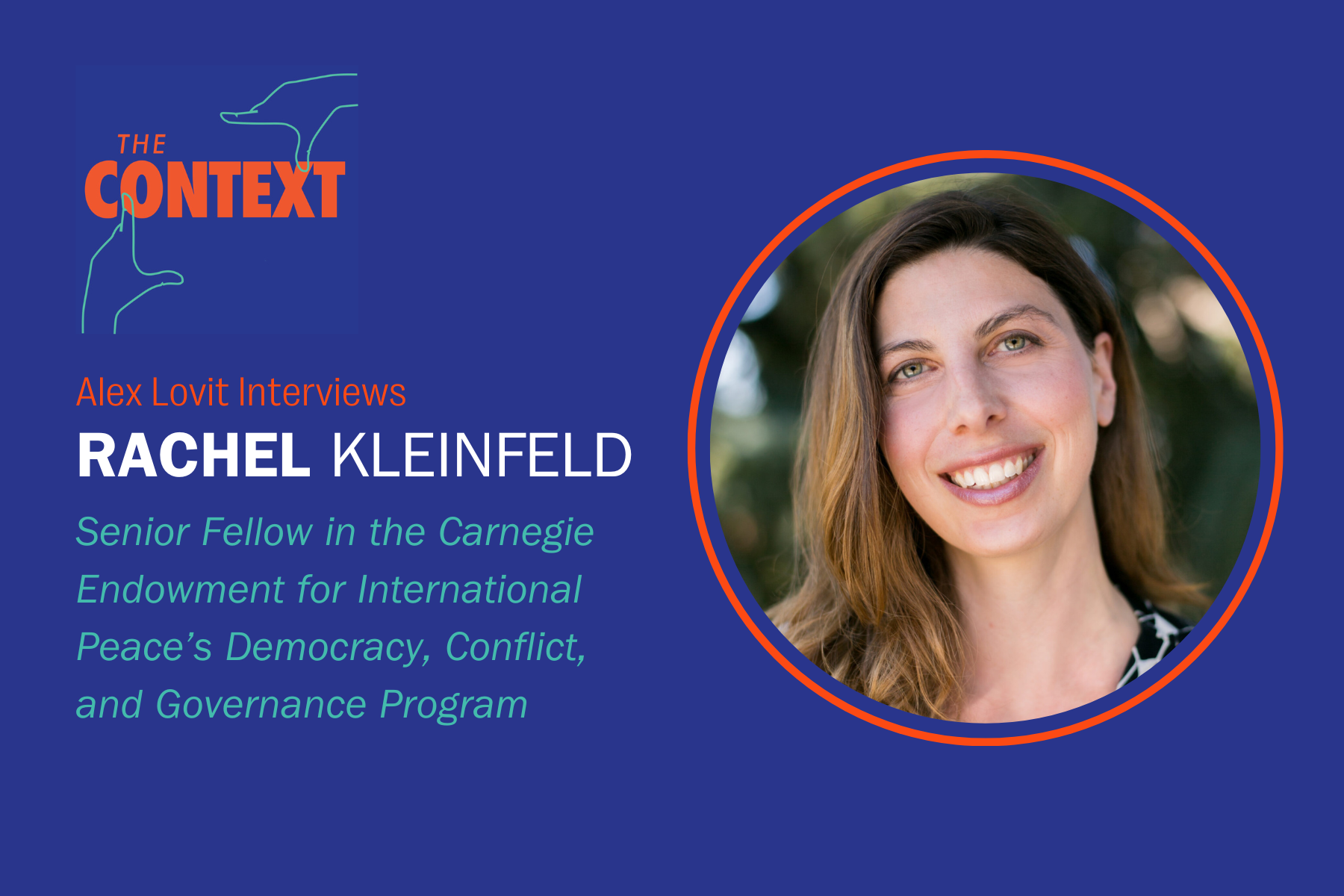
In a democracy, we resolve political disagreements through elections rather than through physical force. Political violence is a threat to democratic societies...
 Published On: August 27, 2024
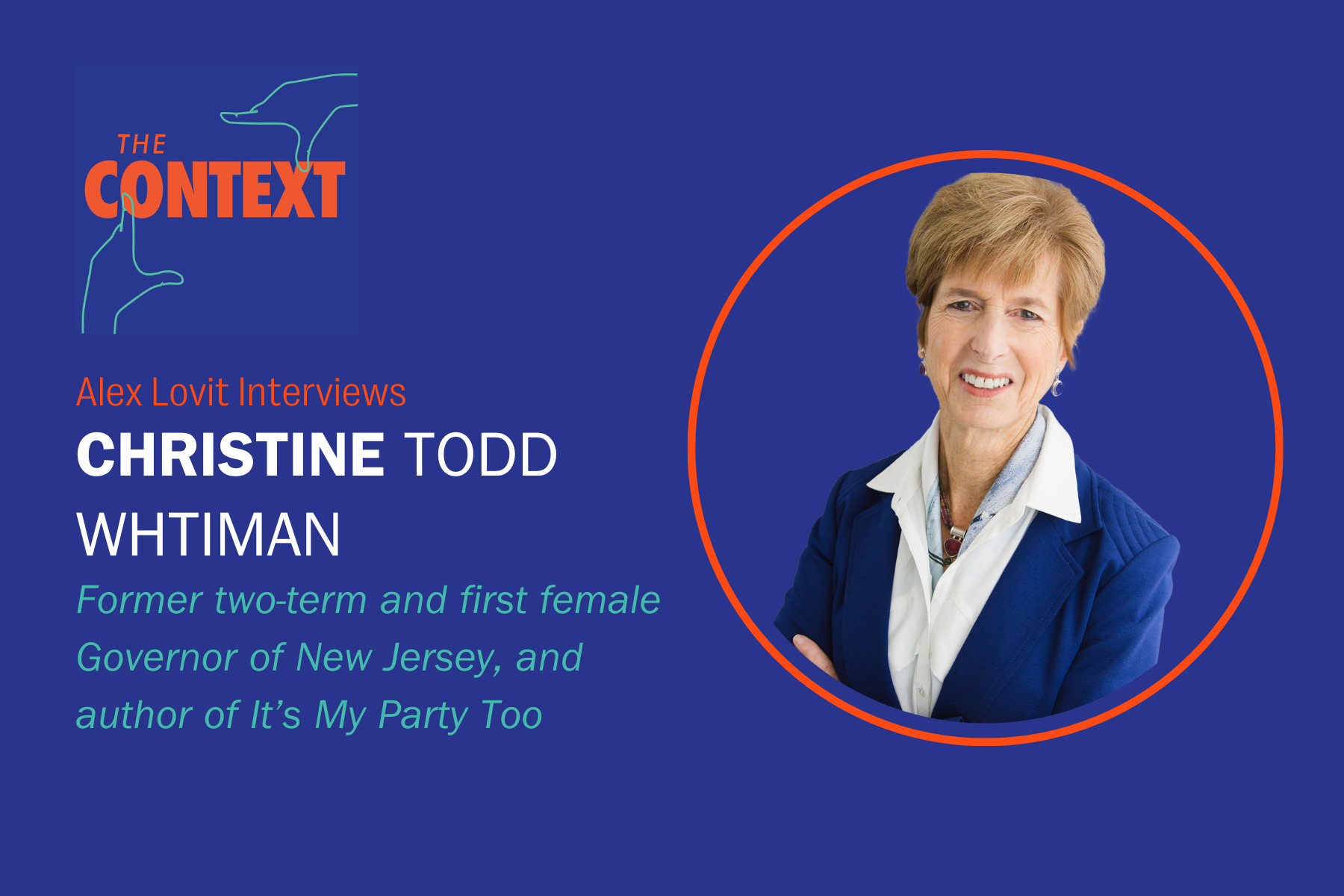
Democracy should work for everyone. Christine Todd Whitman explains how political parties are more concerned with maintaining power than solving problems for...
 Published On: August 13, 2024
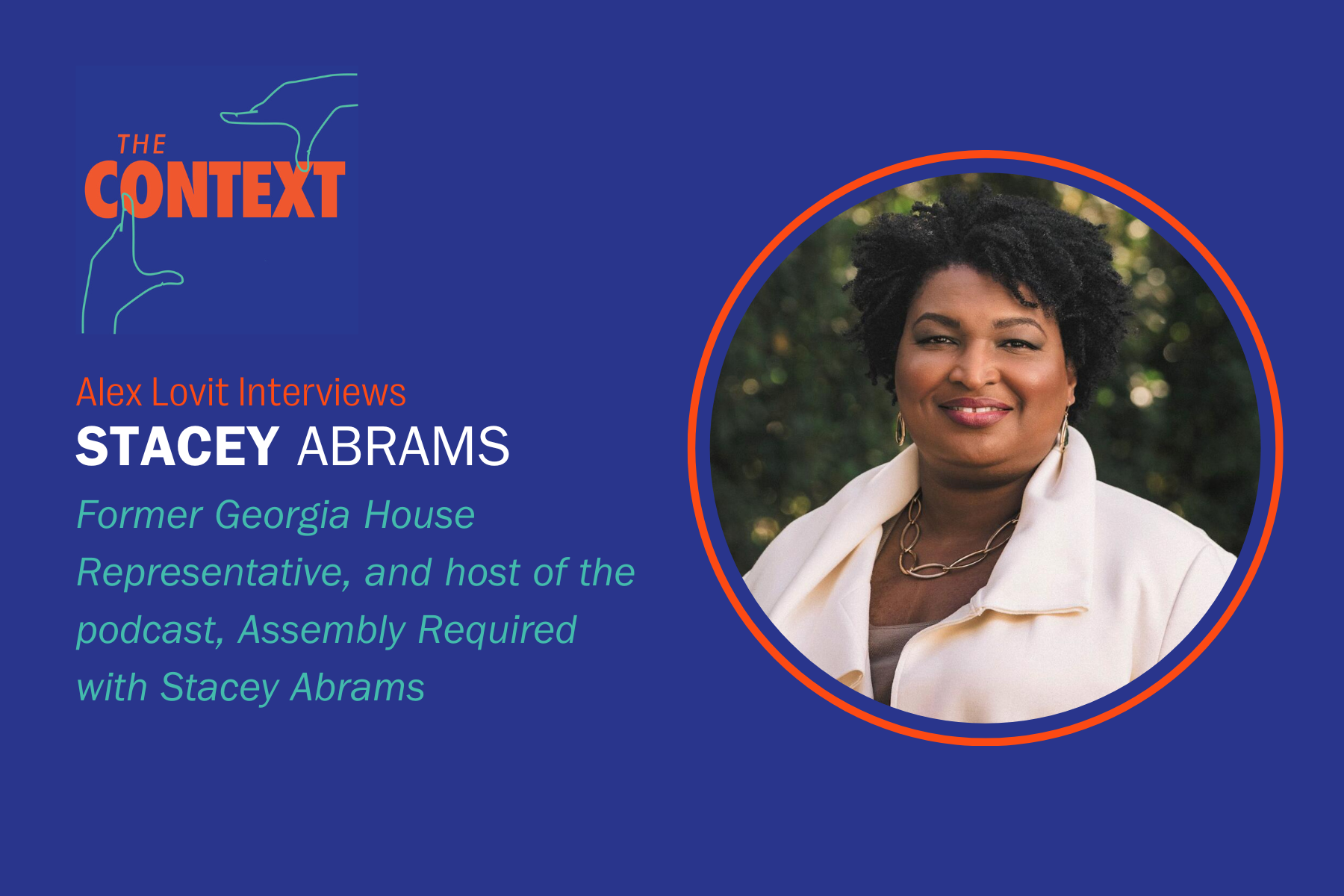
American history is a story about diversity, equity, and inclusion (DEI). Stacey Abrams discusses why Americans should embrace and defend DEI as...
 Published On: July 30, 2024
American democracy relies on nonpartisan civil servants to detect and combat corruption. Alexander Vindman was one such civil servant when he reported...
 Published On: July 16, 2024
The Supreme Court does not belong in the crosshairs of the American political debate. Neal Katyal discusses how the court’s rush to...
