Social Media and Civic Engagement: Solutions Must Embrace Complexity
The Democracy for All Project is a multiyear collaboration between the Kettering Foundation and Gallup. This annual, national survey is designed to understand how Americans experience democracy and elevate all voices across groups and generations. The March 2026 report is based on surveys of 20,338 adults conducted between July and August 2025, with a margin of sampling error of ±0.9 percentage points.
There is a mystery coiled up inside the latest survey results from The People’s Role in American Democracy, the latest report from the Democracy for All Project, a joint endeavor between the Charles F. Kettering Foundation and Gallup. Survey respondents who reported heavy social media use (five or more hours per day) were more likely to believe in the power of civic participation to influence government policy. But across the political spectrum, they are also less likely to believe democracy is the best form of governance and are more likely to express radical views out of sync with democratic norms.
The findings of this survey reiterate the importance of media and information to civic health and highlight the ways our modern media environment feeds poisonous trends. Social media is just one part of this story, which points toward the need for Americans to reconsider the relationship between media consumption, responsible citizenship, and an informed public.
Understanding the Views of Heavy Social Media Users
First, some good news: the survey results find that 61% of Americans are paying attention to news at a “moderate” level. Because an informed public is the basis of a healthy democracy, this is something to celebrate. The survey results also show that attentive Americans are more likely to believe in the power of citizens and to be aware of opportunities for civic engagement. The downside is that increases in the rate of news consumption are at least partially driven by an atmosphere of crisis. The first year of the second Trump administration and the beginning of the COVID-19 pandemic both saw significant upticks in US news consumption.
Audiences are also turning to social media for a growing share of their news and information—with complicated results. The Kettering-Gallup survey results show that heavy social media users are more likely to believe ordinary citizens have a “moderate or great deal” of power to create change; this was true for all age cohorts. According to the data, these individuals are also more likely to believe in the power of specific forms of civic participation, including nonviolent protest (61% said this tactic was moderately or very effective, compared to 45% of nonusers); political campaigning (66% to 55%); donating to a campaign or cause (59% to 49%); and attending town halls (61% to 52%).
Moreover, social media users appear to be more than keyboard warriors: heavy users are as or more likely than nonusers to attend community events, volunteer, or report that friends, family, and neighbors are important sources of civic information. These heavy social media users are not all shut-ins; as the saying goes, many of them “touch grass.”
These positive findings are tempered by more troubling insights. Despite their enthusiasm for civic engagement, heavy social media users also reported higher rates of agreement with extreme, anti-democratic positions than light users (those who use social media for less than an hour each).
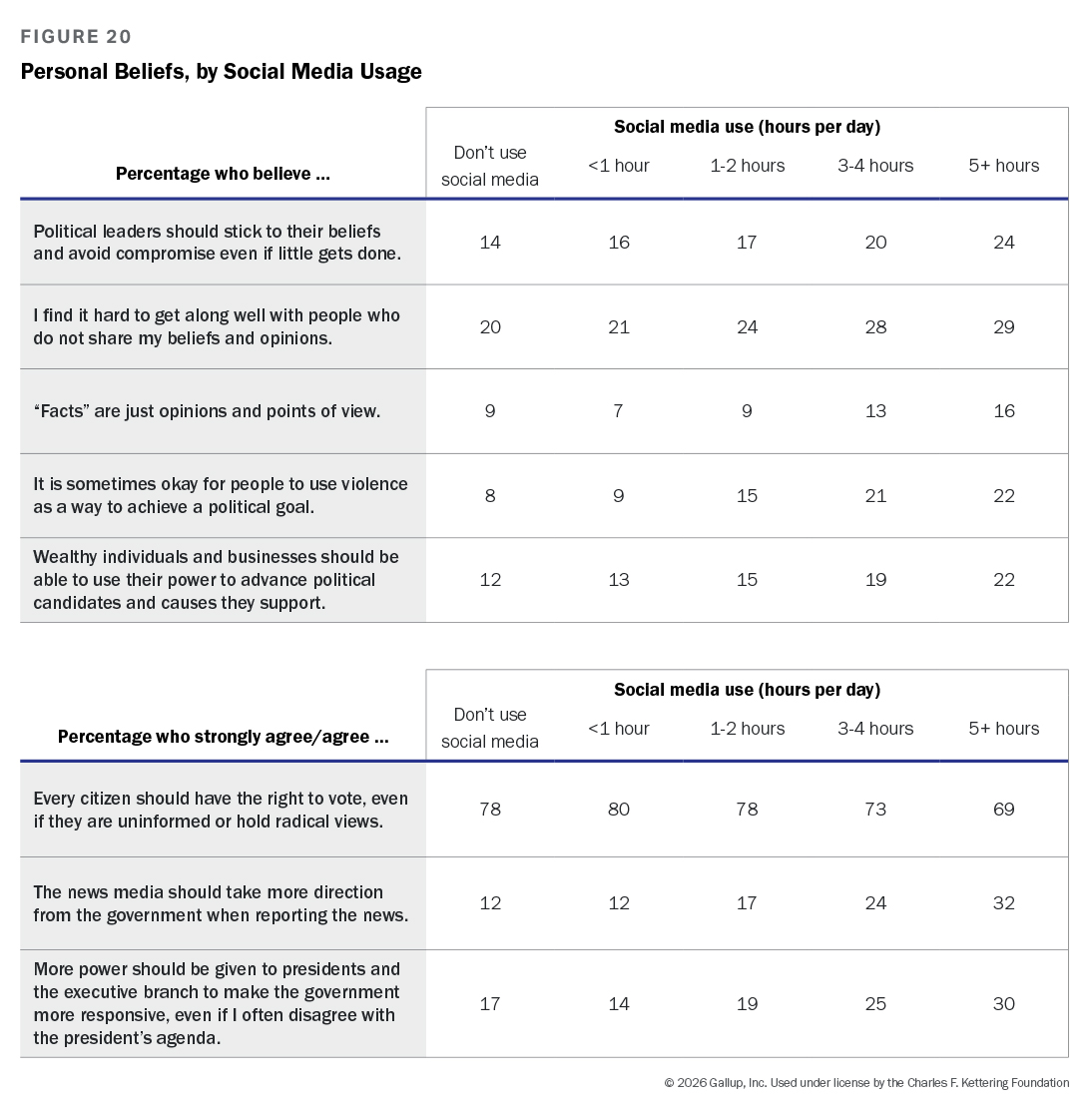
Figure from The People’s Role in American Democracy © 2026 Gallup Inc., used under license by the Charles F. Kettering Foundation.
Some of the problematic findings included “It is sometimes okay for people to use violence as a way to achieve a political goal” (22% versus 9%); “The news media should take more direction from the government when reporting the news” (32% versus 12%); “Facts are just opinions and points of view” (16% versus 7%); and “More power should be given to presidents and the executive branch to make the government more responsive, even if I often disagree with the president’s agenda” (30% versus 14%). Overall, heavy users of social media were less likely to say they believe democracy is the best form of government (58% compared to 72%). This effect seems to be largely driven by political independents, among which heavy social media users are less likely to express faith in democracy than even the most social-media engaged Democrats or Republicans (39% for independents compared to 67% and 66%, respectively, for members of the two major parties).
Problems with Social Media Are Just One Aspect of Our Collapsing Media Ecosystem
These results likely summon in the minds of readers a list of vices attributed to social media. One is the prevalence of online scams, rumors, and hyperpartisan sites masquerading as local news. Another is the role of content curation algorithms that reward controversy and prime citizens for division and confrontation, calcifying their political views and feelings about Americans across the partisan aisle. While most heavy social media users report engagement in their community, those who do not may be most prone to tolerating violence. The Kettering-Gallup data show that lonely Americans, and especially isolated young men, fit this pattern.
But for all its bad press, social media is not solely responsible for every ill in our modern media ecosystem. Observed declines in the sources, content, and quality of news predate the internet. For instance, media scholars say that broadcast news, still a major source of information for many Americans, dedicates less time to issue-based coverage than 50 years ago. The difference is made up of ads and “soft news that focuses on celebrities, scandals, and entertainment.”
The decline of TV news quality and the rise of social media have taken place against a bleak backdrop for print media. Since the 1990s, and especially since the COVID-19 pandemic, local newspapers have been closing at levels nearing a mass extinction event. The economy has shed thousands of journalism jobs over the same period. When local newspapers close, audiences tend to move toward sources with more national coverage, which tends to be more partisan, more divisive, and more sensational than local coverage. If the 61% of Americans paying attention to government and politics in the Kettering-Gallup survey are consuming mostly national news coverage, which is often partisan, the net civic impact could be mixed or even negative.
Information Overload and Active Citizenship
The Kettering-Gallup survey also looked at whether respondents felt overloaded by news and information and, if so, how it impacted their attitude toward civic engagement. Nearly a fifth of adults confessed to feeling “frequently” overloaded by information; for younger adults, that number was 27%. Heavy social media use was a predictor of information overload, and feeling overloaded correlated with lower confidence in expressing political opinions and lower likelihood of participating in political causes.
It is useful to juxtapose these findings with others from the survey. First, civic education (whether formally in school or informally through the influence of nonscholastic authority figures) is a strong predictor of civic engagement. Second, respondents who drew political information from multiple local figures such as religious, business, or other community leaders are more likely to express faith in democracy and the public’s role within it. Strong and active civic networks help individuals do more than passively consume information: those networks empower the people to practice citizenship. Social media, then, may be dangerous by itself but can be a helpful tool for the robust citizen.
Unfortunately, passive consumption seems to be more common than the active kind. Technology has brought the United States into an era that some have deemed to be a post-literate society: strong reading and writing skills are less common and less necessary, especially given the rising dominance of online video content. Reading rates and comprehension levels are decreasing as are deeper skills like critical reading and deep literacy, the ability to engage with meanings and abstract ideas beyond the text itself.
At the same time, it is important not to give in to despair or to cave in to a moral panic about social media. Humanity controls technology, not the other way around. Trends in digital consumption may change because of culture or policy, and if they do not, society may adapt. After all, similar dissatisfaction with past technologies seems unimaginable now. Consider the ancient Roman poem cursing the sundial: today we take something as fundamental as timekeeping for granted, but it was not always so.
Moderating Our Media Habits
The Kettering-Gallup research implies a few suggestions for preserving and promoting the role of measured, reflective media consumption. Attendance at community events like art festivals is positively associated with civic engagement; public activities like these should be considered part of public civic infrastructure by government and nongovernmental funders alike. Support for civic education to bolster the confidence and awareness necessary to speak up or volunteer is another important intervention.
Policy levers for addressing the complex role of social media are slippery, so cultural interventions may be better suited. A provocative suggestion comes from Brink Lindsey at the Niskanen Center, which recently renewed a call for “media temperance.” Lindsey warns that “our current media environment is flatly inconsistent with the healthy operation of democratic politics” and cites problems ranging from the insularity of streaming alone to the rise of social media and hyperpartisan infotainment on cable news and elsewhere.
Some of Lindsey’s specific recommendations are controversial, but his general argument—that “it’s hard to picture a dramatically better society without a dramatically improved media environment”—is provocative and merits consideration.
It is far too early to throw the baby out with the bathwater when it comes to social media and democracy. Instead, stakeholders across all sectors of society, from the federal government to the general public, should pursue answers to more nuanced questions about the diverse ways social media shapes civic behavior and political attitudes. It’s a complex problem, but the answers will reward our .
Dean Jackson is a senior fellow at the University of Pittsburgh’s Communication Technology Research Lab and at Tech Policy Press. In 2022, Jackson was an investigative analyst with the Select Committee to Investigate the January 6th attack on the US Capitol.
From Many, We is a Charles F. Kettering Foundation blog series that highlights the insights of thought leaders dedicated to the idea of inclusive democracy. Queries may be directed to fmw@kettering.org.
The views and opinions expressed by contributors to our digital communications are made independent of their affiliation with the Charles F. Kettering Foundation and without the foundation’s warranty of accuracy, authenticity, or completeness. Such statements do not reflect the views and opinions of the foundation which hereby disclaims liability to any party for direct, indirect, implied, punitive, special, incidental, or other consequential damages that may arise in connection with statements made by a contributor during their association with the foundation or independently. The views and opinions expressed by contributors are likewise made independent of their affiliation with Gallup and without Gallup’s warranty of accuracy, authenticity, or completeness. Such statements do not reflect the views and opinions of Gallup, which hereby disclaims any association with or endorsement of such content.