The 14th Amendment Redefined America
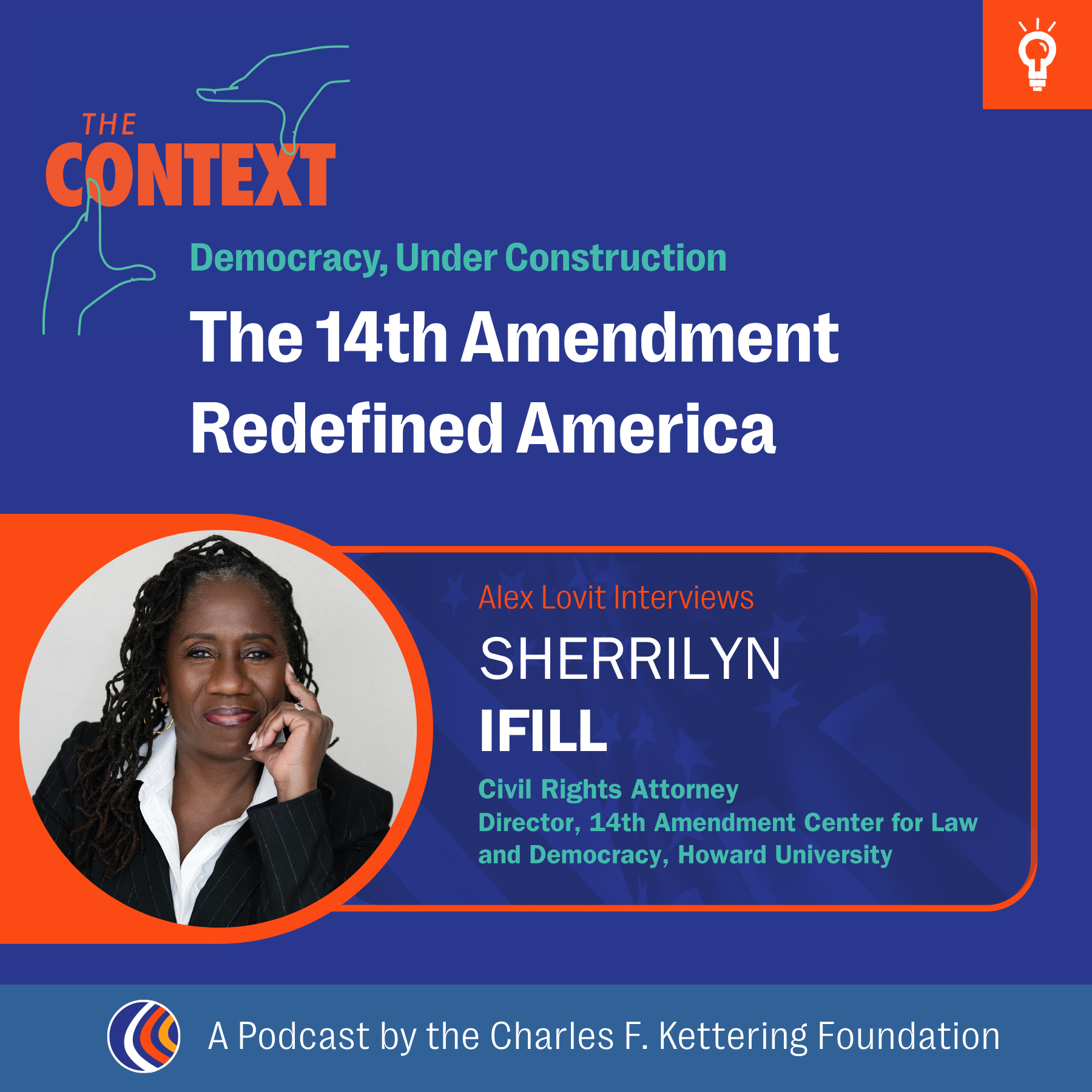
In this first episode of our series, “Democracy, Under Construction,” Sherrilyn Ifill joins host Alex Lovit to discuss the Second Founding, when the Reconstruction Amendments—and in particular the 14th Amendment—fundamentally changed American rights and who was defined as American. Birthright citizenship, protections from abuses by state governments, and equality before the law all entered the Constitution following the ratification of the 14th Amendment in 1868.
The “Democracy, Under Construction” series commemorates America’s 250th anniversary by focusing on the moments when our country became a more inclusive democracy and celebrating the historical figures who pushed the country to live up to its ideals.
Sherrilyn Ifill is among the most accomplished civil rights lawyers in the United States. She is the Vernon Jordan Distinguished Professor in Civil Rights at Howard University School of Law and the founding director of the 14th Amendment Center for Law and Democracy. She previously served as the president and director-counsel of the NAACP Legal Defense and Educational Fund.
Share Episode
The 14th Amendment Redefined America
In this first episode of our series, “Democracy, Under Construction,” Sherrilyn Ifill joins host Alex Lovit to discuss the Second Founding, when the Reconstruction Amendments—and in particular the 14th Amendment—fundamentally changed American rights and who was defined as American. Birthright citizenship, protections from abuses by state governments, and equality before the law all entered the Constitution following the ratification of the 14th Amendment in 1868.
The “Democracy, Under Construction” series commemorates America’s 250th anniversary by focusing on the moments when our country became a more inclusive democracy and celebrating the historical figures who pushed the country to live up to its ideals.
Sherrilyn Ifill is among the most accomplished civil rights lawyers in the United States. She is the Vernon Jordan Distinguished Professor in Civil Rights at Howard University School of Law and the founding director of the 14th Amendment Center for Law and Democracy. She previously served as the president and director-counsel of the NAACP Legal Defense and Educational Fund.
Share Episode
The 14th Amendment Redefined America
Listen & Subscribe
In this first episode of our series, “Democracy, Under Construction,” Sherrilyn Ifill joins host Alex Lovit to discuss the Second Founding, when the Reconstruction Amendments—and in particular the 14th Amendment—fundamentally changed American rights and who was defined as American. Birthright citizenship, protections from abuses by state governments, and equality before the law all entered the Constitution following the ratification of the 14th Amendment in 1868.
The “Democracy, Under Construction” series commemorates America’s 250th anniversary by focusing on the moments when our country became a more inclusive democracy and celebrating the historical figures who pushed the country to live up to its ideals.
Sherrilyn Ifill is among the most accomplished civil rights lawyers in the United States. She is the Vernon Jordan Distinguished Professor in Civil Rights at Howard University School of Law and the founding director of the 14th Amendment Center for Law and Democracy. She previously served as the president and director-counsel of the NAACP Legal Defense and Educational Fund.
Alex Lovit: The United States turns 250 this year, but not our democracy. America declared independence in 1776 and ratified the Constitution in 1788. That constitution created important rights and protections, including guaranteeing a Republican form of government. But at that time, less than 20% of American adults could vote. And about that same percentage of the country’s population was enslaved. I don’t know about you, but I can’t call that a democracy.
But since then, our nation has moved towards democracy and inclusion, even in spite of periods like right now, when many groups are seeing their rights get stripped away. So as our way of marking America’s 250th, we’re celebrating some of the key people, movements, and moments in the fight to make this country live up to its high ideals. The next few episodes of The Context will focus on these stories. In a series we’re calling Democracy: Under Construction. You are listening to The Context. It’s a show from the Charles F. Kettering Foundation about how to get democracy to work for everyone and why that’s so hard to do. I’m your host, Alex Lovit.
Today’s episode is about the amendment that arguably did more to make good on America’s Democratic promise than the Constitution’s first draft, the 14th Amendment. My guest today is Sherrilyn Ifill. Sherrilyn is the Vernon Jordan distinguished professor in civil rights at Howard University School of Law, where she also serves as the founding director of the 14th Amendment Center for Law and Democracy. She previously served as the president of the NAACP Legal Defense and Educational Fund. Today, she’ll walk us through what makes the 14th Amendment so foundational and how it could provide a blueprint for a new vision of inclusive democracy. One that she hopes isn’t too far in the future.
Sherrilyn Ifill, welcome to The Context.
Sherrilyn Ifill: Thrilled to be here. Thanks for having me.
Alex Lovit: So you’re a fan of the 14th Amendment, and I am too, and I’m hoping this conversation will help some people realize that things that they take for granted as fundamental American values weren’t in the original Constitution. But before we get there, what was the context for the 14th Amendment? When was it written? Why was it written?
Sherrilyn Ifill: Well, it’s very much related to the point you just made. It’s important to understand how serious a moment this country confronted after the Civil War. This war was devastating. 600,000 Americans were dead, blood soaked battlefields around the country, and now the need to kind of stitch together the country from the fractures and to create a new country. And this is why we call this the second founding. Most of us think about the founding of this country and we think about Hamilton and Madison and Jefferson, but there was a second founding. The country had been fractured and it became very clear that many Southerners, in fact, most Southerners were prepared to accept becoming part of the Union so that they could have power back and so they could govern their own lives, but they had no real respect for the Union or the federal government.
Four million Black people had been enslaved and now were free after the ratification of the 13th Amendment in 1865. And something had to be done about the citizenship status of Black people who, while now free, still were not citizens. And in fact, the Supreme Court had said in a decision before the Civil War, the decision that some people call the opening salvo of the Civil War, Dred Scott versus Sandford, that Black people in the United States not only were not citizens, but could not be citizens, whether they were enslaved or free. So you basically had a stateless population of Black people in the country who had to be brought into the body politic and the vision was to create a country that was not separated by racial case. And that meant correcting many of the things in the first constitution from the original founding.
And then I’ll have to add one more thing that complicated this period. The person who was seen as the one who held together, who could hold together the Union, who could stitch together the country who was respected throughout the country, was assassinated and was assassinated by, everyone knows John Wilkes Booth, but it was a conspiracy to take down the presidential government, a conspiracy of Confederates who were white supremacists a bit before, maybe a month before President Lincoln had given a speech outside the White House. And for the first time he had talked about the possibility of Black people voting. The story is that John Wilkes Booth was in the crowd that day and said to his companion, “This will be the last speech he ever gives.” And then began to meet with his colleagues to plan the assassination.
So this is important to understand because the war is over, but is the war over? Because there is this attack on the President, the Union government. So I’m trying to say it’s a very unstable time, a time in which there’s a great opportunity to do great things, but the country has been through a lot and the pervasiveness of violence is very much in the air.
Alex Lovit: So you mentioned that everyone knows Madison and Washington and the founders in 1787, but the best part of the Constitution is later. Who do we have to thank for the 14th Amendment?
Sherrilyn Ifill: I think that’s a wonderful question because I think the answer I should give is just the names of some serious members of Congress who drafted the 14th Amendment. And I can give you those names. We can talk about John Bingham, we can talk about Thaddeus Stevens, we can talk about Charles Sumner, we can talk about Jacob Howard, and indeed these all were the people who put pen to paper and drafted the 14th Amendment.
But what I tell my class and what I teach, and one of the reasons I’ve been so serious about trying to help educate Americans about the 14th Amendment, not only because it’s important for our country to understand that we were refounded, that we have the ability to even recover from fracture and reset and create a new vision of our country, but also because the vision of our country, and this is true of the first founding as well, is not just created by those men who sit in the room and write the words. Those men, and they were men at both foundings, the first and the second, they have been influenced by conversations happening not only in this country, but diasporically in which they are being influenced by writings and speeches.
And so who do we have to thank for the 14th Amendment? I think we have many abolitionists to thank for the 14th Amendment who were deeply engaged for decades through the 19th century in writing about and speaking about what equality might mean. I would count Frederick Douglass as one of the founders of our second founding because he was one of the most influential thinker speakers and public intellectuals in the decades leading up to the Civil War. He was largely responsible for convincing President Lincoln, along with President Lincoln’s generals, that Black people should fight in the war and that they should be armed. And of course, 200,000 Black soldiers served in that army and President Lincoln himself conceded that the Union could not have won without those additional forces that Black troops provided.
I would say Frances Ellen Watkins Harper, who was a poet, but also an abolitionist and would travel around after the emancipation, teaching Black people about what it would mean to be citizens and what it would mean to be free. I would count David Walker, another prolific abolitionist of the period. I would count John Brown, and I would even go as far to say, Alex, as I count the enslaved people who relentlessly tried to be free, who really insisted on a kind of understanding of what freedom means to human beings. This is all the context in which those people who end up sitting in that room are beginning to learn and think about what freedom and equality really means.
The Haitian Revolution was a powerful influence in the Haitian Constitution of 1805 and their concept of equality. So there are things happening even within the diaspora that are influencing how we think about and what content goes into the meaning of a word like equality, which does not appear in the Constitution before the 14th Amendment was ratified in 1868. So certainly we should know the names of Sumner and Stevens and Bingham and Howard just as we know Madison and Jefferson and Hamilton and John Jay and the others who were the founders and framers of the first constitution. So we should certainly know those members who were founders of the second, but we also should know the names of those people who influenced them just as we know Patrick Henry and Thomas Paine-
PART 1 OF 4 ENDS [00:10:04]
Sherrilyn Ifill: … just as we know, Patrick Henry and Thomas Paine and others who were not in the room, but who influenced the original founders. This is the history that we’re missing in this country in terms of just what ordinary Americans know about our history. And it’s critical that we know this history because I strongly believe that we are at the precipice of a third founding. And we need to understand that not only do we have permission to reset our country when it fractures, but we have an obligation to do so.
Alex Lovit: Yeah. Well, so I want to get to the third founding, but let’s talk a little bit about the second. The 14th Amendment is the longest amendment in the Constitution by word count, so I’m not going to go through the whole thing, but the first couple of sentences are awfully important. So I’d like to just kind of read those and have you tell me what they mean. So the first sentence is, “All persons born or naturalized in the United States and subject to the jurisdiction thereof are citizens of the United States and of the state wherein they reside.” So what does that mean and what was new?
Sherrilyn Ifill: This is huge. The original constitution doesn’t really speak to what makes one a citizen. There is really no set of criteria in that first constitution. This opening sentence of the 14th Amendment introduces the concept of birthright citizenship into the United States, meaning that if you are born in this country, and of course, if you are naturalized, you are a citizen.
This is not a universally accepted principle. There are many countries in Europe and other places where you are French because your mother was French or you are German because your father was German. So it’s an important innovation for the United States. It very much fits with the character of this new nation. First of all, it is designed first and foremost to overturn that Dred Scott decision that I made reference to earlier. It is a way to ensure that Black people in the United States are citizens, both enslaved and free. Black people who had been rendered stateless people by the Dred Scott decision.
So the first thing it does is it overturns the Dred Scott decision. And when you look at the debates and the conversations that the framers of this particular provision were engaged in, there was the intention of ensuring that we were no longer creating a case system or caste system of citizenship, but that we were creating kind of one vision of what makes one a citizen in this country.
And they did talk about issues of the children of what we would call undocumented people, but let’s say the children of non-citizens who were born in this country. And there were disputes about it because the very same conversations that we hear today are the conversations that they were having as well. There was a whole contingent of individuals who expressed tremendous racial animus against the Chinese and the fear of being overrun by Chinese immigrants on the West Coast who had now become citizens. And there was clarity among the entire body that the children of those Chinese individuals who were workers in this country would be citizens if they were born here. That if they were American-born, those children would be citizens.
And we should not discount the level of animus that there was against the Chinese. You know that at some point Chinese were forbidden from even becoming citizens by the Chinese Exclusion Act in 1882. And that wasn’t changed, I don’t think, till the 1930s.
So the very conversations that we’re hearing from some corners in our country right now was the conversation they considered and they decided in any case that they would adopt birthright citizenship, which meant that if you are born on this soil, you are a citizen.
The effect of that, the reason I said it fits so much with the American character was that America was the place, and I think for many migrants, still is the place where you can start over.
My dear friend, the historian, Martha Jones, said that birthright citizenship means that the children are not bound by the limitations or the sins of the parent. The idea of coming to America to start over was a concept that made this country very attractive to Europeans who were really, in many ways, for decades thereafter, the principal beneficiaries of birthright citizenship. And of course, this is a through line in American history that when we adopt provisions that are designed to bring equality to those who are most marginalized, that the benefit enures to the entire population, and the same was true of birthright citizenship.
Alex Lovit: Yeah. And also important that it’s in the Constitution. It’s not an executive order. It’s not a law.
Sherrilyn Ifill: It’s not policy decision. It’s not a political decision. It is as sacred as First Amendment rights, as Second Amendment rights, as the right not to incriminate yourself under the Fifth Amendment, as the right to be free from cruel and unusual punishment in the Eighth Amendment. It is part of our founding document. And therefore, it is not something that can simply be wished away or excused away or signed away by the policy preferences of any particular president or even of Congress.
Alex Lovit: Okay. So that’s the first sentence. Let’s spend some time with the second sentence.
Sherrilyn Ifill: A chockfull in just that one sentence. Yeah.
Alex Lovit: Yeah. And so the second sentence I think is probably the most important sentence in the Constitution. I don’t know if you agree with that. It starts, “No state shall make or enforce any law.” And already that’s different ’cause if you look back at the Bill of Rights, the First Amendment says, “Congress shall make no law.” This is saying no state shall make a law. What’s the difference there?
Sherrilyn Ifill: Well, it’s huge. Those who were writing the original Constitution had a vision of what oppression would look like, and it comes from their relationship with King George, and therefore they fear creating an all-powerful centralized federal government. That’s why there are amendments to say that troops can’t be quartered in your home, right? But every country goes through processes in which it learns more about itself. And what the Civil War has shown us is that American citizens also need protection from states, and certainly Black Americans need protection from states.
This is important because it is rebalancing our very conception of federalism by strengthening the power of the federal government in relationship to the states. The mere words, “No state shall,” is really important. And it’s repeated throughout this amendment. It is clearly and without question meant to prescribe the ability of states to interfere with certain kinds of rights.
So it’s interesting because as you know, following the Brown versus Board of Education decision, there’s all this talk about state’s rights, and people still talk about it as why they believe the Civil War was fought was for state’s rights. Well, if that was true, it was not only vanquished on the battlefield, it was vanquished constitutionally by these words of the 14th Amendment.
And it’s important to understand that while we continue to debate these questions about state’s rights, that the answer is right there in the 14th Amendment. And it may be nice for people to pretend it doesn’t exist, but that’s kind of why I think it’s so important that we learn this history, that this was fought over and resolved. The Constitution has made clear that there are some things that we cannot entrust to the states and we have to limit their power to overcome rights in a certain context.
Alex Lovit: Okay. So let’s talk about what no state shall do.
Sherrilyn Ifill: Never get through the whole amendment.
Alex Lovit: No, no. Well, and I know there are two word phrases in this amendment that become entire bodies of constitutional law, and I’m sure you could talk about for hours, but let’s try to give the overview of what this stuff means. So “No state shall make or enforce any law which shall abridge the privileges or immunities of citizens of the United States.” So we’ve changed what citizens are. What are the privileges and immunities?
Sherrilyn Ifill: Well, when I ask my students on the first day of class, what do they think are the privileges and immunities of citizenship? To a fault, every student, the first thing they say is voting, and then they say other things like the right to travel or the right to work. That sounds reasonable to me, but of course, as you know, at least half of the citizens of the country could not vote. Neither at the time the country was first founded or the time the country was second founded, and that’s women who did not obtain the right to vote constitutionally until 1920. You know that Black people could not vote. And in many states, there were rules about whether you could vote based on how much property you owned or whether you could pay a poll tax and so on and so forth.
We may think of voting as a universal right. That is our experience of the 20th century, the long fight over the right to vote. But in this period, that was not considered a privilege and immunity of citizenship.
This question arose in the first case brought under the 14th Amendment, which was a case called The Slaughter-House Cases. In that case, the Supreme Court had to address the question of what are the privileges and immunities of citizenship. And the court landed on a meaning that to this day, not only do I think it’s wrong, but I think is almost laughable on its face. Essentially, what the Supreme Court said was that the privileges and immunities of citizenship are actually very quite narrow, very few, the privileges and immunities of national citizenship. And so they said what that means is that you can have access to navigable waters, that there’s certain forms of commerce that you can engage in.
It was nothing like what you and I would think of as the privileges and immunities of citizenship. And as a result, after that decision, The Slaughter-House Cases’ decision in 1873, privileges and immunities in the 14th Amendment really ceased to be a concept with any strength or real meaning …
PART 2 OF 4 ENDS [00:20:04]
Sherrilyn Ifill: … be a concept with any strength or real meaning because of how the Supreme Court interpreted it in 1873. We’re at the second sentence.
Alex Lovit: Well, we’re halfway through the second sentence. And as you’re saying there, there’s some potential.
Sherrilyn Ifill: Yeah.
Alex Lovit: 150 years ago, we decided to define that very narrowly, but those words could be defined differently. Beyond privileges and immunities, “Nor shall any state deprive any person of life, liberty, or property without the due process of law.” Due process had already been in the Constitution. And this is importing that from the federal government to the states. Do I have that right?
Sherrilyn Ifill: That’s correct.
Alex Lovit: Could you talk a little bit about what due process is?
Sherrilyn Ifill: Oh, due process is so important. Could you just go back and read the language slowly again about due process? Because it’s actually quite timely.
Alex Lovit: “Nor shall any state deprive any person of life, liberty, or property without due process of law.”
Sherrilyn Ifill: Okay. This means the government can’t just take something from you that is yours without the things that we think about as due process. If you’re going to arrest me, telling me what I am charged with, giving me an opportunity to confront my accuser, giving me an opportunity to appear before an impartial tribunal and to defend myself, all of the things that we associate with constraining the government from being able to take from us that which is ours, whether it is our property, whether it is our liberty. And so it’s very important, but it’s also important that this language says every person. It does not say, “No state shall deprive any citizen of life, liberty, or property without due process of law,” it says any person. And that’s important because we have conversations about whether undocumented people are entitled to due process, for example.
The 14th Amendment is no respecter of persons when it comes to due process of law, and this is important because they obviously know what citizenship means because they use the word citizen in the first sentence, so they are aware of the difference between a person and a citizen. They could have said citizen, but they don’t say citizen, they say every person. And this is really powerful and important and becomes important later when we think about this in the context of the First Constitution and what constrains the federal government as well and what rights you have, not only in relationship to the state government, but what you have in relationship to the federal government.
Alex Lovit: Okay, let’s get through the end of this second sentence, and then listener, you’re on your own for the rest of it. “States can’t deprive persons of life, liberty, property without due process of law nor deny to any person within its jurisdiction the equal protection of the laws.” And so this phrase equal protection is new.
Sherrilyn Ifill: That’s new. The word equal does not appear anywhere in the First Constitution. In fact, the First Constitution is an anti-equality constitution because the First Constitution says that Black people will be counted as three-fifths of a person for purposes of congressional representation. It sanctions continuation of involvement in the international slave trade until 1808. It is not a constitution of equality. It’s many things, but not that. This is the first place that the concept of equality appears in the Constitution.
And many people believe that the First Constitution contains some equality provisions. It does not. Most people are actually thinking, when they say they believe that, of the Declaration of Independence. They are thinking of, “We hold these truths to be self-evident that all men are created equal.” That is not in the Constitution. And this again is why the 14th Amendment is doing something very powerful, because it is pulling that promise that was in the Declaration into our Constitution for the first time. We believe in that statement, almost everyone knows that phrase, “We hold these truths to be self-evident that all men are created equal,” more than they know of any verbatim provision in the Constitution. But the truth is it was left out of our Constitution, and it is the 14th Amendment that reaches back over the First Constitution and brings the declaration into our founding document. To the extent that we think of our national identity as containing a vision of equality, it did not become part of our national identity until the 14th Amendment was ratified in 1868.
Now there’s this new concept that has been added to our national identity and that lives on that we tend to think of that America is a place of equal promise and where anyone can make it and where it’s no respecter of persons. This promise of equality is vitally important. It is designed to ensure this protection, particularly of the Black population.
And as I said, the Joint Committee on Reconstruction that drafted the 14th Amendment was well aware of the ongoing existence of intense white supremacist ideology in the South. Southern sentiment is quite determined to ensure that Black people are not treated as equal citizens or persons, and therefore the equal protection clause is vitally important. And that equal protection clause is the basis upon which many of our most important civil rights statutes that were enacted after the middle of the 20th century are premised on this concept of equality, which later spills into the concept of equality for women, age discrimination, pregnancy discrimination. All of the ways that we think about that people can be discriminated against all emanate from equal protection in the 14th Amendment.
Alex Lovit: Yeah. And if you’re walking around as an American in 2026 and you think, I want the state to not be able to infringe upon my free speech in addition to the federal government, and I think the government ought to treat everyone equally, that’s from the 14th Amendment. Thank John Bingham, thank Frederick Douglass. That’s where that comes from.
And then for me, part of that lesson is that the story of our country is not that it was handed down by God in 1776 and everything was set, it is that there is this possibility of change, and we can choose as a country to turn toward democracy and equality, as we did in the second founding. You mentioned earlier this idea of the third founding, maybe we’re due for another founding. How could we take inspiration from the 14th Amendment? Or where might there be unrealized potential in the 14th Amendment itself?
Sherrilyn Ifill: Well, I think there is unrealized potential in the 14th Amendment. The 14th Amendment has never been able to walk in its fullest promise. Largely, well, three forces. One, the Supreme Court; I’ll come back to that in a minute. Second, violence, white supremacist violence, which was a very powerful force well through the first half of the 20th century with lynching as a way of prescribing Black citizenship in the country. And the third wave is congressional inaction, because, of course, the part we didn’t get to is section five of the 14th Amendment, which says Congress shall have the power to pass appropriate legislation to protect the guarantees that are articulated in the 14th Amendment. And so Congress is given that power. It is a recognition that we can’t trust the states to protect these rights; we have to ensure that a federal entity that is Congress has that power. It’s not given to the president, it’s not given to the states.
But Congress is largely inactive. Congress passes a civil rights statute, the Civil Rights Act of 1875, which is struck down by the Supreme Court in 1883, and Congress doesn’t pass another civil rights statute until the Civil Rights Act of 1957. And I think we understand the condition that Black people were living in in the first half of the 20th century through economic exploitation, through sharecropping, people living in conditions that were very much like slavery, most Black people not able to vote, not able to register to vote and so forth. And Congress was inactive for the first half of the 20th century until Brown versus Board of Education and the Civil Rights Movement really forced Congress to act.
But the Supreme Court was the most powerful entity that stripped the 14th Amendment of its potential. And so in a series of decisions, beginning with that Slaughterhouse decision we just talked about in 1873, which stripped away the power of the privileges and immunities clause, a case called United States versus Cruikshank, which stripped away the power that Congress had asserted, through the passage of the Ku Klux Klan Act, to try to contain this violence that was being visited on Black people, striking down the Civil Rights Act of 1875. The Civil Rights Act of 1875 had basically did what, 100 years later, the Civil Rights Act of 1964 did, which was to try to strike down discrimination and accommodations. And then finally in Plessy versus Ferguson in 1896 when the Supreme Court said that Jim Crow’s segregation did not violate the equal protection clause. And that wasn’t overturned until Brown versus Board of Education in 1954.
And the Supreme Court is still at it, if I may say so. And the Supreme Court’s interpretation of what equal protection means, the adoption of this idea of colorblindness, which appears nowhere in the 14th Amendment or even in the debates about the 14th Amendment, the idea that to use race to remedy racial discrimination is somehow itself unconstitutional, these are all things that are distortions of the 14th Amendment, but they are the law of the land. The 14th Amendment has never fully had a chance to breathe and to fulfill its promise. And I think there’s still plenty of promise there. But we are at the moment where we can see that the democracy that we had come to rely on is failing us and that we need to make some fixes to ensure that it can withstand the challenges that inevitably come, and especially when those challenges lead to the nation fracturing, as our nation is fractured today, fractured in a way not seen, frankly, since the Civil War. Even during the period of the Civil Rights Movement, the nation was not as fractured as we find it today. And so we have an obligation. We are not as citizen-
PART 3 OF 4 ENDS [00:30:04]
Sherrilyn Ifill: And so we have an obligation. We are not, as citizens in a democracy, supposed to just watch our nation fall apart. We are supposed to act, to shore up the institutions of democracy to strengthen our nation to be able to withstand the forces that are coming against it. And so we are not only due, but we are overdue for a third refounding, for an opportunity to learn just as those second refounders learned and to make our democracy stronger.
Alex Lovit: So you’re saying that we’re living through a political crisis right now. It looks pretty different than the political crisis of the 1860s, but it’s a form of crisis. And that as Americans, we have an obligation to try to push our country towards democracy, towards equality. Do you have advice for people? For listeners to this podcast, what can they do to be part of that?
Sherrilyn Ifill: Well, the first thing is to believe and know that we have permission to do it. Empower yourself with the idea that you are a founder and a framer of the next iteration of American democracy. To the extent that you’re waiting for some people in the room, as I suggested earlier, those people who sit in the room and draft are influenced by you and me. They’re influenced by the debates that we’re having. They’re influenced by the articles that we’re writing. They’re influenced by the protests that we’re having in the street. They’re influenced by the struggles that we’re having and the experiments that we’re engaged in at the state level. So our becoming active and believing that we have a role to play is really the first step.
Secondly, I think we have been trained, especially over the past 20 or 30 years, to see everything through the lens of partisanship. The guarantees that we care most about in this country, the ability to speak, the ability to exercise religion and not have religion imposed on us by the government, to have our due process rights respected, to not be subject to arbitrary violence by the state, to be able to own property and to protect our property, to be able to be free from discrimination, to be free to be employed, and so on and so forth, these are all constitutional principles that have nothing to do with whether you’re a Republican or a Democrat. And so the second thing to do is to free yourself from the idea that we are having a political crisis. We are having a constitutional crisis in which large swaths of the American public do not believe in the principles I just described. There are people who have now come into camps in which they believe that those are partisan values when they are not, they are constitutional values.
And so to the extent we have large swaths of our population that don’t believe in those things anymore, or don’t believe that those things should be extended to every person, but only to the people who hold their political ideology, we are in a moment of constitutional crisis and constitutional fracture. Much of our punditry talks about constitutional crisis in the context of will the president obey a decision of a federal court or of the Supreme Court? Yes, that is also the context for constitutional crisis, but it’s also a constitutional crisis when Congress refuses to assert its authority and power, vis-a-vis the other branches of government, when it refuses to act within our constitutional structure as a check and a balance on the other two branches of government. That is also a constitutional crisis.
It’s also a constitutional crisis when large swaths of the population no longer believe in the core principles of our constitution. If what is constraining you is your sense that you’re not really into politics or your sense that you are of one party or another, free yourself of that and align yourself with the Constitution. To me, helping us think of ourselves as constitutional citizens rather than as partisans is an incredibly important aspect of people thinking about what they can do.
Then I would say, lastly, it’s not what you can do. It’s actually what you must do. Redefining the concept of what it means to be a citizen in a democracy and what the responsibilities are of that citizenship. The responsibilities of that citizenship are not limited to just voting. Now, voting is very, very important. And of course you should vote and you should vote in every election, not just every four years. And you should vote up and down the ballot, which means you should be voting for your public service commission. You should be voting for all the judges on the ballot. You should be voting for the district attorneys or the state attorneys on your ballot. That is part of responsible citizenship, not just knowing who you want to be president or who you want to be governor or who you want to be your senator. That means studying your ballot long before the election, going to candidate fora where candidates are describing their views about various issues, reading the candidate statements that are online. So voting is work. It’s not just that you showed up on election day or that you mailed in your ballot. It’s also that you did the work necessary to be an informed and educated voter who that day is prepared to vote up and down the ballot.
Citizenship responsibility, serving on a jury. This joking about getting out of jury service is actually not good citizenship. It is the privilege of citizenship to be able to serve on juries. If you ever criticized our criminal or a civil justice system, then why are you trying to get out of jury service? You should want to be a part of it. You should want to have your voice heard. So taking that seriously.
To be a citizen in a democracy is to care about the ecosystem in which you live, not to just figure out how you get yours. And so much of what I hear in the rhetoric of this country is about how we get ours. Of course, you have to take care of your family. Of course, you care what happens to you, but to care what happens to you and not to care what happens to the person who’s part of the same tax base and is also subject to the same laws and also has a vote that controls elected officials who have power over you as well is folly. It is a recipe for democratic collapse. So the idea of becoming aware of what is happening in your community and caring what happens in the rest of your community beyond just what happens in your household is also a critical aspect of how you can get involved.
And much of what I’ve seen in Minnesota over the past three months to me has been a robust citizenship. It has been people caring about people they don’t know. It has been people asserting that I understand what is supposed to be the character of this country, and the character of this country is that people have the right to protest. The character of this country is that we don’t leave little children because we just snatched away their parents. The character of this country is that cruel and unusual punishment is a violation of the Constitution, and therefore it matters what the conditions are in detention centers, that every person is entitled to due process and therefore you can’t just scoop them up and then send them to some foreign prison without giving them an opportunity to be heard by someone impartial who can determine whether or not that was a lawful detention and deportation.
All of these are things that we know instinctively is part of the character of our country. And when you begin to act on that character, then you are behaving like a responsible citizen in a democracy.
Alex Lovit: It is my job to think about democracy in the Constitution. So I think about it a lot and you are influencing how I’m thinking about citizenship. And I hope listeners feel the same. Sherrilyn Ifill, thank you for joining me on The Context.
Sherrilyn Ifill: Thank you so much. I enjoyed the conversation.
Alex Lovit: The Context is a production of the Charles F. Kettering Foundation. Our producers are George Drake Jr. and Emily Vaughn. Melinda Gilmore is our director of communications. The rest of our team includes Jamal Bell, Teo Clyburn, Jasmine O’Lari, and Darla Minich. We’ll be back in two weeks with another conversation about democracy. In the meantime, visit our website, kettering.org to learn more about the foundation or to sign up for our newsletter. If you have comments for the show, you can reach us at thecontext@kettering.org. If you like the show, leave us a rating or a review wherever you get your podcasts or just tell a friend about us.
I’m Alex Lovit. I’m a senior program officer and historian here at Kettering. Thanks for listening.
The views and opinions expressed in this podcast are those of the host and guests. They’re not the views and opinions of the Kettering Foundation. The foundation’s support of this podcast is not an endorsement of its content.
Speaker 1:
This podcast is part of the Democracy Group.
More Episodes
 Published On: February 25, 2025
The Constitution is under attack—and not just by Trump and the executive branch. For a long time, the conservative justices on the...
 Published On: February 11, 2025
The United States is the wealthiest nation in the world, but millions of its citizens live in poverty. What prevents poor, low-wage,...
 Published On: January 28, 2025
Why do so many Americans think tax breaks for the uber-wealthy will help the average person? According to Jeffrey Winters, the answer...
 Published On: January 14, 2025
The separation of church and state is a foundational principle of American democracy, but that doesn’t mean that religion hasn’t played an...
 Published On: December 17, 2024
“Administrative burdens” is a term for the frictions people experience when interacting with government—learning how a program works, taking the time to...