
We Are Under Cultural Stress. Art Can Help.
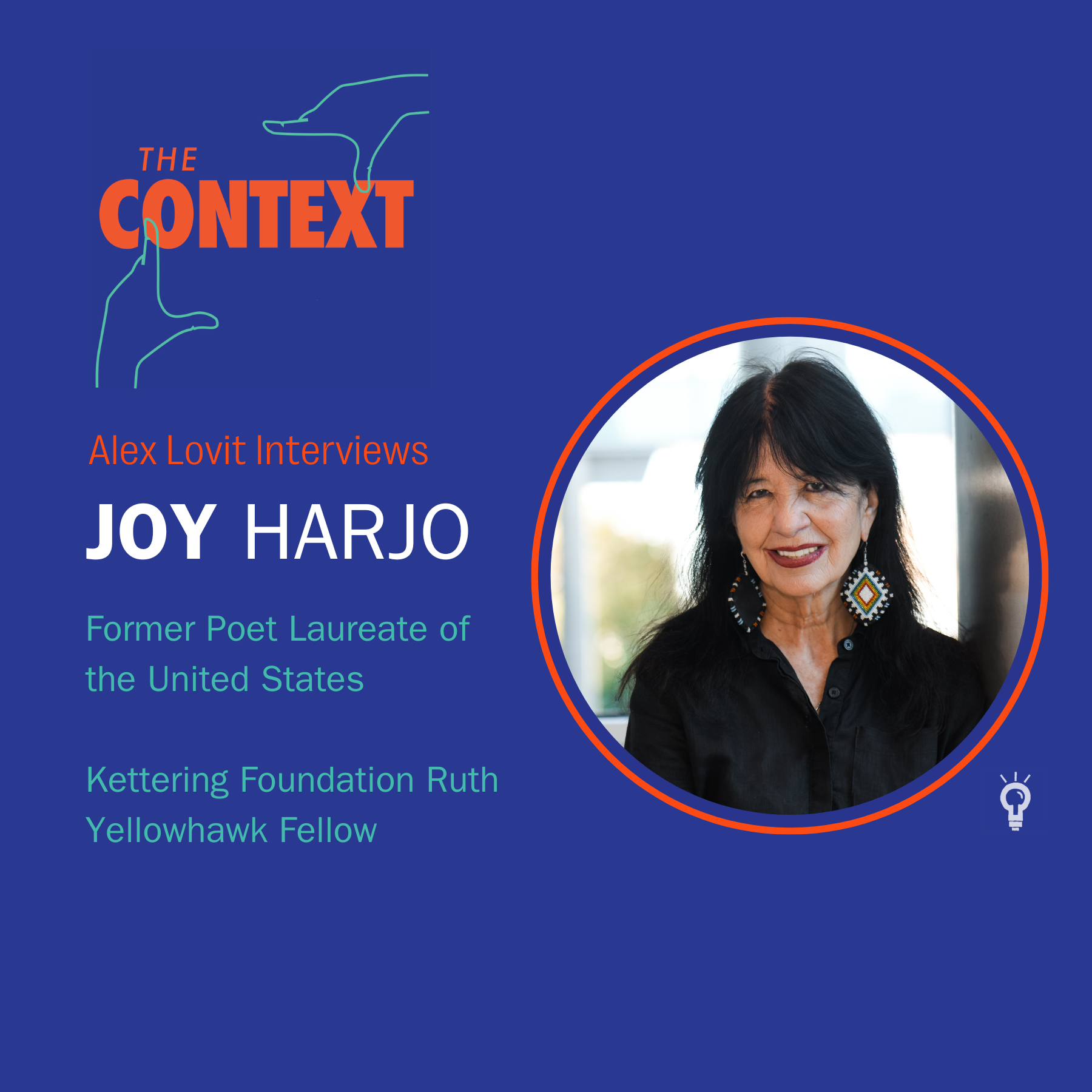
The news is full of stories of political crisis, and these stories are fed to us with speed and intensity through social media. The threats to democracy are real, but this media environment can leave us anxious, depressed, and helpless. In this episode, Joy Harjo joins host Alex Lovit to discuss how art can help nourish our souls, build our communities, and envision a more equitable and democratic society.
Joy Harjo served three terms as the first Native American poet laureate of the United States and has received a National Humanities Medal, among many other awards. She’s written eleven acclaimed volumes of poetry, alongside music albums, memoirs, plays, and children’s books. She serves as the Ruth Yellowhawk Fellow at the Charles F. Kettering Foundation.
Share Episode
We Are Under Cultural Stress. Art Can Help.
The news is full of stories of political crisis, and these stories are fed to us with speed and intensity through social media. The threats to democracy are real, but this media environment can leave us anxious, depressed, and helpless. In this episode, Joy Harjo joins host Alex Lovit to discuss how art can help nourish our souls, build our communities, and envision a more equitable and democratic society.
Joy Harjo served three terms as the first Native American poet laureate of the United States and has received a National Humanities Medal, among many other awards. She’s written eleven acclaimed volumes of poetry, alongside music albums, memoirs, plays, and children’s books. She serves as the Ruth Yellowhawk Fellow at the Charles F. Kettering Foundation.
Share Episode
We Are Under Cultural Stress. Art Can Help.
Listen & Subscribe
The news is full of stories of political crisis, and these stories are fed to us with speed and intensity through social media. The threats to democracy are real, but this media environment can leave us anxious, depressed, and helpless. In this episode, Joy Harjo joins host Alex Lovit to discuss how art can help nourish our souls, build our communities, and envision a more equitable and democratic society.
Joy Harjo served three terms as the first Native American poet laureate of the United States and has received a National Humanities Medal, among many other awards. She’s written eleven acclaimed volumes of poetry, alongside music albums, memoirs, plays, and children’s books. She serves as the Ruth Yellowhawk Fellow at the Charles F. Kettering Foundation.
Alex Lovit: There’s a tug-of-war in American culture — and government – that’s as old as the nation itself. Are we a country that welcomes and includes? Or do we divide and marginalize? We see it play out on the news, in the halls of Congress, in our town halls, in schools… But today we’re focusing on one realm that can help us explore and maybe even reconcile those contradictions: The arts. You’re listening to The Context. It’s a show from the Charles F. Kettering Foundation about how to get democracy to work for everyone—and why that’s so hard to do. I’m your host, Alex Lovit. My guest today is Joy Harjo. Joy served three terms as the first Native American poet laureate of the United States. She’s written eleven acclaimed volumes of poetry, alongside music albums, memoirs, plays, and children’s books. And she’s the Ruth Yellowhawk Fellow here at the Kettering Foundation. In our current moment of political anxiety, we need community, hope, and imagination. Joy is here today to tell us how poetry—and other forms of art—can provide those things. And help us build a more equitable and democratic society.
Alex Lovit: Joy Harjo, welcome to The Context.
Joy Harjo: Well, it’s good to be here.
Alex Lovit: You’ve been poet laureate of the United States three times, and I want to ask you about that, how it works. First of all, how do you find out? Did you know you were in the running? Do you get a letter in the mail? How does that work?
Joy Harjo: I was surprised. You don’t go expecting certain things. Rob Casper of the Poetry and Literature Center at the Library of Congress sent me a note and said, “What’s a good time to talk with you?” I sent him some times, and he calls. Instead of us just talking, he says, “I’m putting you on speakerphone. I have Carla Hayden here, the librarian of Congress,” and she asked, “Would you be the 23rd US Poet Laureate?” It felt like lightning, really, literally. It was like lightning, and I wasn’t… My first response was, “I’m already too busy.” I didn’t say that though. I sat there and took a breath, and I realized I had to say yes.
Alex Lovit: Tell me about the experience of being poet laureate. Are there assignments? What are the responsibilities of the poet laureate?
Joy Harjo: There actually are none, which I reminded my wonderful Library of Congress team when I was working away, but it’s really an honorary title, but every poet laureate makes it their own. I’ve always loved maps, and so, at my orientation, I headed over to the maps department at the Library of Congress and made friends over there and decided to do a map of native poets. We wound up as 47 poets who talked about place and put themselves on a map, they read the poem and talked about the poem, and all of that’s now archived.
Alex Lovit: I’ve heard you say that every generation feels like it’s living in some kind of crisis, but that this moment is a genuine crisis. I wonder if you could talk a little bit about that. How do you see this moment in American history, and what is the crisis?
Joy Harjo: I’ve come to understand that every generation is a kind of person of sorts. They come in, they take their first breath, they come of age together. We have a generation now who is coming of age. They’ve been through COVID. They’ve been through being isolated. They’ve come through an age where phones even take over computers. I have grandchildren who their phone is their community. It’s so different than the way it was when I was growing up or came of age where the stories came around the kitchen table or there was actual physical breath connection to our world. So what happens when you lose that center? Because we’re humans, we make community, and so the communities now are being made online, at a distance.
Alex Lovit: You mentioned in your most recent book, Girl Warrior, you told a story about how you felt that TikTok and other short form media were affecting your dreams, and I wonder if you just mind kind of sharing that story.
Joy Harjo: My dreams always, not always… There’s different kinds of dreams. There’s I ate pizza and drank too much beer dreams. There’s I have to give her presentation tomorrow. I dream about getting up and all the papers flying away and I’m nude. Those kinds of dreams. But then there are the dreams that have a certain kind of light and presence, and those are the dreams where you meet people who have passe and they come and visit you. There are dreams that show you something. They show you something you need to know, or they give you a kind of gift. I count on them. I learned a lot from them. My grandmother, my mother’s mother, was a dreamer. She would dream entire novels. She was a sharecropper. I think they just had a Bible in the house. My mother said that’s how she would get them to bed at night is that she dreamed novels and different lands and everything and would tell them to dream up to a point and then they’d be ready to go. They couldn’t wait to get to bed the next night.
My dreams can be wide-sweeping through time, but one night I realized that my dreams were being chopped up into reels or TikTok pieces. It was like eating cotton candy, which is really… not much there, but all it is sweet and it’s not nourishing you and you feel kind of lightheaded or you get jangly, and that’s what happened. My dreams were starting to turn into reels or TikToks, and I thought, “No, this is not good. There’s an addiction, and it’s an intense addiction, so I have to limit myself.”
Alex Lovit: Yeah, I like that story because not all of us are as in touch with our dreams as you are, but it’s a story about kind of the spiritual effects of social media, how it affects us on a pretty deep level, how our brains work.
Joy Harjo: I think so, and I think it works that way in the waking consciousness too. We find ourselves reaching for our phones. We have a moment, instead of just breathing in and feeling out what’s going on and listening, we’re on the phone, we pick up our phones. We’re not engaging as deeply as when we don’t have the phone right by our side.
Alex Lovit: So you’re talking there about nourishment and how TikTok video is maybe not very nourishing on a spiritual level, on an intellectual level. How do you think about your consumption of poetry or other art forms? How does that nourish you?
Joy Harjo: Poetry requires you to slow down and listen and look and breathe. I think if something is flipping by fast, I would imagine that maybe your heart rate or your mind rate, there’s a word for that, probably speeds up and maybe gets addicted to that speed. And then when you’re slowing down, it’s different. You slow down and read poetry. You slow down because it requires you to pay attention and to listen.
Alex Lovit: I don’t read a lot of poetry. For this show, I read a lot of non-fiction books about political science, so it was nice to have an opportunity to spend some time with poetry. I read a couple of your memoirs, and you would include poems in… you write prose as well as poetry, and I’d be cruising along in the memoir. I read a lot. I’m a fairly fast reader. And then I’d hit a poem, and I’d get like three lines in before I realized, “Oh no, this is a poem. I need to slow down. I need to be more attuned to meaning.” I guess I wonder when you’re writing, do you feel that difference? Is it slower to write a poem than it is to write prose?
Joy Harjo: Well, it’s different. I don’t know if it’s slower because you can agonize over a line or a paragraph in writing fiction, and the same, and I think people might be surprised about this, is that I research as much with poetry as I do for fiction, non-fiction, or whatever I’m writing. That’s what makes life interesting is, to be curious and to continue to learn about the world.
Alex Lovit: Well, I wonder if I could invite you to read a poem right now, and the one I have in mind is In Mystic because I imagine some research went into this poem.
Joy Harjo: Yes. This one directly involves history but also research. This one is In Mystic. That’s Mystic, Connecticut, beautiful, beautiful town, but there are layers of history almost anywhere you walk anywhere in the world. I kept thinking about what happened there, and I’ll read the poem first, but I think it becomes very clear.
“In Mystic
My path is a cross of burning trees,
Lit by crows carrying fire in their beaks.
I ask the guardians of these lands for permission to enter.
I am a visitor to this history.
No one remembers to ask anymore, they answer.
What do I expect in this New England seaport town, near the birthplace of democracy,
Where I am a ghost?
Even a casino can’t make an Indian real.
Or should I say native or savage or demon?
And with what trade language?
I am trading a backwards look for jeopardy.
I agree with the ancient European maps.
There are monsters beyond imagination that troll the waters.
The Puritan’s determined ships did fall off the edge of the world…
I am happy to smell the sea,
Walk the narrow winding streets of shops and restaurants, and delight in the company of friends, trees, and small winds.
I would rather not speak with history but history came to me.
It was dark before daybreak when the fire sparked.
The men left on a hunt from the Pequot village here where I stand.
The women and children left behind were set afire.
I do not want to know this, but my gut knows the language of bloodshed.
Over six hundred were killed, to establish a home for God’s people, crowed the Puritan leaders in their Sunday sermons.
And then history was gone in a betrayal of smoke.
There is still burning though we live in a democracy erected over the burial ground.
This was given to me to speak.
Every poem is an effort at ceremony.
I asked for a way in.”
Alex Lovit: That’s a really lovely poem, and there is obviously some history there you’re writing about.
Joy Harjo: Yeah, definitely.
Alex Lovit: I wonder, could you talk a little bit about the research that went into that?
Joy Harjo: Well, just looking things up, and I had heard that story of the Puritans because they’re important, I think, to understand if you’re looking at even where we are now in this country and how this particular entity called America was founded. The Puritans are very important part of that. So yeah, I was familiar with the Pequots, and I discovered that where I was walking, one area I was walking in, was where the parishioners are waiting for the men to go to war. Again, as is happening in Gaza and Sudan, other parts, they went in and killed women and children and burned the village down. Why? Because they had a belief that theirs was the only way, that they were superior, and that those lands that they had recently arrived on for religious freedom were theirs for the taking because God gave them to them. There’s the roots of a lot of what we’re seeing unfolding in this country, the attack of brown people, et cetera, et cetera.
Alex Lovit: Well, I want to ask you about that because… My background is in history, I went to grad school for that, and I know you pay a lot of attention to history. You’ve thought a lot about that. The story you’re telling in that poem is a hard story to hear, to feel that that is part of our nation’s history, and there’s many versions of that. The Muscogee Creek Nation that you’re a part of was part of the Trail of Tears, forced to migrate halfway across the country. Perhaps a third of the population died en route. You live in Tulsa. We could talk about the Greenwood massacre. American history is so rife with these examples of terrible moments of oppression and violence. But that line in that poem, “We live in a democracy erected over a burial ground,” is that possible? Is it possible to have a real democracy built on that foundation, on that historical foundation?
Joy Harjo: That’s a good question. I would have to think about that. I think that the Muscogee Nation has been called one of the old world’s oldest democracies as is with the Haudenosaunee people in upstate New York. But it’s based on, one, is that everyone has a story, everyone has a voice. So when it comes to decisions and decision-making, women and men both, they have equal voice, they have equal presence. Decisions are come to by consensus, not by force or false beliefs or all the ways that we see. Maybe that’s how we were set up, but we go astray. So I wonder about a larger construct of a master storyteller saying, “Okay. Let’s do this. We’re going to have a democracy, but we’re going to test it.”
Alex Lovit: Well, we’re being tested.
Joy Harjo: Yes, we have people here, Indigenous people here, who are living in democracies, and then people come ashore with swords and then there’s gun power. That’s where we were moved across country, was because of gun power and hordes of people arriving because they were fleeing for a lot of them. Many of them were just regular people looking for a place where they could have a home and grow food and have a safe place. And what happens? Why is the story maker doing this is is what I want to know. Why is the… How do we come to terms with history? Because we all have to, and maybe the one way for everyone to really see is to have it broken apart to really value. Sometimes, you don’t really value something until you lose it or until you’ve nearly lost it and you can reclaim it again is what I would like to think.
Alex Lovit: So you’re talking about democracy there?
Joy Harjo: I think so, yeah. I think that’s where I’m headed. That’s what I’m talking about. I don’t know. What do you do with this kind of history? If I think of all of us as a family, it’s important… There are horrible things that go on in our families, and there can only be healing when it’s brought up. There can only be healing happen when everyone is sitting at a table together in a democratic manner in which everyone has a voice and can have access, and part of that, towards understanding, is access to a higher consciousness. That’s where the arts come in really, and that’s where nature comes in. Here, they are. What brings higher consciousness and understanding and knowledge? Most of our knowledge isn’t in books. We need the arts. We need our presence in the natural world to have a kind of understanding that can go beyond this really low-level, duking it out for greed and addiction and all of that.
Alex Lovit: I want to ask for sure about how the arts can be useful in the current moment, in the current crisis, but I also want to follow up on something you mentioned that the Muscogee Nation was a democracy before the United States was. This is something a lot of historians have written about, that a lot of Native peoples may have helped to inspire the initial impulse of American democracy. Do you think there’s lessons we could learn now? Are there ways that those Native democracies could help the United States right now in our moment of crisis?
Joy Harjo: I think so. One, I think what’s at the root is a spiritual connection with yourself that comes out of the connection with the earth and with… Again, what democracy brings is an acknowledgement of connection between all living things. If you understand that no one is above or below you and that whatever decisions we make, we make together, and we make keeping in mind the personhood of a river, the personhood of the trees, the personhood of the animals, the personhood of each member of human society, that would be huge because, in that, we would look to the well-being of all.
People were considered insane, who tried to gain just… self for self-gain. If somebody started accumulating as many things as possible or bigger and bigger house, they would be considered insane in those Indigenous communities, because who does that in the Muscogee Nation, to gather something just for one person’s use like that, beyond what they need? Another thing is, in our societies, we didn’t have jails. You deal with things in a way that you don’t need to imprison, which has become a business that warehousing, particularly Black and brown people, it’s become a mega business. As my husband Owen Sapulpa says, “We had a really open immigration policy.”
Alex Lovit: Well, maybe too open, as it turns out.
Joy Harjo: I think it was too open, but again emphasizing that connection. I guess, too, you have a different sense of the world if you feel like that you were created by a creator who loves you and brought you into the world versus one in which you believe you’re a sinner and that you have to constantly repent. It shifts your view of the world.
Alex Lovit: How can art help with some of that stuff? If democracy requires a sense of connection of equality, can art help us get there?
Joy Harjo: I think that the artists, and I’m talking about across all the disciplines, are really the point people of culture because we go out a little ahead. Sometimes we’re not understood right away, and sometimes we don’t know what we’re doing right away, except that we’re bringing something forth in a different kind of way for kind of illumination. So that’s how I see art and the artists at work. That was performance art. A lot of what we saw going up in Portland, people are dressing up as characters, balloon characters. I have one of those outfits actually, a dinosaur outfit. It became a kind of street theater, but it was very effective. It made people feel joy. It brought about joy in the midst of devastation. That’s incredible.
Alex Lovit: Well, yeah, definitely art as protest.
Joy Harjo: Yes, art as protest.
Alex Lovit: Is that how you think about your role as a poet? Are you trying to be a point person for culture, or you’re trying to help to steer culture?
Joy Harjo: I’m just making art. I don’t have this grandiose idea about what I’m doing, or I probably would’ve never done it. I came to poetry because of my mother writing songs and singing, and it involves engagement with community, and poetry was something that was usually in books. But it wasn’t until I was… I didn’t start out wanting to be a poet. As I always joke and say, “Well, you don’t have poetry at Career Day.” I think about that about a lot of the arts. It’s really a kind of calling.
I went to the Institute of American Indian Arts, which was a Bureau of Indian Affairs school, but it was different in the sense that it was an experiment in Indian education where we had some of the best artists, Native artists and non-Native artists in the country, as our teachers. We still had a lot of the old BIA military stuff in place, like you had to make your bed tight and corner them, et cetera. You couldn’t speak your native language. But we were all there. We all had to submit art to get in. It was amazing in the late ’60s to be with young Native artists creating.
I didn’t take poetry then. I loved drawing. It wasn’t until I was at the University of New Mexico, and I wound up being kind of at the center where a lot of these Native writers were coming up, like Leslie Marmon Silko, for instance. I was a very active member of our Native student club. It was when a lot of the communities were dealing with extraction companies in the area… They were dealing with uranium companies, coal. When those people, those attorneys, would come out for community discussions, when they came out to “make deals,” quote, unquote, the people would call on university students and Native students to come out because we were being educated. They felt that we knew more than them about how to deal with people like this.
So I sat in a lot of those meetings. This is part of my motivation for becoming a poet, what really deeply moved me was hearing testimonies by community members, the ones who were keeping the land and keeping the knowledge. They would give testimonies that revealed genealogies of land relationships. I came to understand that embedded in human genealogies are genealogies of land and plants and those kinds of connections, and that’s what really started moving me along with my mother’s songwriting. But that gave me a kind of deep, wordless intent on writing poetry because, for me, it became about healing and justice.
Alex Lovit: So how do you see your work, your poetry? You’re also an artist, in other ways, you paint, you’re a musician, but how do you see that work as advancing justice?
Joy Harjo: Well, again, we go back to democracy, that everyone has a voice. My poetry-making came out of that, but it was also related to the art-making. The art-making is what artists do, or painters or fashion designers. We’ve got this huge upswing of Native fashion designers who are doing great. Well, what is in the designs? Well, it can bring… It’s like, “Okay. What plants are used?” It’s not just about the artist and their connection with the piece, but it also has to do with the materials. It also has to do with when, where, and how and why that piece of art was connected and how it emerges out of a cultural, I don’t want to say mayhem, well, I do want to say mayhem… how it emerges out of cultural stress, because it’s needed. We go back to nourishment that the people need. We may not even know we need it yet, but it helps move thought, compassion, insight forward.
Alex Lovit: So if we are in a moment of cultural stress, political stress, does your relationship with art change as a consumer or as a producer?
Joy Harjo: I think there’s an urgent… I know, especially with poets, there becomes an urgency. I’m with a school of poets that are… we call it truth-tellers. I don’t belong to a particular school of poetry, but I feel that we’re charged to be truth-tellers. I think especially when you come from people or a culture, you’re on your own lands, but you’ve been under genocidal attacks to destroy you, then your art becomes even a more potent and needed tool in particular, I think. Then you start having a different relationship with what you are.
There is an urgency, and I feel that urgency in the art-making world because what we thought, at least my generation thought, that we had sealed it up, a done deal, for say, Roe versus wade, say for certain rights, Native rights and obligations by the United States government to fulfill Treaty rights. For example, civil rights, when we thought these things were done deals and now they’ve been undone with a flick of the wrist, so to speak, yes, I think the art-making for this period becomes somewhat more intensely directed. I know that it was a pejorative term in graduate school. Political poetry was a pejorative term.
Alex Lovit: Well, all poetry is political.
Joy Harjo: Yeah, but that’s what I was going to say. Everything is, even that I’m breathing here and that we’re talking with each other. All of it, all of it’s very political.
Alex Lovit: You talked about yourself as a truth-teller. I think in our political climate right now, we’re seeing some attacks on the truth. Can art help us in this moment when there are fewer opportunities to tell the truth?
Joy Harjo: I think so. Sometimes to even be safe or to keep yourself from being taken down, you rely back on archetypes and satire and other ways to tell stories. I’m going to read a poem called Rabbit is Up to Tricks. Rabbit is the trickster figure for our Muscogee people, also for a lot of West African tribal groups. We all have trickster figures. For some, it’s coyote. For us, it’s rabbit. Usually, you find tricksters around seats of power. Some of them are placed there like jesters and so on because people need to be reminded, and that’s why some of these trickster stories that if they’re holding power, any power that we have, whether it’s the power of running a nation or power of taking care of your own soul, that the power doesn’t belong to you. It’s a gift to be shared, and people can forget that. And then in the strangest times, the trickster winds up sitting in the seat of power.
“In a world long before this one, there was enough for everyone,
Until somebody got out of line.
We heard it was Rabbit, fooling around with clay and the wind.
Everybody was tired of his tricks and no one would play with him.
And he was lonely in this world.
So Rabbit thought to make a person.
And when he blew into the mouth of that crude figure to see what would happen,
The clay man stood up.
Rabbit showed the clay man how to steal a chicken.
The clay man obeyed.
Then he showed him how to steal corn.
The clay man obeyed.
Then he showed him how to steal someone else’s wife.
That clay man obeyed.
Rabbit felt important and powerful.
And clay man felt important and powerful.
And once that clay man started, he could not stop.
Once he took that chicken, he wanted all the chickens.
Once he took that corn, he wanted all the corn.
And once he took that wife, well, he wanted all the wives.
He was insatiable.
Then he had a taste of gold, he wanted all the gold.
Soon it was land or anything else he saw.
His wanting only made him want more.
Soon it was countries, then it was trade.
The wanting infected the earth.
We lost track of the purpose and meaning for life.
We began to forget our songs, our stories.
We can no longer see or hear our ancestors,
Or talk with each other across the kitchen table.”
Or in the house or in the Senate.
“Forests were being mowed down all over the world to make more.
And Rabbit had no place left to play.
Rabbit’s trick had backfired.
Rabbit tried to call that clay man back,
But when that clay man wouldn’t listen,
Rabbit realized he made a clay man with no ears.”
Alex Lovit: Yeah, that’s a funny poem. I like that one a lot. What strikes me about it, I don’t know if this is what your intent is, but it feels like a poem in part about leadership.
Joy Harjo: It is, and I wrote it some time ago, but it’s funny how it’s coming to its time. It’s like I was saying, “Sometimes as point people, artists, you’re working on things and you don’t really…. It may not fit itself into time at the beginning, but it finds its place, or it can find its place.” This one, it’s interesting how it’s been almost prophetic.
Alex Lovit: Well, yeah, we’ll see how our current country’s Rabbits and clay men proceed over the next few years. I want to ask about art as how that can help people right now. I think we are in a moment of political crisis. We’ve talked about that on the show. We’ve tried to give people advice for what they can do to help preserve and expand American democracy rather than allow it to crumble. But I’m wondering what your advice to people would be right now who are feeling powerless, despondent about the current moment, how could they turn to art, use art, think about nourishing themselves for the fight ahead?
Joy Harjo: By partaking in art reading, stopping all of the… because there is a lot of anxiety. We all go through it. I’ve discovered music really helps me get through. I’ve been listening to these rotations of heartbreak songs. I kind of happened on that, and I realized that when I put those heartbreak songs on, it does something and my anxiety starts sliding away. Partly, it’s the music. People come out of concerts energized, whether it’s heavy metal or Billie Eilish or Kendrick. People come out together because when you’re in a big group like that, enjoying, your hearts all want to beat to get start… It’s a physiological thing. Your heart starts. So gathering with people who are listening to poetry readings or stories or storytelling or going to concerts or things like that where you feel like you’re in a community, but also in doing it…
Writing, it helps to write… You don’t have to write poetry. You can start writing to write down your experience. It’s so particular and even exotic to somebody else about what you’re experiencing. Our stories are what makes history. All of us are in this story that ultimately will grow incredible spiritual muscle. We will make it, somehow or the other. Because if you do, if you go back and read poetry from World War I, World War II, read poetry from people who just came out of slave ships, read Native poetry from… embedded in that are stories like this of these times and how people… what they saw and what they understood and how they move through because we are their descendants. People made it through. This is not the first time. As Native people, we look at this and say, “Oh, we’ve been through this before. We’ve been through this. We know what this looks like.”
Go out and see art, watch dance, go out and dance, but be a participant. Another is to give back in some way, food banks, make sandwiches and take them out to people on the street. That really helps, especially if you get dealing with grief. I think we’re dealing with deep grief right now, but those are all ways. It’s really about making a connection with who we really are at heart.
Alex Lovit: I love that answer. It’s a very hopeful… that we have been through hard times in the past, and we can get through this one again. Anytime we can end this show on a note of hope, I like to do so.
Joy Harjo, thank you for joining me on The Context.
Joy Harjo: Well, thank you for having me on here. Appreciate it.
More Episodes
 Published On: February 11, 2025
The United States is the wealthiest nation in the world, but millions of its citizens live in poverty. What prevents poor, low-wage,...
 Published On: January 28, 2025
Why do so many Americans think tax breaks for the uber-wealthy will help the average person? According to Jeffrey Winters, the answer...
 Published On: January 14, 2025
The separation of church and state is a foundational principle of American democracy, but that doesn’t mean that religion hasn’t played an...
 Published On: December 17, 2024
“Administrative burdens” is a term for the frictions people experience when interacting with government—learning how a program works, taking the time to...
 Published On: December 3, 2024
In 2015, Crossroads Church, a majority-White evangelical megachurch based in Cincinnati, Ohio, launched a new program to address racial division and racism....