
What’s Required for a Free and Fair Election in 2026?
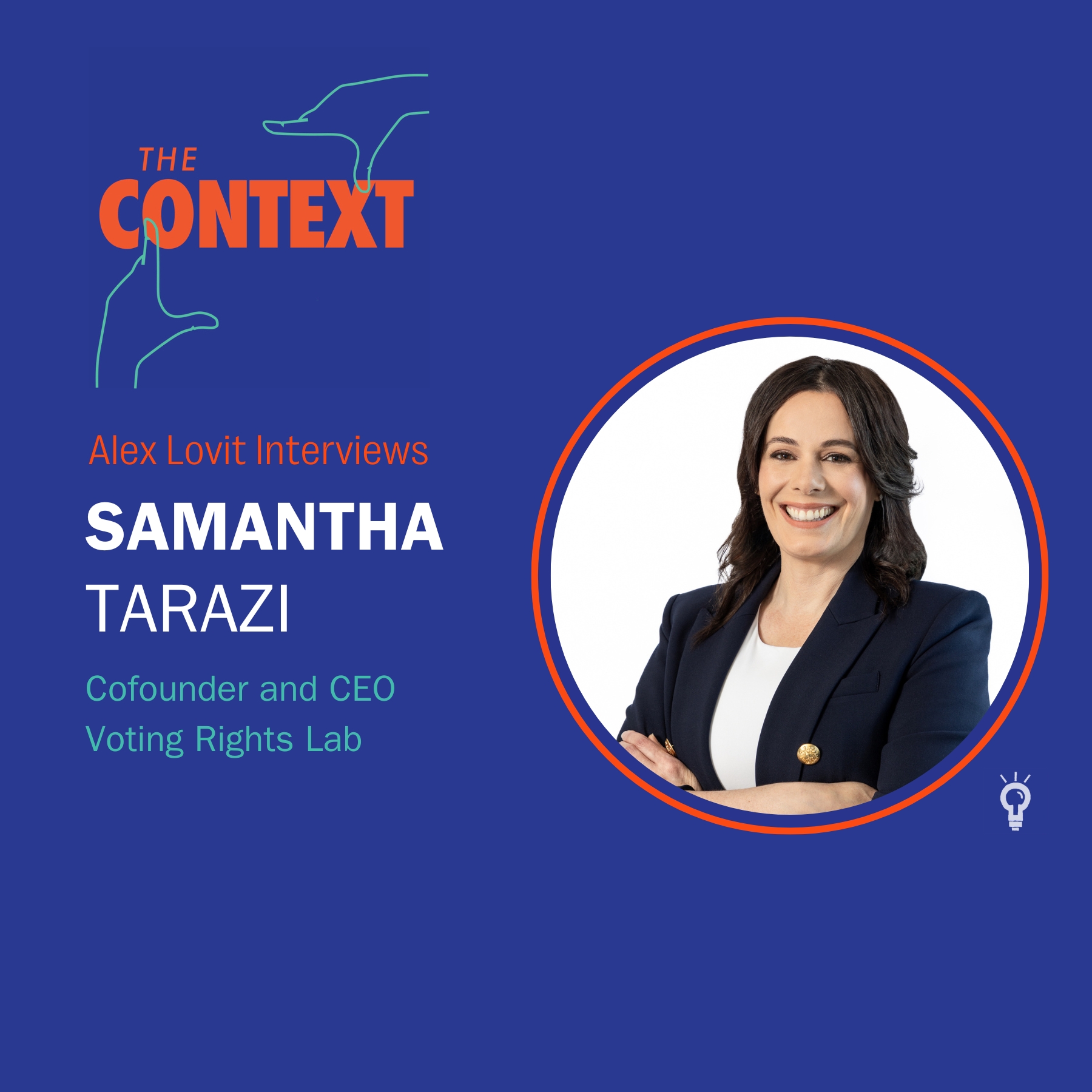
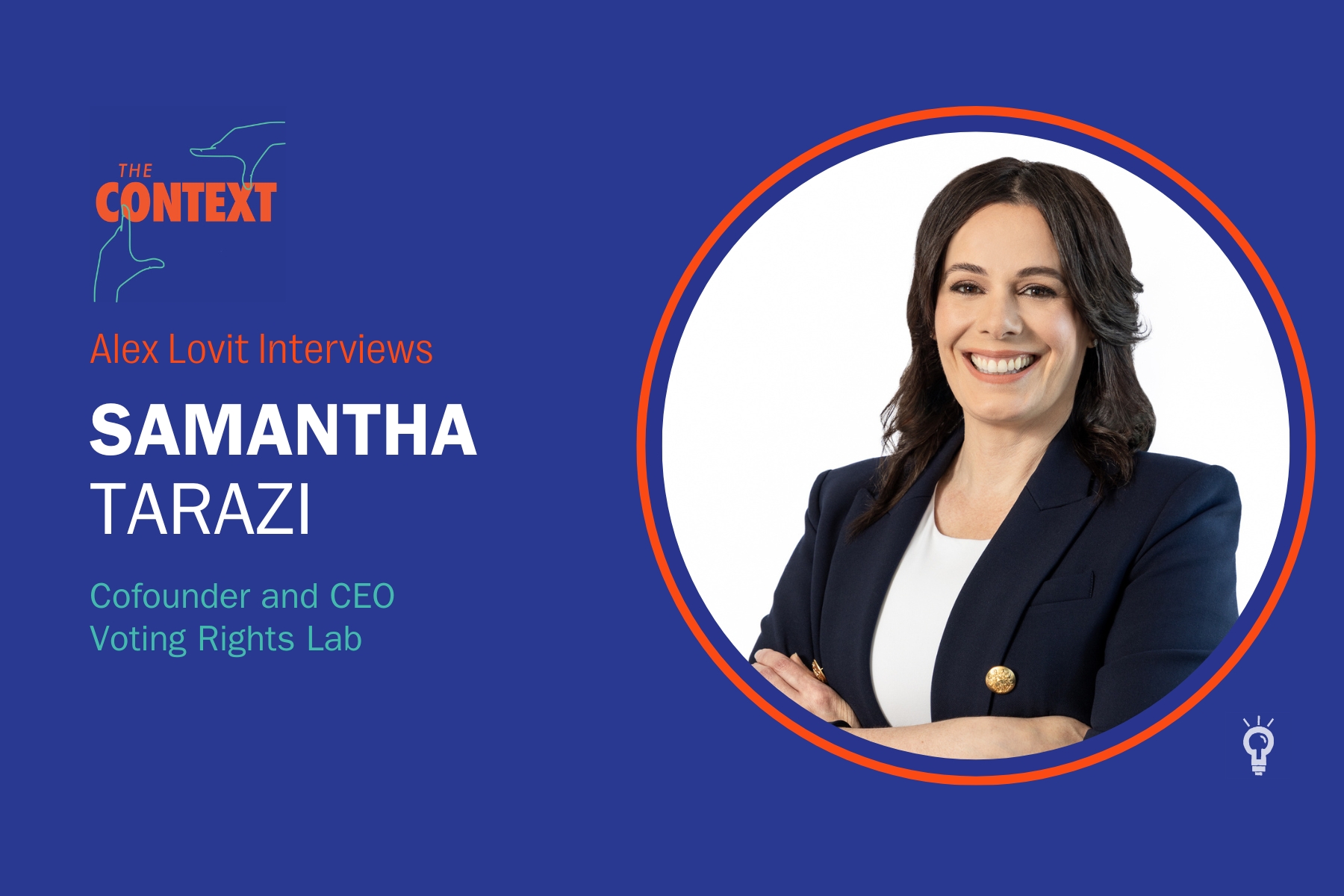
Free and fair elections are an essential component of democracy. But fair elections face a number of threats in the United States right now. Onerous ID and proof of citizenship requirements exclude millions of legal voters. And lack of legal clarity about the process to certify results creates the risks of post-election chaos. Samantha Tarazi joins host Alex Lovit to discuss these and other threats to American elections.
Samantha Tarazi is the cofounder and chief executive officer of Voting Rights Lab, a nonpartisan, nonprofit organization securing and expanding the freedom to vote in all 50 states since 2017. Her voting and elections policy expertise has been featured in major national and in-state publications. Previously, as the inaugural chief engagement officer at Everytown for Gun Safety, Sam helped grow Moms Demand Action from a Facebook group into a national network of over 55,000 volunteer leaders working to advance gun safety education and policy.
Share Episode
What’s Required for a Free and Fair Election in 2026?
Free and fair elections are an essential component of democracy. But fair elections face a number of threats in the United States right now. Onerous ID and proof of citizenship requirements exclude millions of legal voters. And lack of legal clarity about the process to certify results creates the risks of post-election chaos. Samantha Tarazi joins host Alex Lovit to discuss these and other threats to American elections.
Samantha Tarazi is the cofounder and chief executive officer of Voting Rights Lab, a nonpartisan, nonprofit organization securing and expanding the freedom to vote in all 50 states since 2017. Her voting and elections policy expertise has been featured in major national and in-state publications. Previously, as the inaugural chief engagement officer at Everytown for Gun Safety, Sam helped grow Moms Demand Action from a Facebook group into a national network of over 55,000 volunteer leaders working to advance gun safety education and policy.
Share Episode
What’s Required for a Free and Fair Election in 2026?
Listen & Subscribe
Free and fair elections are an essential component of democracy. But fair elections face a number of threats in the United States right now. Onerous ID and proof of citizenship requirements exclude millions of legal voters. And lack of legal clarity about the process to certify results creates the risks of post-election chaos. Samantha Tarazi joins host Alex Lovit to discuss these and other threats to American elections.
Samantha Tarazi is the cofounder and chief executive officer of Voting Rights Lab, a nonpartisan, nonprofit organization securing and expanding the freedom to vote in all 50 states since 2017. Her voting and elections policy expertise has been featured in major national and in-state publications. Previously, as the inaugural chief engagement officer at Everytown for Gun Safety, Sam helped grow Moms Demand Action from a Facebook group into a national network of over 55,000 volunteer leaders working to advance gun safety education and policy.
Alex Lovit: This November, voters will decide whether the Republican Party will continue to control both houses of Congress in addition to the White House. If the Democrats don’t take back power in the House or Senate, then the Trump administration’s authoritarian policies will continue to be unchecked, which has a lot of people saying that this midterm election could determine the future of American democracy. But it’s not just the outcome of the November elections that matters, it’s also the way elections are carried out. My guest today has made it her job to identify flaws in the election system so we can try to fix them before it’s too late. You are listening to The Context. It’s a show from the Charles F. Kettering Foundation about how to get democracy to work for everyone and why that’s so hard to do. I’m your host, Alex Lovit.
Today I am speaking with Samantha Tarazi. Sam is the co-founder and CEO of Voting Rights Lab. It’s a non-profit that researches and analyzes election policy in the United States. Sam focuses a lot on policies that decide how elections are carried out at the state and county level because despite the Trump administration’s attempts to change elections policies, those decisions aren’t up to the White House. So, today on the show, we’ll learn where the vulnerabilities and inequities actually are in our elections and what we can do to solve them.
Sam Tarazi, welcome to The Context.
Samantha Tarazi: Thanks so much for having me, Alex. Great to be here.
Alex Lovit: So, you think a lot about elections and here we are in an election year. What’s a nightmare scenario if things go really bad in November, like democracy breaking bad, what does that look like?
Samantha Tarazi: We often imagine democracy’s downfall occurring in a sudden coup or even in the outright cancellation of elections. But in the 21st century, that is rarely how it works. It’s more that modern autocracies begin with a democratically elected strongman, and then once in power, those leaders weaken democracy bit by bit. So, each move is typically small enough that most of it goes unnoticed, but then together it’s like a coordinated assault on free and fair elections. And what we should expect to see and watch out for this year is a slow chipping away of our institution of elections. We should alarmed that we are in a backsliding democracy and in backsliding democracies, elections are under pressure to bend. So, it can be hard to see that big picture. The president and his allies are pushing marching orders to state legislatures to really chip away and change our election laws in the states. That’s the first piece.
The second piece is that even though the president and the administration does not technically have authority over elections, because the constitution is clear that that authority rests with the states and Congress, they’re still leveraging their power and weaponizing the DOJ to intimidate election administrators and voters alike. And then the third piece, which is if all of that fails, the administration is preparing to manipulate and eventually overturn election results they do not like.
Alex Lovit: It Sounds like the third part of that would be the kind of you wake up the next day and there’s a newspaper headline that elections overturned that might be very dramatic, might be kind of obvious that something has gone wrong with the election, but the first two parts may be not so obvious and maybe in that more gradual erosion way, the concern is that 2026 is less democratic and then 2028 is less democratic and then 2030, and then at some point we can no longer call ourselves a democracy. What should we be looking for? What would be signs of trouble in this year that would indicate we are on that path of slow erosion?
Samantha Tarazi: Yeah, so especially in the first half of this year, the thing to pay attention to is changes to our elections in the states in response to the president’s sort of broadcast system, either via social media or executive orders that often trickle down into copycat legislation in the states. So, what to look for there is policies and proposals that narrow who can vote. This is presented under the false pretense of preventing non-citizens from voting, but actually it’s really for the purpose of excluding eligible voters. Each state already has a system for verifying voter eligibility and citizenship. And when Kansas, as one example, tried a proof of citizenship bill during the three years that it was in effect, more than one in eight eligible voters were blocked from voting. So, this is a very chaotic policy that ultimately results in eligible voters in the millions potentially being blocked from participating.
And the way that this plays out is that the president will broadcast marching orders and then the states is where the fight will play and where we have the ability to stop it. There’s also a whole other slew of policies and proposals like restrictions on voter registration efforts, imposing new requirements on overseas service members and students that will limit their ability to participate, attempts to legislate really aggressive voter purges. Then there’s a whole bunch of efforts to make it harder to cast a ballot and more likely that those ballots will get tossed out, like restricting the use of mail ballots to eliminating early voting days and hours and locations to cutting ballot return deadlines to make it more difficult to vote by mail or ensure that your ballot is counted.
And then probably most importantly, there are category of policies that we are seeing that are designed to weaken the safeguards that keep our elections fair. There will also be legislative proposals to take over non-partisan election administration in key counties that see really high engagement and turnout. There will certainly be legislation attempting to require hand counting of ballots and restricting the use of tabulators, which throws our elections into chaos. So, this is giving you a sense of the way that the administration is attempting to change our elections by pressuring state legislatures to fundamentally erode the rules that keep them fair.
Alex Lovit: Let’s talk a little bit more about the policies that might keep people from accessing the ballot. For example, there’s been first a federal push both through Trump’s executive order and through the SAVE Act for proof of citizenship requirements. That has not happened at the federal level. So, it is happening state by state. Who gets excluded by those policy? Well, I guess first of all, what do you need to prove citizenship?
Samantha Tarazi: Yeah. So, the core vision that the president is putting forward with proof of citizenship is that you would have to show a passport or a birth certificate to register to vote. The people who are most impacted by that are typically rural Americans, Americans of color, lower income Americans, just think about people who are probably be less likely to get a passport and that’s who would be most affected by that. You can also show a birth certificate to register. The problem without, obviously, I don’t know about you, I’m a fairly organized person, but I could not tell you right now where my birth certificate is. I think that’s probably the case for a lot of people.
Alex Lovit: It’s hard to keep track of things when you’re an infant.
Samantha Tarazi: Yeah, exactly. So, when it comes to birth certificates, the group that is most impacted here is actually married women who have changed their names and don’t have a birth certificate that matches their current legal name. According to our research that is roughly half of voting age women in this country. So, we’re talking about a significant number of people who would be impacted by proof of citizenship bills, keeping in mind that it is already the law that you have to be a citizen to vote in federal elections. And every state already has a system for confirming voter identity and eligibility and citizenship. It is not that no one is checking for these things, it’s that it happens on the back end through the government that has access to this information for you. The idea that you then need to put that on the voter as a barrier to be able to register to vote is actually just a recipe for chaos.
I mean, one in eight eligible voters being blocked from voting is a significant number. We’re talking about millions of voters, but it’s also extremely expensive and very hard to administer if you just think about the red tape and the bureaucracy that would go into implementing a policy like that. And that’s why proof of citizenship is such a problem.
Alex Lovit: As we stand right now at the start of 2026, what policy changes have already put in place in states that damage voting rights?
Samantha Tarazi: Well, Florida recently just made it much harder for non-partisan voter registration groups to run voter registration drives and groups that violate the new restrictions, which include things like if you turn in applications late or fail to record certain information, they risk massive fines that could bankrupt them. So, I think we’re seeing a real chilling effect on voter registration. There have been a number of attacks on mail voting in particular that have become law in a handful of states, as well as some attempts to restrict the use of early voting.
Alex Lovit: So, those are things that are already in place. And now we’re at the beginning of the year, there’s going to be a legislative session, a state legislative session in most states where they could pass new laws that would have implications for the upcoming election. So, now is a good time to take a look at what might be coming up. What are you worried about passing in states across the country that would damage voting rights?
Samantha Tarazi: It’s hard to ask me to choose the one thing I’m most afraid of. If I were to point to a single policy that is of the greatest concern, I would say, pieces of legislation that have been proposed that change the role of election certification from being non-discretionary and compulsory to giving those people in the role of election certification full authority to investigate or use their own discretion into whether or not they want to certify election results is what scares me the most.
Alex Lovit: So, I want to ask about the role that certification plays in elections, but let’s back up a little bit and let me ask in general, how do elections work? And I know it’s different in all different counties and states, so that’s a more complicated question than it appears. 100 million Americans are going to vote this year and all those votes need to be secret, but they also need to be accurately counted. How does the system ensure that? How does it ensure that I can be confident that my vote is accurately counted at the end of the day?
Samantha Tarazi: It’s a great question. I’m glad you asked. So, let me give you a brief primer here. Teams of people from both parties work together at every step of the voting, counting and reporting process to ensure that every election, no matter where you live is safe, fair, and accessible. Now, you’re right that every state does it a little bit differently. So, maybe let me walk you through an example state. Let’s pick Georgia because it’s a good example of those checks and balances in action. Each political party is given the opportunity to appoint two official poll watchers at each precinct who monitor the steps of the counting process. Then the next stage in our elections is called the canvas, and it includes an audit process to confirm accuracy. So, once each of those precincts tabulates all of their ballots, they report that vote total to county officials and then county officials then hold a public meeting where each precinct’s results are officially consolidated.
And that’s the point where county officials can investigate any discrepancies. So, for example, if a precinct returns 1,000 ballots that they show 1005 votes cast in a particular race, they go back step in and work with that precinct administrator to resolve the discrepancy to make sure that they line up one for one. That’s also the point where precinct officials conduct their own audit. So, in Georgia, the officials, they manually inspect a random sample of ballots in public view. So, these audits in which in Georgia take place before results are certified are another example of the ways that the checks and balances are designed to keep our election secure.
And then the last stage in that process is called certification. This is the final step. So, the counting and the canvassing processes that happen before are designed to catch and resolve any and all concerns around the results. And then once those steps are complete, the local officials officially certify the local races and county officials certify county races and the Secretary of State certifies statewide and federal contests. So, the system contains multiple checks where teams of workers, teams of observers from multiple parties are involved in each step and every step is verified.
Alex Lovit: So, if all of that sort of verification and auditing and random sampling and all that’s happening before we get to certification, why do we need certification?
Samantha Tarazi: It is the official part where the results are said they’re done, the canvassing part is in order to verify the results, and then they’re aggregated across jurisdictions. And then certification is the official stamp to say this process is done.
Alex Lovit: What you’re saying you’re worried about is that we’ll get all the way. So this is post-election, the election has already happened, and we’re trying to determine what the results of the election are and we’re getting towards the end of that process, and the certifier refuses to certify. What does that look like? What would happen?
Samantha Tarazi: Yeah. The way that challenges to election results have really played out, the most common has been at that certification stage where someone or multiple people in the role of certifier have refused to certify results typically under partisan pressure from the president or his allies. So, this has happened in 2020 in Wayne County, Michigan, in 2022 in Cochise County, Arizona, also 2022 in Surry County, North Carolina, 2024 in Washoe County, Nevada and 2024 in Waynesboro County, Virginia. And in each of those instances, either the certifiers who refused to certify, eventually followed through and did their jobs in the face of public pressure or a court ordered them to certify or the state had clear processes for removing them and replacing them if they were refusing to do their jobs. And this brings up a really important opportunity for states. So, in all the examples that I mentioned, the law worked, which demonstrates why it’s so critical that the state law is clear.
Some states are lacking clear statute that defines certification as non-discretionary. Some example states are Arizona, Georgia, New Hampshire, and Pennsylvania. Other states are lacking clear procedures to compel certification if a certifier doesn’t do their job. This includes Texas, Maine, Ohio, Virginia, Georgia, and Pennsylvania just as some examples. That’s one of the primary ways that the certification process is being interfered with. There’s three other ways I would like to get into as well.
One is challenges to the eligibility of voters on state registration lists. So, you may have heard about the North Carolina Supreme Court candidate, Jefferson Griffin who lost his election in 2024, and he attempted to overturn not defeat through litigation, challenging 65,000 ballots that were cast by claiming voters had incomplete voter registration lists. And part of his challenge specifically targeted ballots cast in six Democratic-leaning counties, this dragged on for six months. So, it’s really important here. What this highlights is that states can protect against these types of challenges by strengthening their list maintenance practices. They need to really make sure that their voter registration lists are up-to-date and accurate. So, that’s one of the angles.
The second angle is to use that window of time between when the polls close to when the results are reported to sow doubt about the legitimacy of election results. So, what you need to know about delayed election results is that they are inevitable in really close races where every vote has to be counted in order to figure out who won. But there still is a lot that state leaders can do to speed up election returns and prevent that key window from being exploited. Election officials can verify preprocessed mail ballots as they come in. They can provide early voting opportunities, they can reject efforts to mandate the hand counting of ballots. Those things all reduce delays. And meanwhile, they really need to be providing regular public updates about the status of the count.
And then the last category that we see here is exploiting imperfect audit processes in order to question the validity of results. So, you might remember in Arizona in 2021, the state legislature pursued a really partisan, pretty conspiracy-driven audit, supposed audit of Maricopa County’s election results following the 2020 election. It was conducted by an organization called the Cyber Ninjas that had no training or experience performing election audits. It dragged on for months and it really fueled a lot of false narratives around the integrity of Arizona’s elections.
And so, this is an example of an opportunity where states really should implement policies that complete their audits before certifying results. For example, Michigan, Wisconsin, Florida or just a few states that do not complete their audits until after certification, which creates an opportunity for all kinds of bad faith actors or losing candidates to throw those results into question, which then in turn creates opportunity for more Cyber Ninja boondoggles. So, those are the four main ways that challenges to election results and attempts to overturn the results manifest. But each one of them is built off of exploiting a weakness in state law. That’s why there’s so much opportunity for state lawmakers to actually strengthen our elections and insulate the integrity of our elections against election manipulation from losing candidates.
Alex Lovit: So, what you’re saying is these are all kind of excuses that certifiers might make to refuse to certify. I do have one question because you’re mentioning this often happens at the county level. What happens if every county in the state certifies except one? What happens at that point?
Samantha Tarazi: Well, it depends on if the race in question is a statewide race or a federal race, in which case the results couldn’t be called. So, in the case of the Supreme Court race in North Carolina, it was a statewide election. The question was unanswered for six months. It was a drawn out process that meant that this state could not seat its elected Supreme Court member. In other cases where the election has more national implications, then that means that we could see the final results of congressional elections or presidential elections be held up while these local challenges are taking place.
Alex Lovit: So, it’s not just that you need certifiers at the state level that are going to operate in good faith, but you actually need at every single county in the state that people are going to operate in good faith.
Samantha Tarazi: Absolutely, and I should say for the most part, those people in those roles, there are thousands of election certifiers in county level roles across the country. For the most part, they are local everyday heroes who are doing a job that had up until a few years ago, been mostly invisible and definitely not politicized in the way that it has been. I think a number of the examples that I give you earlier of election certifiers failing to do their job, a number of them said they were just responding to really outspoken protests from voters in their area and they had never dealt with an influx of that pressure before. So, I think one of the things that I want your listeners to know about this is that it’s incredibly important that people in the position of election certification roles need to actually be hearing loud and often from voters who want the results of the election no matter what they were to be upheld. And that is different than who has been most outspoken in the past.
Alex Lovit: All right. So, if you’re worried about the election this year, you can contact your board of elections, thank them for their service, and try to encourage them to do the right thing so that they’re not only hearing from anti-democratic forces.
Samantha Tarazi: Exactly.
Alex Lovit: I do want to ask about another piece of advice that you have for our listeners I think is that not just interacting with elections officials, but also interacting with state legislatures. So, we are entering a year when the laws being passed about voting regulations are going to be really important. Some of those laws could be really harmful laws that might restrict voting access, that might require onerous ID requirements or proof of citizenship requirements. Other laws could be positive to tighten and strengthen the certification process so that we can avoid some of these problems you’ve been talking about. And then all that’s a really complicated story because there’s 50 states and some of them are headed in different directions. So, how should people figure out what’s going on in their state?
Samantha Tarazi: There’s a couple of things that I would recommend and I would start by saying you cannot burden yourself with knowing and following and understanding everything. I would pick something that really motivates you or feels important to you, and that is a way to do your part. My team at Voting Rights Lab is tracking each and every effort to bolster or dismantle all of these checks and balances that safeguard our elections. And we’re going to continue to monitor how the administration and the courts and state lawmakers are changing election laws ahead of 2026. So, if you want to follow those changes to state election laws, you can sign up for our newsletter at votingrightslab.org, but I would also say there’s some other very important things for people to do. I would make sure that your voter registration is accurate ahead of election day. The other thing I would say is that when and where you have the opportunity to engage with people whose opinions differ from yours, I would highly encourage you to do that.
When we look at the original story that the president has been selling, if you live in such an echo chamber that you never have exposure to anyone who thinks differently from you, you are much more likely to believe the president’s story that he won the 2020 election and that our elections are not trustworthy. So, when we think about the things that we can do as individuals, one of the things we can do is talk to people whose opinions differ from our own without making it divisive or hypercharged. I grew up in a small town in the mountains of Oregon. When I was a kid, I’d ask the grownups in my family why they voted for Democrats. And what I heard over and over again is that Democrats are for people like us and you fast-forward to today and some of those very same family members have been swept up by Trumpism after years of really feeling unseen and forgotten in our politics.
That shift taught me something important about the work of securing free and fair elections, that you really can’t protect a democracy without the people who feel furthest from it. And if they feel shut out or dismissed, our system becomes weaker and more vulnerable to the politicians who want to manipulate it. So, I really truly believe that we can’t secure the future of American democracy without people like my family. They have to feel welcomed into the pro-democracy coalition that we’re building.
And I think there’s some good news there. The vast majority of Americans across parties, across political ideology, they still really believe in the fundamental importance of free and fair elections. Very few people in this country who want politicians deciding election outcomes instead of voters. It’s that belief that they need to be part of our coalition that I carry into our work every day. And so, that’s kind of the story behind why I co-founded Voting Rights Lab in the wake of Trump’s first election, and I think a story about how it’s really important to not get stuck in the trap of polarized politics when you are looking at something as fundamental as democracy.
Alex Lovit: As evidence that most Americans want free and fair elections, the fact that so many Republicans believe that 2020 was stolen, that is a false belief, but it is a belief that we need fair elections and that has become a very partisan issue. So, I’m looking at some polling from Pew after the 2020 elections, only 21% of Republican voters said that elections had been run and administered well. So, after an election loss in 2020, 21% said it had been a fair election. After 2024, big difference, winning an election, 93% say that the election had been administered well. And then there’s a little bit of the reverse story among Democrats. So, 94% were confident after the 2020 election, which they won, and 84% in 2024 after a loss. So, there’s a little bit of a kind of loser’s bias in both cases. You’re more likely to trust elections that your preferred candidate won than trust elections your preferred candidate lost. But there’s a huge partisan divide between how Republicans are responding to that and how Democrats are responding to that in recent election cycles. Do you have any thoughts on why?
Samantha Tarazi: Yes, I do. I think you’re absolutely right to acknowledge that if someone’s candidate lost, they’re going to feel much less confident in the system and just reflect more negativity in general. It’s become a little bit of just a calling card in Republican circles to just say, “Oh, yeah, that election in 2020 was fraudulent or unfair.” But often when you unpack that, there’s a number of those voters who are like, “Well, it’s not that I think necessarily that Joe Biden actually lost and Donald Trump actually won, but there’s too much money in politics, and I think the media is biased.” And so, there is actually a layer of just people expressing frustration with the system that they think is generally rigged in a certain direction. I think it’s very hard to find any sort of wiggle room in that because it’s just a calcified partisan issue at that point. You’re on one team or another. You say it this way or that way.
Alex Lovit: But can American democracy survive if one of the two major parties is going to deny every election loss?
Samantha Tarazi: Yeah, I think it’s a huge risk. The stories, the disinformation that is woven and told to the American public exploits their fears and gears them up to distrust the results. That’s why it’s really important that we actually take steps to increase the accuracy and the transparency of our elections to make them much less vulnerable to that type of disinformation. There is a trust dynamic that I think might be helpful to talk about here too, which is when you look at this deficit of trust, particularly amongst Republicans, it tends to be the greatest when you look at national issues. So, if you say, “Do you think that your local election was adequately administered, it was fair that your vote was accurately counted?” That trust tends to be much higher. And then when you ask that same question about state issues, it’s a little bit smaller, and then when you ask it about national issues, it goes down much more.
Alex Lovit: Yeah, the fraud is always somewhere else.
Samantha Tarazi: Exactly. Like, “That state is clearly getting it wrong, but I’m sure that my state’s doing it right.” And so, I do think that this highlights the important role of total transparency and responsiveness in the system. We need to shore up our elections so that there are less opportunities to weave false narratives around them so that they are more transparent, so that they are more timely, so that the certification processes are more clear, which leads to less litigation, less false claims that then just plants the seed of doubt in people’s heads when that’s the dominant narrative. And I think that’s a huge proactive way to solve the problem that you’re bringing up.
Alex Lovit: So, it sounds like you’re saying American elections are already fair and secure, but there’s some weaknesses that provide bad actors chances to gum up the system to throw up dirt and make it look like something went wrong.
Samantha Tarazi: Exactly.
Alex Lovit: And then the more that happens, the more it builds this kind of narrative of problems in our elections.
Samantha Tarazi: Exactly.
Alex Lovit: There’s sort of an irony of trying to draw attention to there are potential issues with elections, and the issue is basically that people are going to claim there’s issues with elections that aren’t real.
Samantha Tarazi: Yeah.
Alex Lovit: Do you have thoughts on how to talk about this issue without exacerbating it?
Samantha Tarazi: Yes, and it’s such a thoughtful question, and thank you for asking it, Alex. We actually wrestle with this a lot. I think that it is important for people to understand how the decline towards authoritarianism is going to play out and how it will not likely be something drastic like canceling elections or an overnight coup, but that we actually have to pay attention to the paper cut strategy that is eroding our checks and balances. But do I think that this is something that we need to be screaming from the rooftops to a politically disengaged person who we really know is focused on making rent this month and hasn’t thought about the elections this year and probably won’t think about them until the very last minute, if at all? No, I don’t think it’s the way to engage those voters. So, I wrestle with it a lot. I think it’s important that a higher information community understand those threats and leverage everything they can to fight against it, but it’s not necessarily a strategy for engaging voters. Does that distinction make sense to you?
Alex Lovit: It does. It’s a hard line to draw. And so for our audience, which I think if you’re listening to this podcast, you probably are pretty politically engaged. So, if you can get involved in the state level, which is hard to do, all the attention gets drawn to the national level. And so even very politically engaged people sometimes don’t really have a good sense of what’s going on in their state legislatures.
Samantha Tarazi: Totally. But I will say that the thing about the way that this fight is playing out over our elections, this is actually our greatest opportunity. The administration, any administration, any president constitutionally does not have direct authority over elections. It’s the states and Congress. And so the president is doing a lot to project the illusion of authority, but ultimately it all comes down to his wish list and his marching orders, and that gives us a chance to fight his agenda on a playing field where we know we can win. I mean, our track record in 2025 across all of our coalition spaces and with our partners is we’ve shown that we can defeat proof of citizenship bills even though they’re hitting the states like a tidal wave. And that should give people a lot of hope. That is actually a playing field on which we can win and is incredibly meaningful as we look towards protecting free and fair elections in 2026 and 2028.
Alex Lovit: So, tell me about some of those wins.
Samantha Tarazi: When the president signed an executive order on elections early last year, the centerpiece of that executive order was to require proof of citizenship to register to vote. We knew basically immediately that that executive order would be challenged in the courts because it’s not the president’s authority to actually change election law and procedure via executive order. It’s the states and Congress that have authority. But what happened is almost overnight, we saw states rushing to fast-track copycat legislation, and within a couple of months, 27 states had introduced proof of citizenship bills to require either a passport or a birth certificate to register to vote. But at the end of the day, not a single state passed a law that reflected Trump’s core vision of requiring a passport or a birth certificate. And that includes efforts in very difficult states like Texas, Florida, Missouri, Mississippi, Montana, and others, where groups on the ground stopped those policies from becoming law.
And they were hard fought, but really, really important victories that I think is very strong case study for how we can win on these fights. There’s also a lot of good work happening to strengthen our elections too. Michigan has active legislation that’s currently working its way through to refresh and improve its list maintenance procedures to make it less vulnerable to challenges from losing candidates. Wisconsin is advancing measures that will build public confidence and improve election transparency, like letting election officials verify and then pre-process mail ballots as they come in, which ultimately has the effect of speeding up election returns, which helps improve people’s trust in the system when they get faster election results. But also doing things like improving the way that the state allows voters to fix minor mistakes on absentee ballots. So, if they accidentally forget to sign the ballot or include a date to make sure that there is a way for that voter to correct that error instead of throwing that ballot in the trash. And I think that’s really good progress.
And even Florida’s Republican Secretary of State has named strengthening state audit procedures and timelines as a top legislative priority. So, I think that there is a lot of momentum in the states to strengthen our elections in the ways that we’ve been talking about that I think people should be excited about.
Alex Lovit: Yeah. Well, that’s all great news, and I think it’s something I think about a lot that it’s hard to draw people’s attention to procedural structural reform. It’s not sexy, but it is very important. And anything that people can do to help put political pressure on our election system to be free and fair and make sure that we maintain voter access and free and fair election system in this country is very important.
Samantha Tarazi: Yes.
Alex Lovit: Thank you for all your work to do that, and thank you for joining me on The Context.
Samantha Tarazi: Thanks so much, Alex. I appreciate it.
Alex Lovit: Most Americans are used to taking elections for granted. We’re a pretty divided nation right now, so we don’t take the outcome for granted. We cast our votes and then we wait anxiously on election night to find out who won, but we generally don’t think too much about the process that leads from one to the other. And most of us, even still today, most Americans trust that the results are accurate. Talking with Sam made me realize that we can’t take our elections for granted anymore. A big part of the reason why is Donald Trump, of course. His false claims of elections fraud have become a dominant narrative in the Republican Party. For Republican voters, election denialism can be a genuine belief, or it can be a way of expressing frustration with what they see as an unfair political system or some combination of the two. But for Republican officials, questioning elections can be a way to avoid democratic accountability. That’s especially dangerous for elections officials. If they don’t do their jobs in good faith will have chaos and confusion instead of clear results this November.
I hope this episode has given you a few ideas about how to get involved in fixing what’s broken in American elections. You can look your state up in the Elections Policy Tracker on Voting Rights Lab’s website. If you’re up for it, get in touch with your state representatives. Tell them you care about elections law. I did, write your county board of elections, so they’re not just hearing from angry conspiracy theorists. I did that too, and after the election, be ready for everything Sam warned us about. Officials may refuse to certify results. If it happens in one of those states Sam mentioned where there isn’t a clear law forcing them to certify, that could mean chaos. There will be a lot of different stories thrown around, and it’ll be hard to understand what’s happening or what to demand from which parts of our government. Groups like Voting Rights Lab can help you figure out what to believe. Happy New Year. Welcome to 2026. Let’s have a clean election this year. The future of American democracy might depend on it.
The Context is a production of the Charles F. Kettering Foundation. Our producers are George Drake Jr. and Emily Vaughn. Melinda Gilmore is our Director of communications. The rest of our team includes Jamaal Bell, Tayo Clyburn, Jasmine Olaore, and Darla Minnich. We’ll be back in two weeks with another conversation about democracy.
In the meantime, visit our website kettering.org to learn more about the foundation or to sign up for our newsletter. If you have comments for the show, you can reach us at thecontext@kettering.org. If you like the show, leave us a rating or a review wherever you get your podcasts, or just tell a friend about us. I’m Alex Lovit. I’m a senior program officer and historian here at Kettering. Thanks for listening.
The views and opinions expressed in this podcast are those of the host and guests. They’re not the views and opinions of the Kettering Foundation. The foundation’s support of this podcast is not an endorsement of its content.
Speaker 3: This podcast is part of The Democracy Group.
More Episodes
 Published On: March 10, 2026
The decisions judges make during the coming months in various active legal cases will affect who can vote, which districts they vote...
 Published On: February 24, 2026
As the United States continues to experience democratic backsliding, people are looking for ways to rise to the moment. But what does...
 Published On: February 10, 2026
Christian nationalists view other religious, cultural, and racial identities as less than fully American. Andrew Whitehead joins host Alex Lovit to discuss...
 Published On: January 27, 2026
Latinos are the largest and fastest growing minority group in the United States, which means they have growing political influence. In recent...
 Published On: January 13, 2026
Free and fair elections are an essential component of democracy. But fair elections face a number of threats in the United States...
 Published On: December 30, 2025
Transparency is essential to hold democratic governments accountable. That requires preserving documents and making them accessible to the public. Colleen Shogan joins...
